



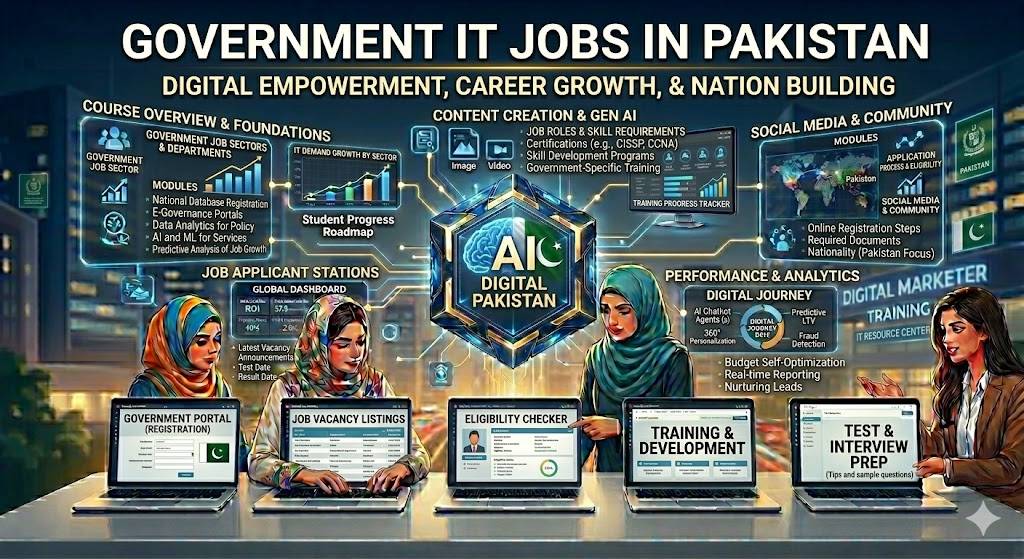
Government IT Jobs in Pakistan
Imagine graduating with a degree in computer science or completing a short IT certification and instead of competing in a crowded freelance market, you land a stable, well-paying government job with benefits, job security, and long-term growth. For many students in Pakistan, that’s not just a dream. It’s a realistic and achievable career path.
Over the past decade, Pakistan’s public sector has rapidly digitized its systems. From NADRA’s biometric databases to FBR’s online tax portals and provincial e-governance platforms, technology now drives how government institutions operate. This digital transformation has created a growing demand for skilled IT professionals across federal and provincial departments.
In this guide, you’ll learn what government IT jobs in Pakistan really involve, what roles are available, required qualifications, salary expectations, how to apply, and how to prepare effectively as a student or beginner. Whether you’re studying computer science, software engineering, IT, or even transitioning from another field, this article will give you clarity and direction.
Why Government IT Jobs Are Growing in Pakistan
Pakistan’s public sector is no longer limited to paperwork and manual processes. Government institutions are actively investing in:
-
E-governance systems
-
Cybersecurity infrastructure
-
National databases
-
Digital payment systems
-
Cloud-based record management
-
Data analytics and AI-driven decision-making
Programs such as Digital Pakistan and various provincial IT board initiatives have accelerated the need for IT professionals. As a result, departments like NADRA, FIA Cyber Crime Wing, FBR, State Bank of Pakistan (SBP), SUPARCO, and provincial IT boards regularly hire technical staff.
For students, this shift means opportunity not just for developers, but for network engineers, cybersecurity analysts, data specialists, and system administrators.
Types of Government IT Jobs in Pakistan
Government IT jobs are not limited to one title. They span multiple disciplines and levels.
1. Software Development Roles
These are among the most in-demand roles.
Common positions include:
-
Software Engineer
-
Web Developer
-
Application Developer
-
Mobile App Developer
-
Software Quality Assurance Engineer
Departments build internal systems such as payroll systems, digital records, citizen portals, and monitoring dashboards. Developers often work with technologies like Java, .NET, PHP, Python, Angular, React, and database systems like SQL Server or Oracle.
2. Network and System Administration
Every government department relies on secure networks.
Typical roles include:
-
Network Administrator
-
System Administrator
-
IT Support Officer
-
Infrastructure Engineer
These professionals manage servers, routers, firewalls, cloud infrastructure, and ensure smooth daily operations.
Certifications like CCNA, MCSA, or CompTIA Network+ can significantly strengthen your profile for such positions.
3. Cybersecurity and Digital Forensics
With increasing cyber threats, cybersecurity is becoming critical in the public sector.
Organizations such as:
-
FIA Cyber Crime Wing
-
State Bank of Pakistan
-
Ministry of IT
Regularly hire:
-
Information Security Analysts
-
SOC Analysts
-
Ethical Hackers
-
Digital Forensics Experts
Students with knowledge of penetration testing, ethical hacking, and cybersecurity frameworks have a strong advantage.
4. Data and Analytics Roles
Government institutions generate massive amounts of data — tax records, census data, national identity databases, health records, and more.
This has opened roles such as:
-
Data Analyst
-
Database Administrator
-
Business Intelligence Analyst
-
AI/ML Specialist
Skills in SQL, Python, Power BI, Tableau, and data visualization tools are increasingly valuable.
Major Government Departments That Hire IT Professionals
If you’re serious about government IT jobs in Pakistan, you should know where to look.
Federal-Level Institutions
-
NADRA – Database systems and national identity infrastructure
-
FBR (Federal Board of Revenue) – Tax and digital financial systems
-
State Bank of Pakistan (SBP) – Banking technology and cybersecurity
-
FIA – Cyber crime and digital investigations
-
SUPARCO – Space research and technical computing
-
Ministry of IT & Telecom
Provincial IT Boards
Each province has its own IT board, such as:
-
Punjab Information Technology Board (PITB)
-
Sindh IT initiatives
-
KP IT Board
-
Balochistan IT initiatives
These boards often hire on contract and project-based terms for digital transformation initiatives.
Eligibility Criteria and Qualifications
Government hiring is structured and transparent. However, requirements vary depending on the position.
Educational Requirements
Most technical roles require:
-
BS in Computer Science
-
BS in Software Engineering
-
BS in Information Technology
-
BS in Computer Engineering
Some support-level roles may accept a relevant diploma or associate degree.
For higher-grade positions (BPS-17 and above), a 16-year education is typically required.
Experience Requirements
-
Entry-level roles: 0–2 years
-
Mid-level roles: 3–5 years
-
Senior roles: 5+ years
Fresh graduates can apply for trainee programs and junior positions.
Certifications That Add Value
Although not always mandatory, certifications improve your chances:
-
CCNA (Networking)
-
CEH (Ethical Hacking)
-
Microsoft certifications
-
AWS or Cloud certifications
-
Data analytics certifications
Government recruiters value practical skills alongside academic qualifications.
Salary Structure in Government IT Jobs
Government salaries are usually structured under the Basic Pay Scale (BPS) system or contract-based packages.
BPS-Based Roles
-
BPS-16 to BPS-17 (Entry-Level Officer): Moderate salary plus allowances
-
BPS-18 and above: Higher pay with leadership roles
Allowances may include:
-
House rent
-
Medical benefits
-
Pension (for permanent roles)
-
Annual increments
Contract-Based Roles
Many IT board and project-based jobs offer competitive market salaries, sometimes higher than traditional BPS roles, but without long-term pension benefits.
For example, an entry-level software engineer in a government project may earn a reasonable monthly salary with project-based increments.
How to Apply for Government IT Jobs in Pakistan
Understanding the process is crucial.
Step 1: Monitor Official Platforms
Regularly check:
-
FPSC (Federal Public Service Commission)
-
PPSC (Punjab Public Service Commission)
-
SPSC, KPPSC, BPSC
-
Official department websites
-
National Job Portals
Step 2: Prepare Required Documents
You typically need:
-
Academic transcripts
-
CNIC
-
Domicile
-
Experience certificates
-
Updated CV
Step 3: Written Test and Interview
Many BPS-based roles require:
-
Written exam
-
Technical test
-
Interview
Tests often include:
-
Basic programming
-
Networking fundamentals
-
General knowledge
-
Analytical reasoning
Preparation is key.
Skills Students Should Start Learning Today
If you are still studying, this is your advantage.
Focus on:
1. Strong Programming Foundations
Learn at least one backend and one frontend technology. For example:
-
Python or Java
-
HTML, CSS, JavaScript
Understand data structures and algorithms.
2. Networking Basics
Even developers benefit from understanding:
-
IP addressing
-
Subnetting
-
Routing
-
Firewalls
3. Database Management
Practice:
-
SQL queries
-
Database design
-
Normalization
4. Cybersecurity Awareness
Learn:
-
Common cyber threats
-
Encryption basics
-
Secure coding practices
Government systems handle sensitive data. Security knowledge is a big plus.
Advantages of Government IT Jobs
Many students overlook public sector opportunities. Here’s why they matter.
-
Job stability
-
Structured promotions
-
Medical and pension benefits
-
Work-life balance (in most cases)
-
National-level impact
Working in government IT often means contributing to systems used by millions of citizens.
Challenges to Consider
It’s important to be realistic.
-
Hiring process can be slow
-
Bureaucracy may limit innovation
-
Some roles are contract-based
-
Promotions may depend on policy rather than performance
Understanding these factors helps you make informed career decisions.
Government vs Private IT Jobs: What’s Better?
There’s no universal answer.
If you want:
-
Stability → Government may suit you
-
Rapid salary growth → Private sector may offer more
-
Pension and long-term benefits → Government is stronger
-
International exposure → Private or remote work may be better
Some professionals even start in government and later transition to private roles.
Future of Government IT Careers in Pakistan
Digital transformation is not slowing down. Emerging fields include:
-
Artificial Intelligence
-
Cloud migration
-
Blockchain for governance
-
Smart city infrastructure
-
Digital identity expansion
As more services move online, demand for skilled IT professionals in government will continue to rise.
For students, this means preparing today for opportunities that will expand tomorrow.
FAQs: Government IT Jobs in Pakistan
1. Can fresh graduates apply for government IT jobs in Pakistan?
Yes. Many entry-level and junior roles are open to fresh graduates, especially in BPS-16 or trainee-level positions.
2. Are government IT jobs permanent?
Some are permanent under the BPS system. Others are contract-based, especially project roles under IT boards.
3. Do government IT jobs pay well?
They offer stable salaries with benefits. While starting pay may be lower than some private companies, long-term benefits like pension and job security add value.
4. Is CSS required for IT government jobs?
No. CSS is for administrative services. IT roles are usually filled through FPSC, PPSC, or direct departmental recruitment.
5. Which degree is best for government IT jobs?
BS Computer Science, Software Engineering, IT, or Computer Engineering are most relevant.
Conclusion
Government IT jobs in Pakistan represent a powerful combination of stability, purpose, and professional growth. As the country accelerates its digital transformation, skilled IT professionals are no longer optional they are essential.
For students and beginners, the opportunity is clear: build strong technical foundations, understand how government recruitment works, and stay consistent in preparation. Focus on practical skills, certifications, and hands-on projects while keeping an eye on official job portals.
A government IT career is not just about securing a job. It’s about contributing to national systems that impact millions of people every day.
If you start preparing today, your future role could be shaping Pakistan’s digital infrastructure tomorrow.
Tags :
No Tags

0 Comments