



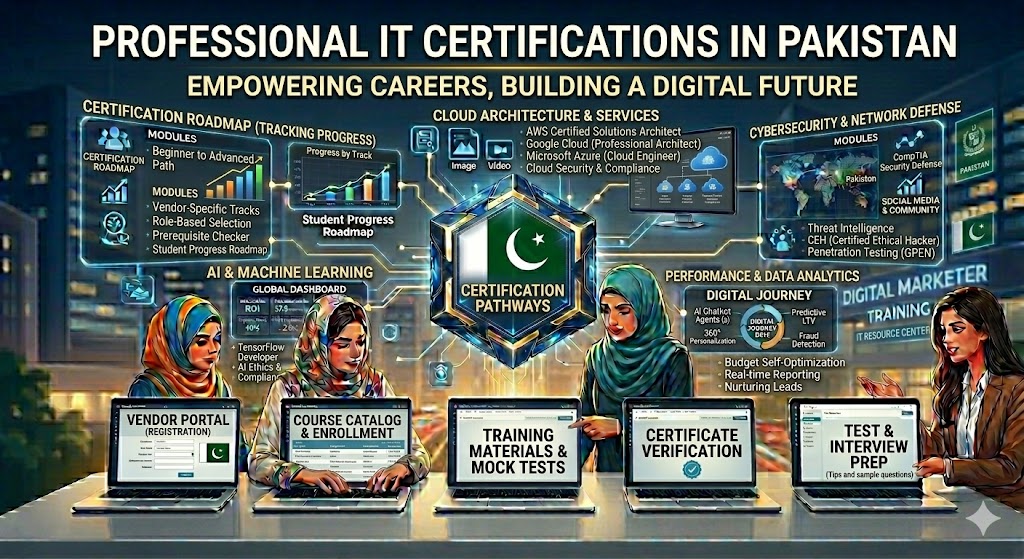
Professional IT Certifications in Pakistan
Imagine two graduates applying for the same entry-level IT job in Lahore or Karachi. Both have similar degrees. Both can talk about programming, networking, or cybersecurity. But one candidate has a globally recognized certification say CompTIA, Cisco, or AWS listed right under their name.
Who do you think gets the interview call first?
In today’s competitive job market in Pakistan, professional IT certifications are no longer “extra.” They are often the deciding factor between being shortlisted and being ignored. For students and beginners especially, certifications can bridge the gap between theory and practical, job-ready skills.
In this guide, you’ll learn what professional IT certifications really mean, which certifications are most valuable in Pakistan, how they connect to real career paths, and how to choose the right one based on your goals. By the end, you’ll have a clear roadmap—not just a list of names.
What Are Professional IT Certifications?
Professional IT certifications are industry-recognized credentials that validate your skills in a specific technology or domain. Unlike a university degree, which covers broad theory over several years, certifications focus on specific, practical competencies.
They are typically:
-
Issued by global tech companies (Microsoft, Cisco, Amazon, Google, CompTIA, etc.)
-
Exam-based
-
Updated regularly to match industry changes
-
Focused on job roles and real-world tasks
For example:
-
A Cisco CCNA certification proves you understand networking fundamentals.
-
An AWS Certified Solutions Architect certification proves you can design cloud systems.
-
A Microsoft Azure certification shows you can manage cloud services.
In simple terms, certifications answer one key question for employers:
“Can this person actually do the job?”
Why Professional IT Certifications Matter in Pakistan
Pakistan’s IT industry is growing rapidly. From software houses in Islamabad to freelancing professionals in Peshawar and remote teams serving US clients, the demand for skilled IT professionals is increasing every year.
However, employers face one challenge:
There are many graduates, but not all of them are job-ready.
Certifications help solve this problem by:
-
Standardizing skills
-
Proving technical competence
-
Reducing training costs for companies
-
Increasing trust in freelance profiles
For students and beginners, certifications offer three major advantages:
1. Stronger Job Applications
Many job postings in Pakistan now mention certifications as “preferred” or “required.” Especially in networking, cloud computing, cybersecurity, and system administration.
2. Higher Salary Potential
Certified professionals often earn more than non-certified peers. Even at entry level, certifications can help you negotiate better pay.
3. Global Recognition
Freelancers on platforms like Upwork and Fiverr benefit from globally recognized credentials. International clients trust certifications they recognize.
Most In-Demand IT Certifications in Pakistan
Let’s explore the most valuable certification paths based on career fields.
1. Networking Certifications
If you’re interested in managing networks, routers, and IT infrastructure, networking certifications are essential.
Cisco Certified Network Associate (CCNA)
-
One of the most recognized entry-level networking certifications.
-
Covers IP addressing, routing, switching, network security basics.
-
Widely valued by telecom companies, ISPs, and corporate IT departments in Pakistan.
Best for: Students interested in network engineering or system administration.
CompTIA Network+
-
Vendor-neutral certification.
-
Focuses on general networking concepts.
-
Ideal for beginners before moving to advanced certifications.
2. Cloud Computing Certifications
Cloud computing is growing rapidly in Pakistan, especially among startups and software houses.
AWS Certified Solutions Architect – Associate
-
Focuses on designing cloud-based systems.
-
High demand for remote and international jobs.
-
Valuable for DevOps engineers and backend developers.
Microsoft Azure Certifications
-
Popular among companies using Microsoft infrastructure.
-
Good option if you already work with Windows servers or .NET technologies.
Why cloud certifications matter:
Many Pakistani companies are migrating from on-premise servers to cloud platforms. Certified cloud professionals are in high demand.
3. Cybersecurity Certifications
Cybersecurity is one of the fastest-growing IT fields worldwide—and Pakistan is no exception.
CompTIA Security+
-
Entry-level cybersecurity certification.
-
Covers threats, vulnerabilities, risk management.
-
Excellent starting point for beginners.
Certified Ethical Hacker (CEH)
-
Focuses on penetration testing and ethical hacking.
-
Popular among students interested in offensive security.
Important: Cybersecurity requires practical skills. Certification alone is not enough you must practice in labs and simulated environments.
4. Software Development Certifications
While many developers focus on portfolios rather than certifications, certain credentials can strengthen your profile.
Microsoft Certified: Azure Developer Associate
-
Ideal for developers working with cloud-based applications.
Oracle Certified Java Programmer (OCJP)
-
Validates strong Java programming knowledge.
That said, in development roles, GitHub projects and real applications often matter more than certifications.
5. Data and Analytics Certifications
Data skills are becoming essential across industries.
Google Data Analytics Certificate
Microsoft Power BI Certification
AWS Data Analytics Certification
These certifications help you enter roles such as:
-
Data Analyst
-
Business Intelligence Developer
-
Junior Data Engineer
Companies in banking, e-commerce, and telecom increasingly seek data-skilled professionals.
How to Choose the Right IT Certification
Choosing randomly is a mistake many students make.
Before selecting a certification, ask yourself:
-
Do I enjoy networking, coding, security, or cloud?
-
Do I want a local job or international freelance work?
-
What is my current skill level?
-
Can I afford the exam fee?
Step-by-Step Strategy
-
Start with a foundation-level certification (e.g., CompTIA, entry-level cloud).
-
Build practical skills alongside study.
-
Avoid collecting unrelated certifications.
-
Focus on one career path first.
Remember:
It’s better to have one relevant certification with strong practical skills than three unrelated ones with weak understanding.
Certification vs Degree: Which Is More Important?
This is one of the most common questions students ask.
The honest answer: Both serve different purposes.
-
A degree builds theoretical foundation.
-
A certification validates practical, job-ready skills.
In Pakistan, many successful IT professionals combine:
-
A BS in Computer Science or IT
-
One or two industry certifications
-
Real-world projects or internships
However, even if you don’t have a degree, certifications can still open doors—especially in freelancing and technical roles.
Real-World Example: How Certifications Make a Difference
Consider a fresh graduate from a university in Swat or Islamabad. He applies for a junior network engineer role. His CV lists a degree in IT and some coursework.
Another candidate has:
-
A diploma
-
CCNA certification
-
Hands-on lab experience using Packet Tracer and real routers
In most cases, the second candidate is more likely to be hired. Why?
Because certifications demonstrate:
-
Structured learning
-
Exam-tested knowledge
-
Commitment to professional growth
Employers prefer lower-risk hiring decisions.
Common Myths About IT Certifications
Let’s clear up some misconceptions.
Myth 1: Certification Guarantees a Job
No certification guarantees employment. It improves your chances—but skills, communication, and attitude matter too.
Myth 2: More Certifications = Better Career
Quality matters more than quantity. Deep expertise in one area is more valuable than shallow knowledge in many.
Myth 3: Certifications Are Only for Advanced Professionals
Many certifications are designed specifically for beginners. In fact, starting early gives you an advantage.
Myth 4: Certifications Are Too Expensive
Yes, exams can be costly. But compared to a four-year degree, certification costs are relatively small. Many students save up or prepare thoroughly to avoid retakes.
Practical Skills Students Should Build Alongside Certifications
Certifications are not just about passing exams. You must develop real skills.
Here’s what students in Pakistan should start doing:
-
Set up a home lab (virtual machines using VirtualBox or VMware)
-
Practice cloud deployment on free-tier accounts
-
Contribute to GitHub projects
-
Build small networking setups
-
Participate in cybersecurity labs like TryHackMe or Hack The Box
-
Learn documentation and reporting skills
Also, improve:
-
English communication
-
LinkedIn profile optimization
-
Professional CV writing
-
Interview preparation skills
Technical knowledge alone is not enough in today’s job market.
How IT Careers in Pakistan Are Evolving
The IT industry in Pakistan is shifting in several important ways:
1. Remote Work Is Expanding
Many certified cloud engineers and cybersecurity professionals now work remotely for international companies.
2. Freelancing Is Professionalizing
Clients now look for verified credentials and proven expertise.
3. Specialized Roles Are Growing
Instead of “IT support,” companies now hire:
-
DevOps Engineers
-
Cloud Architects
-
SOC Analysts
-
Data Engineers
Certifications aligned with these roles increase employability.
FAQs About Professional IT Certifications in Pakistan
1. Which IT certification is best for beginners in Pakistan?
For beginners, CompTIA A+, Network+, or CCNA are excellent starting points. They build strong foundations in IT and networking.
2. Are IT certifications worth it without a degree?
Yes. Many professionals work successfully with certifications and practical skills, especially in networking, cloud, and freelancing roles.
3. How much do IT certification exams cost?
Costs vary. Entry-level exams may range from a few hundred dollars. Always check official vendor websites for updated pricing.
4. How long does it take to prepare for an IT certification?
Typically 2–6 months, depending on your background and study consistency.
5. Do Pakistani employers value international certifications?
Yes. Certifications from Cisco, Microsoft, AWS, CompTIA, and Google are globally recognized and respected by local employers.
Conclusion
Professional IT certifications in Pakistan are more than just extra credentials they are strategic career tools. In a competitive and rapidly growing IT market, certifications help you stand out, validate your skills, and gain employer trust.
But remember, certifications are not magic. They work best when combined with practical experience, strong communication skills, and a clear career direction.
If you’re a student or beginner, don’t wait until graduation. Start exploring certification paths now. Choose one field, commit to learning deeply, practice consistently, and build real skills alongside exam preparation.
The IT industry rewards those who stay current, adaptable, and proactive. A professional certification could be your first serious step toward a stable, high-growth career both in Pakistan and globally.
Your future in IT doesn’t begin after your degree. It begins the moment you decide to take your skills seriously.
Tags :
No Tags

0 Comments