



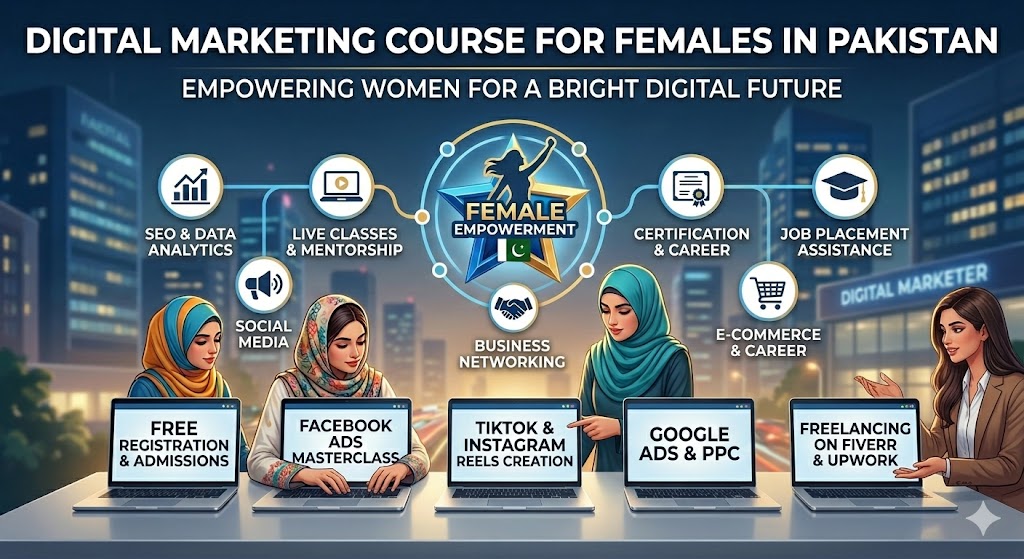
Digital Marketing Course for Females in Pakistan
Introduction
Imagine a young woman in Lahore, Abbottabad, or Karachi who wants to earn independently but prefers flexible working hours. Maybe she’s a university student. Maybe she’s a mother managing home responsibilities. Or perhaps she simply wants a career that isn’t limited by location.
Digital marketing has quietly become one of the most accessible and powerful career paths for women in Pakistan. And at the center of digital marketing lies a skill that drives visibility, traffic, and long-term growth: SEO (Search Engine Optimization).
Today, businesses do not just compete on streets or in malls they compete on Google. Whether someone searches for “best clothing brand in Pakistan” or “online Quran classes,” the brands that appear on the first page win attention and customers. That visibility is not luck. It is strategy.
In this article, you’ll learn what SEO really means, how it works behind the scenes, how it fits into digital marketing, and why it’s a particularly strong opportunity for females in Pakistan who want a flexible, skill-based career.
Why Digital Marketing Is a Powerful Career Path for Women in Pakistan
Before diving into SEO, it’s important to understand the bigger picture.
Digital marketing includes:
-
Social media marketing
-
Content marketing
-
Email marketing
-
Paid advertising (Google Ads, Meta Ads)
-
SEO (Search Engine Optimization)
-
E-commerce marketing
For women in Pakistan, this field offers several advantages:
-
Remote work opportunities (local and international clients)
-
Freelancing flexibility
-
Low startup costs (just a laptop and internet)
-
Skill-based growth instead of degree-based limitations
Many women are now working with international clients through platforms like Upwork and Fiverr or managing Instagram and Shopify stores from home. SEO is often the skill that helps these businesses grow sustainably.
Let’s break it down.
What SEO Really Means in Digital Marketing
Most beginners think SEO is just “adding keywords to a website.” That’s an incomplete and misleading idea.
SEO is the process of making a website:
-
Easier for search engines to understand
-
More useful for users
-
More trustworthy compared to competitors
At its core, SEO answers one question:
When someone searches for something online, why should your website appear instead of someone else’s?
For example, if a clothing boutique in Islamabad wants to rank for “modest fashion Pakistan,” SEO helps that brand:
-
Create helpful content
-
Structure pages properly
-
Improve website speed
-
Build credibility through backlinks
-
Align with what users are actually searching for
SEO is not manipulation. It is optimization.
And that’s an important mindset shift for students.
How Search Engines Work (In Simple Terms)
Search engines like Google operate in three basic steps:
1. Crawling
Google sends automated bots (called crawlers or spiders) to scan websites across the internet. They look at pages, links, images, and content.
Think of this as Google “reading” the web.
2. Indexing
After crawling, Google stores the content in a massive database. If your page is indexed, it can appear in search results.
If it’s not indexed, it’s invisible.
3. Ranking
When someone searches for “best digital marketing course for females in Pakistan,” Google:
-
Analyzes the query
-
Finds relevant pages in its index
-
Ranks them based on hundreds of factors
These factors include:
-
Relevance
-
Content quality
-
Website authority
-
Page speed
-
Mobile-friendliness
-
User experience
SEO is about aligning your website with these ranking factors.
The Key Components of SEO
SEO is not one task. It has three major components:
-
On-page SEO
-
Technical SEO
-
Off-page SEO
Let’s explore each in practical terms.
On-Page SEO: Optimizing What’s on Your Website
On-page SEO refers to everything you control directly on your website.
Key Elements:
-
Keyword research
-
High-quality content
-
Title tags and meta descriptions
-
Proper heading structure (H1, H2, H3)
-
Internal linking
-
Image optimization
Why It Matters
If your content does not clearly answer what users are searching for, Google has no reason to rank it.
For example, if someone searches for:
“Best digital marketing course for females in Pakistan”
Your page should:
-
Clearly address women specifically
-
Mention career outcomes
-
Provide details about course structure
-
Answer common questions
On-page SEO is about clarity and usefulness not stuffing keywords.
Beginner Takeaway
Start learning:
-
How to use tools for keyword research
-
How to write structured blog posts
-
How to optimize titles and headings
These skills are foundational.
Technical SEO: The Foundation Behind the Scenes
Technical SEO focuses on how well your website functions.
This includes:
-
Website speed
-
Mobile responsiveness
-
Secure connection (HTTPS)
-
Proper URL structure
-
XML sitemaps
-
Fixing broken links
Imagine building a beautiful house with weak plumbing and wiring. That’s a website with good content but poor technical SEO.
In Pakistan, many small businesses struggle because:
-
Their websites load slowly
-
They are not optimized for mobile
-
Pages are not properly indexed
Given that most Pakistani users browse on mobile devices, mobile optimization is essential.
Beginner Takeaway
You don’t need to become a developer, but you should understand:
-
How website speed affects rankings
-
Why mobile-friendly design matters
-
Basic technical health checks
These are practical, employable skills.
Off-Page SEO: Building Trust and Authority
Off-page SEO is about signals from outside your website.
The most important factor here is backlinks links from other websites to yours.
If reputable websites link to your content, Google interprets this as a sign of trust.
Other off-page factors include:
-
Brand mentions
-
Online reviews
-
Social signals
-
Digital PR
For example:
If a well-known Pakistani blog writes about your digital marketing course and links to your website, that strengthens your authority.
Beginner Takeaway
Learn:
-
Outreach strategies
-
Guest posting
-
Ethical link-building techniques
-
Brand building fundamentals
Authority is earned, not bought.
How SEO Fits Into the Broader Digital Marketing Ecosystem
SEO does not exist alone.
It connects with:
-
Content marketing (blogs, guides, educational articles)
-
Social media (sharing optimized content)
-
Email marketing (nurturing organic traffic)
-
E-commerce (product page optimization)
-
Paid ads (using SEO data to guide campaigns)
For example:
A female entrepreneur selling handmade jewelry in Pakistan might:
-
Use SEO to rank for “handmade jewelry Pakistan.”
-
Share blog posts on Instagram.
-
Collect emails from visitors.
-
Retarget visitors with ads.
SEO becomes the foundation that brings consistent, free traffic over time.
That’s why it’s considered a long-term asset.
Real-World Example: A Small Home-Based Business
Let’s imagine a woman in Faisalabad running an online clothing store from home.
Initially, she depends only on Instagram.
Sales fluctuate.
She learns SEO and:
-
Creates a website
-
Publishes blogs about modest fashion trends
-
Optimizes product pages
-
Targets keywords like “affordable abayas in Pakistan”
Within months:
-
She starts getting organic traffic
-
Customers find her through Google
-
Sales become more consistent
This is the power of search visibility.
Common SEO Myths Beginners Believe
Many students start with misconceptions. Let’s clear a few.
Myth 1: SEO Gives Instant Results
SEO is not overnight success. It takes time usually months to see consistent growth.
Myth 2: More Keywords = Better Ranking
Keyword stuffing harms your site. Clarity and relevance matter more than repetition.
Myth 3: SEO Is Too Technical for Beginners
While technical aspects exist, much of SEO is logical and learnable with practice.
Myth 4: Only Big Companies Can Rank
Small businesses rank every day by targeting specific, niche keywords.
For females entering the field, confidence matters. SEO is skill-based not gender-based.
Practical SEO Skills Students Should Start Learning Today
If you’re considering a digital marketing course, focus on practical skills.
1. Keyword Research
Understand:
-
Search intent
-
Competition level
-
Long-tail keywords
2. Content Writing for SEO
Learn how to:
-
Structure blog posts
-
Use headings effectively
-
Write for both users and search engines
3. Basic Analytics
Understand:
-
Google Analytics
-
Search Console
-
Traffic analysis
4. Website Platforms
Familiarize yourself with:
-
WordPress
-
Shopify
-
Basic CMS systems
5. Freelancing Skills
Especially important for females seeking flexibility:
-
Client communication
-
Proposal writing
-
Portfolio building
These are employable, monetizable skills.
SEO Career Opportunities for Females in Pakistan
The career landscape is expanding rapidly.
You can work as:
-
SEO Executive
-
Content Strategist
-
Digital Marketing Specialist
-
Freelance SEO Consultant
-
E-commerce SEO Manager
-
Blogger or affiliate marketer
Many women in Pakistan are now earning in dollars by working with international clients remotely.
Companies value:
-
Results
-
Communication
-
Analytical thinking
Not gender.
As businesses move online, demand for SEO professionals continues to grow.
FAQs About SEO and Digital Marketing Courses for Females in Pakistan
1. Is digital marketing a good career for females in Pakistan?
Yes. It offers flexibility, remote work options, freelancing opportunities, and strong income potential. Many women balance it alongside studies or family responsibilities.
2. Do I need a degree to learn SEO?
No. While education helps, SEO is skill-based. Many successful professionals are self-taught or trained through short courses.
3. How long does it take to learn SEO?
Basic understanding can take 2–3 months. Mastery comes with real-world practice and project experience.
4. Can I work from home as an SEO expert?
Absolutely. SEO is one of the most remote-friendly digital marketing roles.
5. Is English necessary for SEO?
Basic English proficiency helps, especially for international clients. However, you can also work in local languages and markets.
Conclusion: Why SEO Is a Long-Term Skill Worth Learning
Digital marketing is not a trend it is the present and future of business. And within digital marketing, SEO stands out as a foundational skill that creates sustainable growth.
For females in Pakistan seeking independence, flexibility, and career growth, learning SEO can open doors that traditional career paths may not.
It doesn’t require massive investment. It requires curiosity, consistency, and practical learning.
Start small. Learn the fundamentals. Practice on real websites. Build a portfolio.
Over time, SEO becomes more than a skill it becomes an asset you carry wherever you go.
The digital world is expanding. There has never been a better time to claim your place in it.
Tags :
No Tags

0 Comments