



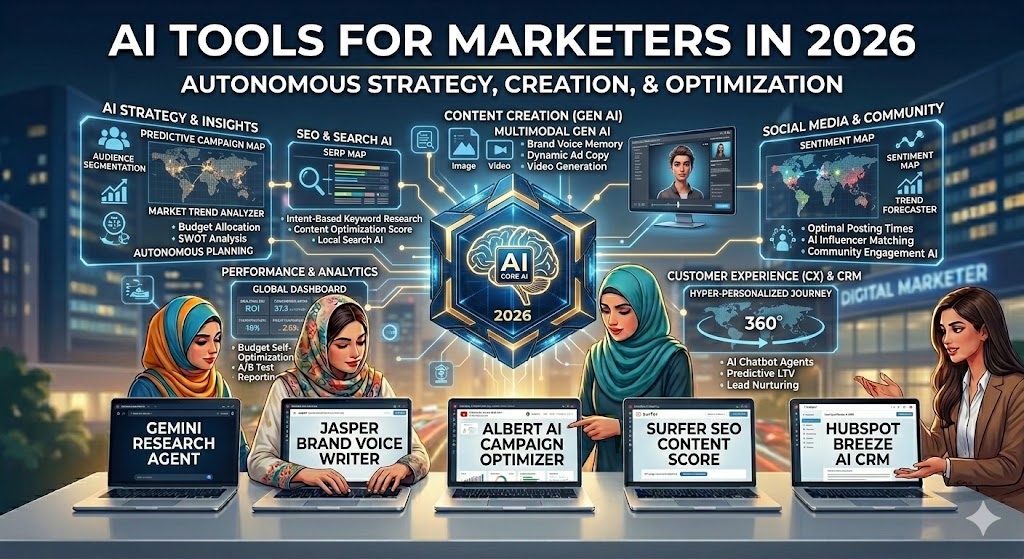
AI Tools for Marketers in 2026
Introduction
In 2026, marketing doesn’t move at the speed of creativity alone it moves at the speed of data.
Imagine launching a campaign in the morning, testing five versions of your headline before lunch, analyzing customer behavior by mid-afternoon, and refining your strategy before the day ends. That’s not a futuristic fantasy anymore. It’s what modern marketing looks like when powered by AI tools.
For students and beginners, this shift can feel overwhelming. New platforms appear every month. Buzzwords dominate LinkedIn. Employers expect “AI familiarity” even for entry-level roles. So where do you start? What tools actually matter? And how do you build skills that make you employable not replaceable?
This guide will walk you through the most important AI tools for marketers in 2026, how they work in real-world campaigns, and which practical skills you should start learning today. Think of this as your roadmap to understanding the modern marketing toolkit clearly, realistically, and without hype.
Why AI Tools Matter More Than Ever in 2026
Marketing today is no longer just about creativity or branding. It’s about:
-
Data-driven decisions
-
Personalized customer experiences
-
Automation at scale
-
Speed and efficiency
Brands now compete not just on ideas, but on how fast they can test, optimize, and adapt. AI tools allow marketers to:
-
Analyze large datasets instantly
-
Generate content variations quickly
-
Predict customer behavior
-
Personalize messages for different audiences
-
Automate repetitive tasks
For students, understanding these tools isn’t optional anymore. It’s becoming a core job requirement in digital marketing, SEO, paid ads, email marketing, and social media management.
Core Categories of AI Tools for Marketers in 2026
Instead of chasing every new app, it’s smarter to understand the major categories. Once you grasp the ecosystem, you can adapt to any tool.
1. AI Content Creation Tools
Content is still the foundation of digital marketing. But in 2026, it’s rarely created without AI assistance.
What These Tools Do
AI content tools help marketers:
-
Generate blog outlines and drafts
-
Create ad copy variations
-
Write product descriptions
-
Develop email sequences
-
Repurpose content across platforms
They don’t replace strategy. They accelerate execution.
Real-World Example
A small eCommerce brand launching 50 new products would traditionally need weeks to write descriptions. With AI-assisted content tools, the marketing team can:
-
Create optimized drafts in hours
-
Adjust tone to match brand voice
-
Add SEO elements quickly
-
Test multiple versions for conversion
The time saved allows marketers to focus on storytelling and strategy instead of repetitive writing.
Beginner Takeaway
Learn:
-
How to structure effective prompts
-
How to edit and refine AI-generated content
-
SEO basics to optimize outputs
-
Brand voice consistency
Your value as a marketer comes from judgment not just generation.
2. AI-Powered SEO and Search Optimization Tools
Search engine optimization has become increasingly data-heavy. AI tools now assist with:
-
Keyword research
-
Content gap analysis
-
SERP trend predictions
-
Search intent analysis
-
Automated technical audits
Why This Matters
Search engines evolve constantly. AI tools help marketers identify:
-
What users are actually searching for
-
What competitors are ranking for
-
Which topics are worth targeting
-
How to structure content for visibility
Mini Case Study
A marketing student managing a local fitness blog uses AI-powered SEO software to analyze search data. The tool reveals:
-
High search volume for “beginner home workouts 2026”
-
Low competition for “AI-based fitness tracking apps review”
Instead of guessing topics, the student builds content around real demand. Traffic grows because decisions are based on data, not assumptions.
Beginner Skills to Build
-
Search intent analysis
-
Keyword clustering
-
Content optimization
-
Basic technical SEO understanding
In 2026, marketers who understand both AI tools and search behavior have a major advantage.
3. AI Analytics and Predictive Insights Tools
Marketing decisions today rely on predictive insights not just past performance.
What These Tools Do
AI analytics platforms can:
-
Predict customer churn
-
Identify high-value segments
-
Forecast sales trends
-
Recommend budget allocation
-
Analyze user behavior patterns
Example in Action
An online clothing store uses predictive analytics to identify customers likely to stop buying. The system flags users who:
-
Haven’t purchased in 60 days
-
Open emails but don’t click
-
Viewed products without completing checkout
The marketing team automatically triggers personalized discount campaigns. Retention improves not by guessing, but by anticipating behavior.
What Students Should Learn
-
Google Analytics 4 basics
-
Data interpretation skills
-
Understanding funnels and conversion tracking
-
How to translate insights into strategy
The tool gives data. The marketer gives direction.
4. AI in Paid Advertising
Paid ads in 2026 rely heavily on machine learning systems that optimize campaigns automatically.
How AI Enhances Ads
-
Automated bidding strategies
-
Audience segmentation
-
Dynamic creative optimization
-
Budget distribution across channels
Platforms like Google Ads and Meta Ads now use advanced AI to decide:
-
Which user sees which ad
-
What headline performs best
-
When to adjust budgets
Important Insight
Many beginners think AI “runs everything.” In reality, human strategy still determines:
-
Target audience definition
-
Messaging angles
-
Offer positioning
-
Creative direction
AI optimizes execution not core strategy.
Practical Skill Tip
Learn:
-
Campaign structure fundamentals
-
Audience research
-
Ad copy psychology
-
Conversion tracking setup
The better your strategy, the more effectively AI tools can optimize.
5. AI for Social Media Management
Social media marketing in 2026 is more automated and data-driven than ever.
AI tools now assist with:
-
Content scheduling
-
Trend prediction
-
Caption suggestions
-
Engagement analysis
-
Sentiment tracking
Real-World Use Case
A startup uses AI-driven social listening tools to monitor:
-
Brand mentions
-
Competitor campaigns
-
Industry trends
When a trending topic aligns with their niche, they quickly create relevant content. Engagement spikes because they respond at the right moment.
Beginner Focus Areas
-
Understanding algorithms
-
Analyzing engagement metrics
-
Community management skills
-
Content repurposing techniques
AI identifies patterns. Marketers build relationships.
6. AI for Email Marketing and Personalization
Email marketing remains one of the highest ROI channels and AI has transformed it.
What AI Now Does
-
Personalized subject lines
-
Send-time optimization
-
Behavior-based automation
-
Segmentation based on user activity
Instead of sending one email to everyone, marketers now send:
-
Different content to new subscribers
-
Special offers to loyal buyers
-
Re-engagement campaigns to inactive users
Why Personalization Matters
Consumers expect relevance. Generic messaging gets ignored.
AI tools help brands scale personalization something impossible to do manually for thousands of users.
Student Takeaway
Start learning:
-
Email automation workflows
-
Audience segmentation
-
Basic copywriting psychology
-
CRM fundamentals
These are highly employable skills in 2026.
How AI Tools Fit Into the Bigger Marketing Ecosystem
It’s important to understand that AI tools are not separate from digital marketing — they enhance every channel.
Here’s how they connect:
-
SEO drives organic traffic
-
Paid ads drive targeted traffic
-
Email nurtures leads
-
Social media builds brand awareness
-
Analytics informs decisions
AI sits across all these channels, optimizing performance and improving efficiency.
But strategy remains human.
The best marketers in 2026 are not tool-dependent. They understand:
-
Customer psychology
-
Brand positioning
-
Market research
-
Data interpretation
AI amplifies strong fundamentals. It doesn’t fix weak strategy.
Common Myths About AI in Marketing
Let’s clear up a few misconceptions students often believe.
Myth 1: AI Will Replace Marketers
AI replaces repetitive tasks, not creative strategy. Employers still need:
-
Critical thinking
-
Campaign planning
-
Storytelling
-
Brand management
Myth 2: You Need Advanced Coding Skills
Most modern marketing tools are user-friendly. You need data literacy not engineering expertise.
Myth 3: More Tools = Better Marketer
Depth beats quantity. It’s better to master:
-
One SEO tool
-
One analytics platform
-
One email system
…than to barely understand ten platforms.
Myth 4: AI Always Gives Perfect Answers
AI suggestions require human review. Data can be misinterpreted. Context matters.
Your judgment is your advantage.
Practical Skills Students Should Start Learning Today
If you’re serious about building a career in marketing in 2026, focus on these foundational skills:
-
SEO fundamentals
-
Data analysis basics
-
Copywriting
-
Paid ads campaign structure
-
Marketing automation workflows
-
Audience research techniques
In addition, build:
-
Critical thinking
-
Adaptability
-
Continuous learning habits
Technology evolves quickly. Your ability to learn is more important than mastering a single tool.
Career Opportunities in AI-Enhanced Marketing
The job market is shifting. Roles now include:
-
AI Marketing Specialist
-
Growth Marketing Analyst
-
Marketing Automation Manager
-
SEO Strategist with AI expertise
-
Data-Driven Content Strategist
Employers value candidates who:
-
Understand tools
-
Interpret data
-
Think strategically
-
Adapt to new platforms
Students who combine marketing fundamentals with AI literacy will have a competitive edge in internships and entry-level roles.
FAQs: AI Tools for Marketers in 2026
1. Do I need to learn coding to use AI marketing tools?
No. Most tools are designed for marketers, not programmers. Basic data understanding is more important than coding.
2. Are AI marketing tools expensive?
Some are premium, but many platforms offer free plans or student versions. Beginners can start with accessible tools and upgrade later.
3. Will AI replace entry-level marketing jobs?
AI will change tasks, not eliminate the need for marketers. Entry-level roles increasingly require tool familiarity and analytical thinking.
4. Which AI tool should beginners learn first?
Start with one SEO tool, one analytics platform, and one email marketing system. Build depth before expanding.
5. Is AI-generated content bad for SEO?
Search engines prioritize helpful, high-quality content. AI-assisted content performs well when it’s edited, optimized, and written for users.
Conclusion: Your Future in AI-Driven Marketing
Marketing in 2026 is faster, smarter, and more data-driven than ever before. AI tools have become essential — not because they replace marketers, but because they amplify human potential.
For students and beginners, the opportunity is enormous. You don’t need years of experience to start. You need:
-
Curiosity
-
Strong fundamentals
-
Willingness to experiment
-
Commitment to continuous learning
The marketers who succeed in this new era won’t be those who fear technology they’ll be the ones who understand it, guide it, and use it strategically.
If you start building these skills today, you won’t just adapt to the future of marketing. You’ll help shape it.
Tags :
No Tags

0 Comments