



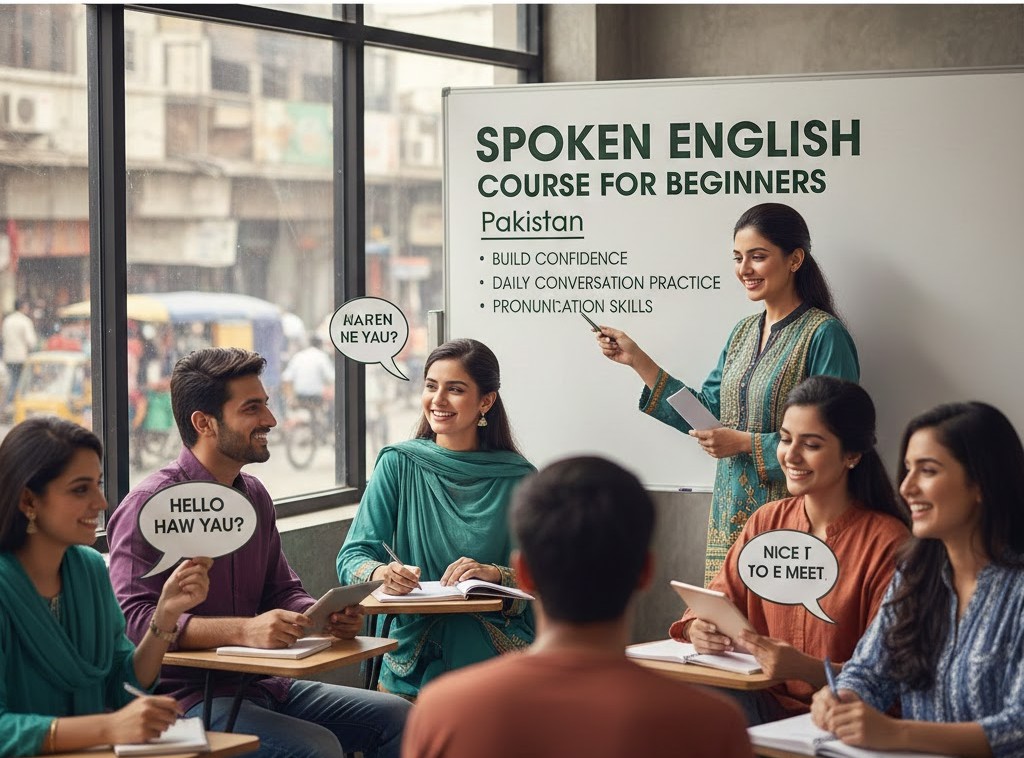
Spoken English Course for Beginners in Pakistan
Introduction
Have you ever understood English perfectly in your head but felt your mind go blank when it was time to speak? You’re not alone. Across Pakistan, millions of students can read and write English reasonably well, yet hesitate when they need to speak it in class, at a job interview, or in everyday conversations. The problem isn’t intelligence. It’s usually confidence, practice, and the right learning environment.
In today’s world, spoken English is no longer just an “extra skill.” It affects your academic performance, career opportunities, and even how confidently you express your ideas. Whether you’re a student preparing for university, a job seeker aiming for better interviews, or someone who simply wants to communicate more clearly, enrolling in a spoken English course for beginners can be a turning point.
This article will help you understand what a good spoken English course looks like, how learning actually happens, what skills you should focus on, common myths to avoid, and how you can build real, lasting fluency. By the end, you’ll have a clear roadmap to start your journey with confidence.
What a Spoken English Course Really Means (Beyond Grammar Rules)
Many beginners think a spoken English course is just about memorizing grammar rules or difficult vocabulary. That’s a misunderstanding — and often the reason people stay stuck for years.
A quality spoken English course focuses on communication, not perfection. The goal is not to sound like a dictionary. The goal is to express your thoughts clearly and naturally.
A practical course usually helps you develop three core areas:
-
Confidence in speaking, even when you make mistakes
-
Fluency, so your words flow without long pauses
-
Clarity, so others can easily understand you
For example, instead of teaching you advanced grammar terms like “past perfect continuous tense” on day one, a good beginner course starts with real-life language:
-
How to introduce yourself
-
How to ask simple questions
-
How to describe your daily routine
-
How to handle basic conversations in class, at work, or in public
When a course is designed well, you start using English from the very first week not just studying it.
How People Actually Learn to Speak English
Understanding how speaking skills develop can save you from frustration.
Many students in Pakistan spend years reading textbooks but still struggle to speak. That happens because speaking is a skill, not just knowledge. You can’t learn it by watching videos alone, just like you can’t learn swimming by reading about swimming.
Speaking develops through three things:
1. Exposure
You need to hear English regularly: different accents, different speeds, real conversations. This trains your brain to recognize patterns naturally.
2. Practice
You must speak, even if your sentences are short or imperfect. The more you use the language, the more comfortable it feels.
3. Feedback
A good teacher or learning environment corrects you gently, so you improve without losing confidence.
A strong spoken English course for beginners in Pakistan understands this psychology. It doesn’t shame students for mistakes. It encourages them to speak more.
Core Components of a Good Spoken English Course
Not all courses are equal. Some promise “fluency in 30 days” but deliver little. Here’s what actually matters.
Pronunciation and Accent Clarity
You don’t need a foreign accent, but you do need clear pronunciation. Many beginners struggle because they pronounce words based on Urdu spelling habits.
A practical course will:
-
Teach common problem sounds (like “th,” “v,” and “w”)
-
Use listening exercises with repetition
-
Help you understand word stress and sentence rhythm
This makes your English easier to understand, even if your grammar isn’t perfect yet.
Vocabulary for Real Life
Instead of giving long word lists, good courses teach vocabulary in context.
For example, instead of teaching random words like “umbrella, mountain, elephant,” they teach useful phrases such as:
-
“Could you please repeat that?”
-
“I’m not sure about that.”
-
“Let me think for a moment.”
-
“I agree with you.”
This kind of vocabulary is what actually improves your daily communication.
Grammar for Speaking, Not Exams
Grammar is important, but beginners don’t need complex rules immediately. A well-designed course teaches grammar in a practical way:
-
Using simple present tense for daily routines
-
Using past tense for telling stories
-
Using future forms for plans
The focus is on using grammar naturally while speaking, not memorizing definitions.
Listening and Conversation Practice
Many students can speak alone but freeze in real conversations. That’s why interactive practice matters.
Strong courses include:
-
Role plays (student–teacher, customer–shopkeeper, interviewer–candidate)
-
Group discussions
-
Pair speaking activities
-
Listening to natural conversations
This builds confidence for real-world situations.
How Spoken English Fits into Education and Career Growth
Spoken English is not just a language skill; it’s a career skill.
In Pakistan, many students lose opportunities not because they lack knowledge, but because they struggle to communicate their ideas.
In education
-
University presentations require confidence
-
Group projects involve discussion
-
Teachers often give better feedback to students who express themselves clearly
In jobs
-
Interviews depend heavily on communication
-
Client-facing roles need conversational fluency
-
Remote work opportunities often require spoken English
Even in fields like IT, design, or freelancing, communication skills often determine who gets the best clients.
A spoken English course for beginners is therefore not just about language. It’s about opening doors.
Real-World Examples of Transformation
Consider two common situations.
A university student from Lahore had excellent grades but avoided speaking in class. After joining a beginner-level spoken English course that focused on daily speaking practice, she began participating in discussions. Within months, her teachers noticed her confidence, and she later became a class representative.
A shopkeeper in Karachi started learning spoken English to communicate with foreign customers. At first, he only practiced simple greetings and questions. Over time, his improved communication helped him build better relationships with tourists and increase his sales.
These are not extraordinary stories. They are realistic outcomes when learning is consistent and practical.
Common Myths Beginners Believe About Spoken English
Many learners delay their progress because of false beliefs.
“My English is too weak to start”
You don’t need strong English to join a beginner course. That’s the whole point. Courses are designed to start from zero.
“I must learn all grammar before speaking”
No. You learn grammar faster when you use it while speaking. Waiting for perfection only slows you down.
“I need a foreign accent to sound good”
Clear communication matters more than accent. A neutral, understandable style is perfectly acceptable worldwide.
“Adults can’t become fluent”
Adults learn differently, but they can absolutely become fluent with the right method and consistency.
Once you let go of these myths, progress becomes much easier.
Practical Skills Beginners Should Start Building Today
Even before joining a formal course, you can develop habits that accelerate your learning.
Daily speaking habit
Talk to yourself in English about your routine:
-
What you did today
-
What you plan to do tomorrow
-
What you like or dislike
This trains your brain to think in English.
Listening practice
Listen to English content slightly above your current level. Short interviews, educational videos, and conversations are ideal.
Simple sentence building
Instead of long, complex sentences, focus on clarity:
-
“I am learning English.”
-
“I want to improve my speaking.”
-
“This topic is interesting.”
Fluency grows from simple foundations.
A good spoken English course reinforces these habits instead of replacing them.
Choosing the Right Spoken English Course in Pakistan
With so many academies, online platforms, and tutors available, how do you choose wisely?
Look for practical teaching methods
Avoid courses that only focus on lectures. Choose ones that prioritize interaction, speaking tasks, and real communication.
Check the level structure
A serious course has levels such as:
-
Beginner
-
Elementary
-
Intermediate
This ensures you’re not thrown into content that’s too advanced.
Observe teacher communication style
A good teacher encourages, corrects politely, and makes students feel safe to speak.
Flexibility matters
Online courses, recorded sessions, and mobile-friendly options can help students in smaller cities access quality learning without relocating.
The right environment can make the difference between giving up and genuinely improving.
How Opportunities Are Evolving for English Speakers
The demand for good communication skills is growing faster than ever.
Remote work has opened global doors for Pakistanis. Freelancers who can communicate confidently with international clients often earn significantly more. Customer support roles, virtual assistants, content creators, and online educators all rely heavily on spoken English.
Even locally, multinational companies increasingly prioritize communication skills over technical perfection. They know skills can be trained, but communication attitude is harder to build.
This makes spoken English a long-term investment, not a short-term course.
FAQs About Spoken English Courses for Beginners in Pakistan
How long does it take to become fluent?
It depends on your starting level and practice. Many beginners notice significant improvement in 3–6 months with consistent effort.
Can I learn spoken English online effectively?
Yes, if the course includes live speaking practice, feedback, and interaction. Passive videos alone are not enough.
Do I need to know grammar before joining a course?
No. Beginner courses are designed to teach grammar gradually through speaking.
Is age a barrier to learning spoken English?
Not at all. Motivation and consistency matter far more than age.
How can I practice if I don’t have anyone to speak with?
You can use self-speaking exercises, join online speaking groups, or choose a course that includes partner practice.
Conclusion
Learning spoken English as a beginner in Pakistan is not about talent. It’s about approach, environment, and consistency. When you choose a course that focuses on real communication, supports your confidence, and gives you practical speaking opportunities, improvement becomes inevitable.
The most important step is not finding the “perfect” course. It’s starting. Speak imperfectly. Practice daily. Accept corrections. Over time, the hesitation fades, your sentences become smoother, and your confidence grows naturally.
Spoken English is more than a skill. It’s a tool that empowers you to express your ideas, claim opportunities, and connect with the world. And like any powerful tool, the earlier you start using it, the stronger it becomes.
Tags :
No Tags

0 Comments