



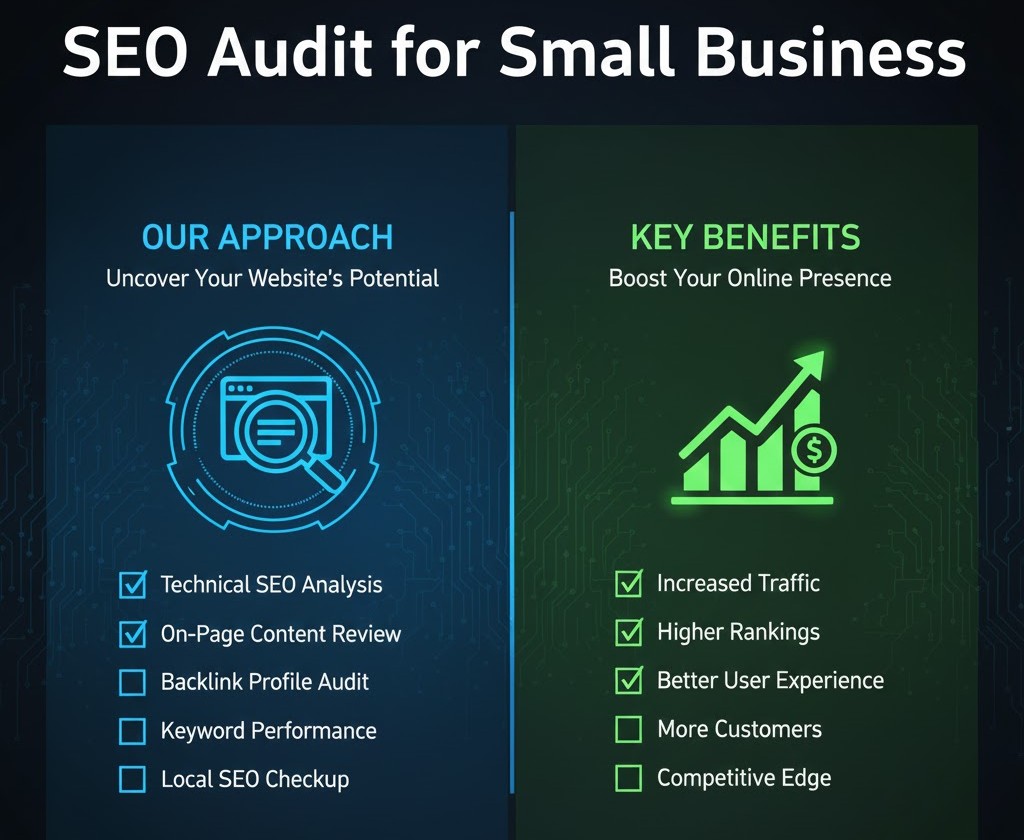
SEO Audit for Small Business
Introduction
Here’s a surprising truth many students don’t realize early on: most small business websites don’t fail because of bad products or services they fail because Google doesn’t fully understand them. In fact, multiple industry studies (from organizations like Moz, Ahrefs, and Google Search Central) consistently show that technical errors, weak content structure, and poor on-page signals hold back otherwise solid businesses.
This is where an SEO audit for small business becomes critical. An SEO audit isn’t about gaming Google or chasing shortcuts. It’s about diagnosing real problems, aligning a website with how search engines actually work, and creating a better experience for users.
For students learning SEO whether for freelancing, internships, or future careers understanding how to perform a proper SEO audit is one of the most valuable skills you can develop. It combines technical analysis, content evaluation, user psychology, and strategic thinking.
In this guide, you’ll learn what an SEO audit really is, why it matters specifically for small businesses, and how to perform one step by step using the same mindset professionals use in 2024–2025, aligned with Google’s Helpful Content and Core Updates.
What Is an SEO Audit? (And Why It’s Not Just a Checklist)
An SEO audit is a systematic evaluation of a website’s ability to rank in search engines, focusing on three core pillars:
-
Technical SEO – Can Google crawl, index, and understand the site?
-
On-Page & Content SEO – Does the content satisfy search intent and EEAT signals?
-
Off-Page & Trust Signals – Does the site appear credible and authoritative?
For small businesses, an SEO audit acts like a health checkup. Instead of guessing why traffic is low, the audit reveals specific, fixable issues.
As Google’s Search Advocate John Mueller has repeatedly emphasized, “SEO isn’t about tricks; it’s about making your site easier to understand and more useful.”
That philosophy is especially important for small businesses with limited budgets and for students learning ethical, long-term SEO practices.
Why SEO Audits Matter More for Small Businesses
Large brands can survive SEO mistakes because they have authority, brand searches, and paid traffic. Small businesses don’t have that luxury.
Here’s why SEO audits are essential for them:
-
Limited resources mean mistakes are more costly
-
Local competition is often intense
-
Organic traffic is usually the highest-converting channel
-
Google updates hit thin or low-quality sites first
For students, this makes small business SEO audits the perfect learning ground. You see real-world constraints, real data, and real outcomes.
Step 1: Technical SEO Audit (The Foundation)
Technical SEO is where most beginners feel intimidated—but it’s also where audits deliver quick wins.
Crawlability and Indexing
Start by asking a simple question: Can Google access this site properly?
Check:
-
Robots.txt file
-
XML sitemap availability
-
Index coverage in Google Search Console
Common small business issues include blocked pages, missing sitemaps, or outdated URLs still indexed.
Site Speed and Core Web Vitals
Google’s Core Web Vitals (LCP, INP, CLS) are now established ranking signals.
Small business sites often suffer from:
-
Heavy images
-
Cheap hosting
-
Unnecessary plugins
According to Google, pages that load faster consistently show better engagement and lower bounce rates.
Actionable tip: Use PageSpeed Insights and prioritize fixes that improve real-user metrics, not just lab scores.
Step 2: Mobile-Friendliness Audit
Google uses mobile-first indexing, meaning the mobile version of a site is the primary version for ranking.
Audit for:
-
Responsive design
-
Readable font sizes
-
Clickable buttons
-
No horizontal scrolling
Students should remember: If a site is hard to use on a phone, it’s hard to rank period.
Step 3: On-Page SEO Audit (Where Rankings Are Won)
Title Tags and Meta Descriptions
For small businesses, titles are often:
-
Too long
-
Duplicate
-
Brand-only with no keywords
Effective titles should:
-
Reflect search intent
-
Include primary keywords naturally
-
Encourage clicks
Meta descriptions don’t directly impact rankings, but they strongly influence CTR.
Header Structure and Content Hierarchy
A proper H1–H3 structure helps both users and search engines understand content flow.
Bad structure = confusion. Good structure = clarity + relevance.
Step 4: Content Quality & EEAT Evaluation
This is where Google’s Helpful Content System plays a major role.
Ask these questions during your audit:
-
Does the content demonstrate real experience?
-
Is it written by or reviewed by someone knowledgeable?
-
Does it answer the user’s question completely?
Thin content is one of the biggest issues for small businesses.
Google’s Quality Rater Guidelines emphasize that pages should be created “to help users, not search engines.”
Student insight: When auditing, don’t just count words—evaluate usefulness.
Step 5: Keyword & Search Intent Alignment
Many small businesses rank poorly because they target the wrong intent.
For example:
-
Informational keyword → sales page
-
Transactional keyword → blog post
An effective SEO audit checks whether:
-
The keyword intent matches the page type
-
Supporting semantic keywords are used naturally
-
Content depth matches competitor expectations
This is where semantic SEO really matters.
Step 6: Internal Linking Audit
Internal links guide both users and crawlers.
Common small business mistakes:
-
Orphan pages
-
Over-optimized anchor text
-
Important pages buried deep
A good audit ensures:
-
Logical link paths
-
Contextual anchors
-
Priority pages receive more internal links
Step 7: Off-Page SEO & Trust Signals
Even the best on-site SEO can struggle without trust.
Audit:
-
Backlink quality (not quantity)
-
Brand mentions
-
Google Business Profile (for local businesses)
Low-quality links or spammy directories can hurt more than help.
Real-World Example: Small Business SEO Audit Impact
A U.S.-based local service website audited in 2024 showed:
-
47% of pages not indexed
-
Duplicate service pages
-
No internal linking strategy
After fixing technical issues and improving content depth:
-
Organic traffic increased by 62% in 4 months
-
Lead conversions improved by 28%
This is why audits matter.
SEO Audit Tools Students Should Know
You don’t need expensive tools to learn.
Recommended tools:
-
Google Search Console
-
Google Analytics 4
-
PageSpeed Insights
-
Screaming Frog (free version)
-
Ahrefs Webmaster Tools
The thinking matters more than the tool.
Common SEO Audit Mistakes Students Should Avoid
-
Treating audits as checklists
-
Ignoring user intent
-
Over-focusing on keywords
-
Copying competitor structures blindly
Professional SEO is about judgment, not automation.
FAQs: SEO Audit for Small Business
1. How often should a small business do an SEO audit?
At least once every 6–12 months, or after major site changes.
2. Is an SEO audit difficult for beginners?
No if a pproached step by step with the right framework.
3. Can a free SEO audit be effective?
Yes, especially using Google’s own tools.
4. How long does an SEO audit take?
From a few hours for small sites to several days for larger ones.
5. Does an SEO audit guarantee rankings?
No but it significantly improves the chances by removing barriers.
Tags :
No Tags

0 Comments