



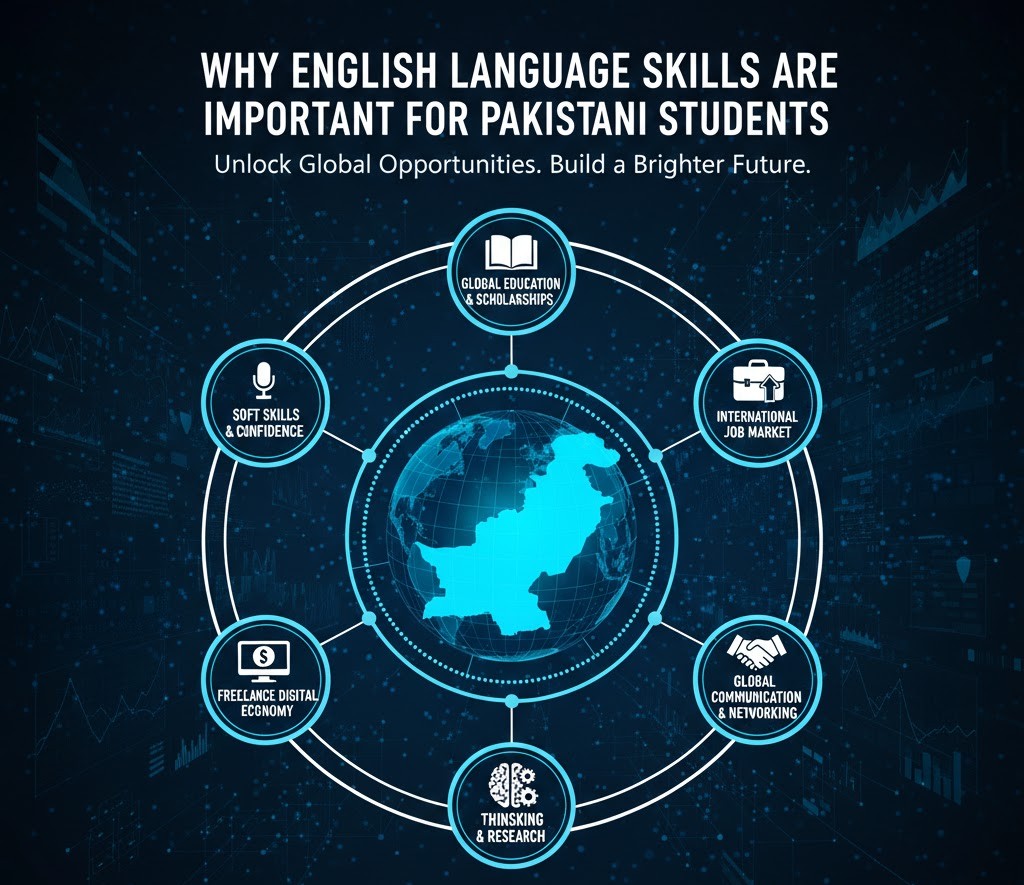
Why English Language Skills Are Important for Pakistani Students
Introduction
Imagine a Pakistani student who has strong ideas, solid technical knowledge, and real ambition but struggles to express those ideas confidently in class, online, or during an interview. This situation is more common than we like to admit. In Pakistan, many students are intelligent and hardworking, yet their limited English language skills become an invisible barrier holding them back from academic success, career growth, and global opportunities.
English is no longer just a school subject. It is the language of higher education, technology, business, research, and international communication. From university lectures and textbooks to job interviews and online freelancing platforms, English quietly shapes how far a student can go.
This article explains why English language skills are so important for Pakistani students, especially beginners and learners planning their future. We’ll explore how English affects education, careers, confidence, and global exposure, while also clearing common misconceptions. Most importantly, you’ll walk away with practical insights on how students can start improving their English in realistic, achievable ways.
The Role of English in Pakistan’s Education System
English as the Language of Instruction
In Pakistan, English plays a central role in education, particularly after primary school. Many:
-
University programs
-
Professional degrees (medicine, engineering, IT, business)
-
Competitive exams
are taught and examined primarily in English.
Textbooks, research papers, reference materials, and even classroom discussions often rely on English terminology. A student who struggles with the language may understand the subject but still perform poorly because they cannot fully grasp exam questions or express answers clearly.
This creates a language gap, not a knowledge gap.
Academic Performance and Understanding
English proficiency directly affects:
-
Reading speed and comprehension
-
Note-taking during lectures
-
Writing assignments, reports, and exams
-
Participating in discussions and presentations
Students with stronger English skills tend to absorb information faster and perform better academically—not because they are smarter, but because they can access and process information more easily.
English as a Gateway to Better Career Opportunities
The Job Market Reality in Pakistan
Today’s job market in Pakistan is highly competitive. Employers consistently look for candidates who can:
-
Communicate professionally
-
Write emails and reports
-
Interact with clients or teams
-
Understand international standards
In many job descriptions, “good communication skills” is a polite way of saying strong English skills.
Whether it’s a corporate office, a startup, a call center, or a multinational company, English is often the working language.
Freelancing, Remote Work, and Global Clients
Pakistan has one of the fastest-growing freelancing communities in the world. Platforms like Upwork, Fiverr, and Freelancer offer opportunities in:
-
Graphic design
-
Web development
-
Digital marketing
-
Content writing
-
Virtual assistance
But there’s a catch: clients communicate in English.
Students with good English skills can:
-
Write convincing proposals
-
Understand client requirements
-
Build long-term international relationships
-
Charge higher rates
Those without these skills often struggle, even if their technical abilities are strong.
How English Builds Confidence and Personality
Communication Shapes Confidence
Many students feel nervous speaking in public or sharing opinions not because they lack ideas, but because they fear making mistakes in English. Over time, this fear can:
-
Reduce classroom participation
-
Limit leadership opportunities
-
Affect self-esteem
As English skills improve, students often notice a change in how they carry themselves. They speak more confidently, ask questions freely, and express opinions without hesitation.
English and Personal Development
Strong English skills contribute to:
-
Better presentation skills
-
Improved critical thinking
-
Clearer expression of thoughts
-
Stronger social and professional presence
Confidence in language often translates into confidence in life.
Access to Global Knowledge and Resources
The Internet Speaks English
A large portion of high-quality educational content online is in English, including:
-
Online courses
-
Research articles
-
Tutorials and documentation
-
Academic journals
Students who rely only on Urdu or limited English miss out on vast learning opportunities.
With English proficiency, students can learn directly from global experts instead of waiting for translated or simplified material.
Scholarships and International Exposure
Many international scholarships, exchange programs, and study-abroad opportunities require:
-
English proficiency tests (IELTS, TOEFL)
-
English-written applications
-
Interviews in English
Without adequate English skills, talented Pakistani students may never even apply, let alone succeed.
English in the Digital and Professional World
Workplace Communication
In professional environments, English is commonly used for:
-
Emails and official documents
-
Meetings and presentations
-
Training materials
-
Software and technical tools
Employees who communicate clearly in English are often perceived as more professional and competent, which can influence promotions and leadership opportunities.
Technology, IT, and Innovation
The language of technology is English. Programming languages, software documentation, and online developer communities all operate primarily in English.
For students entering fields like IT, data science, or engineering, English is not optional—it’s essential.
Common Myths About Learning English in Pakistan
“English Is Only for Elite or Private School Students”
This is one of the most damaging myths. English is a skill, not a social class indicator. With consistent practice and exposure, students from any background can improve.
“You Must Speak Perfect English”
Perfection is not the goal—clarity is. Many successful professionals speak English with accents or minor grammatical mistakes, yet communicate effectively.
“English Means Forgetting Urdu or Culture”
Learning English does not mean abandoning local languages or identity. In fact, bilingual or multilingual individuals often have stronger cognitive and communication abilities.
Practical English Skills Students Should Start Learning Today
Focus on Communication, Not Just Grammar
Instead of memorizing rules, students should focus on:
-
Everyday speaking practice
-
Listening to English content
-
Reading simple articles or books
-
Writing short paragraphs or journal entries
Essential Skills to Build First
-
Vocabulary for daily and academic use
-
Basic sentence structure
-
Listening comprehension
-
Confidence in speaking
Consistency matters more than perfection. Even 20–30 minutes a day can create noticeable improvement over time.
Using English in Daily Life
Students can practice English by:
-
Watching English videos with subtitles
-
Following English-speaking educators online
-
Speaking English with friends during practice sessions
-
Reading news articles or blogs
The goal is exposure and usage, not memorization.
How English Skills Shape Long-Term Career Growth
English proficiency doesn’t just help students get their first job it supports long-term career growth.
Professionals with strong English skills are more likely to:
-
Move into managerial roles
-
Represent companies internationally
-
Learn new skills faster
-
Adapt to global work environments
In a world that is increasingly interconnected, English acts as a bridge between local talent and global opportunity.
FAQs: Common Questions Students Ask
Is English really necessary for success in Pakistan?
Yes. While not every job requires advanced English, strong communication skills significantly improve academic, professional, and financial opportunities.
Can students from Urdu-medium backgrounds learn English well?
Absolutely. Many successful professionals in Pakistan started with limited English and improved through practice and exposure.
How long does it take to improve English skills?
Improvement depends on consistency. With daily practice, students can see meaningful progress within a few months.
Is spoken English more important than written English?
Both matter. Spoken English builds confidence and communication, while written English is essential for exams, emails, and professional work.
Do accents matter when speaking English?
No. Clear communication matters far more than having a “native” accent.
Conclusion
For Pakistani students, English language skills are not just an academic requirement they are a life skill. English opens doors to better education, stronger careers, global exposure, and personal confidence. In today’s world, where opportunities increasingly cross borders, the ability to understand and communicate in English can shape a student’s future in powerful ways.
The good news is that English is learnable. It does not require privilege, perfection, or expensive institutions only consistency, patience, and the willingness to practice. Students who start improving their English today are not just learning a language; they are investing in their confidence, careers, and global relevance.
The future belongs to those who can communicate their ideas clearly. English is one of the strongest tools Pakistani students can use to make their voices heard.
Tags :
No Tags

0 Comments