



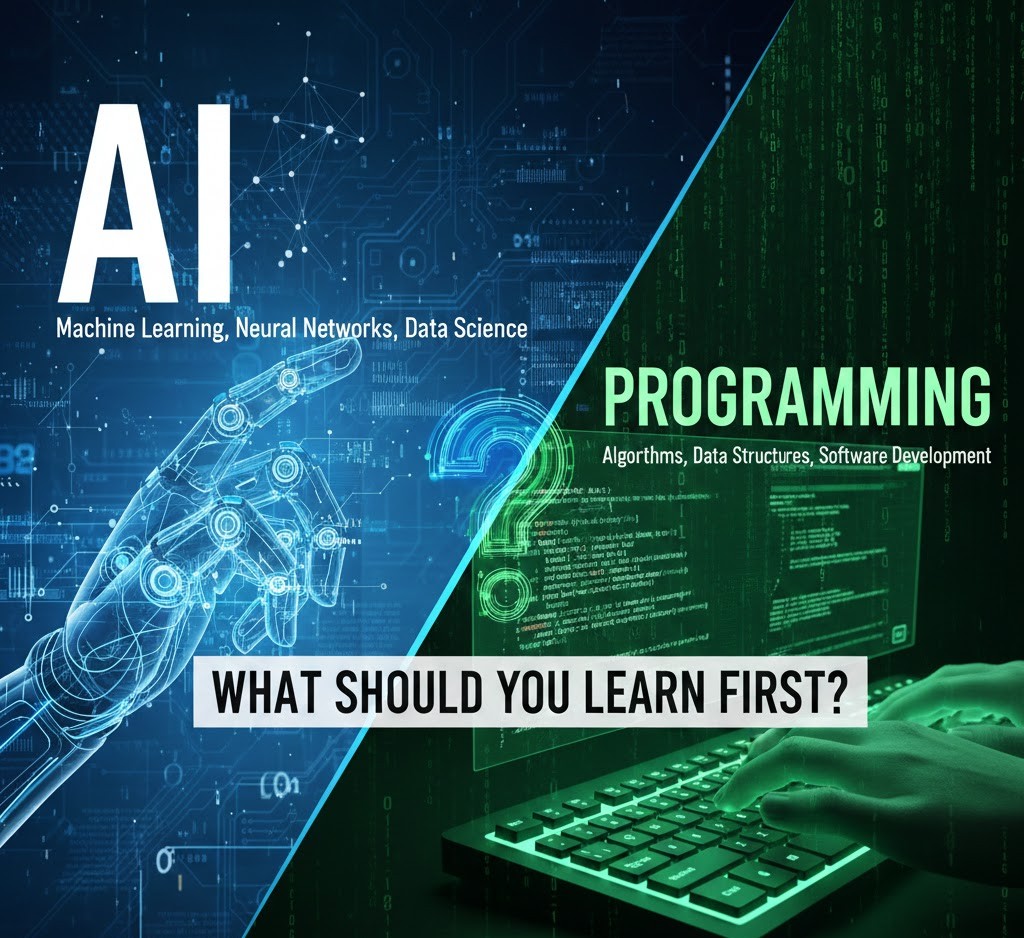
AI vs Programming: What Should You Learn First?
Introduction
Imagine this scenario: you’re a student or early-career professional, scrolling through LinkedIn or YouTube, and every second post seems to shout “Learn AI now!” or “Programming is dead AI will do everything!” At the same time, others insist that without strong programming fundamentals, learning AI is pointless. It’s confusing, a little overwhelming, and honestly, it makes many beginners freeze instead of starting.
This debate AI vs programming has become one of the most common questions among students today. And it’s an important one. The choice you make can shape how easily you learn, the kind of jobs you qualify for, and how confident you feel navigating the tech world.
In this article, we’ll unpack this question calmly and realistically. You’ll learn what programming and AI actually involve (beyond buzzwords), how they differ, how they depend on each other, and most importantly which one you should learn first based on your goals, background, and career plans. There’s no hype here, just clear guidance from an educator’s perspective.
Understanding the Basics: Programming and AI Are Not the Same Thing
Before deciding what to learn first, it’s essential to understand what each field truly represents.
What Programming Really Is
Programming is the skill of giving instructions to a computer in a language it understands. These instructions tell software what to do, how to do it, and when to do it. Whether it’s a mobile app, a website, or a banking system, programming is the foundation underneath.
Key characteristics of programming:
-
You write explicit rules for the computer to follow
-
Logic, structure, and problem-solving are central
-
Results are predictable if the code is correct
Common beginner programming languages include Python, JavaScript, C++, and Java. Each has its own use cases, but they all share the same core idea: humans control the logic.
Programming teaches you how computers think and just as importantly how they don’t.
What AI Actually Means in Practice
Artificial Intelligence, in contrast, focuses on building systems that can learn from data, recognize patterns, and make decisions with minimal human instruction. Instead of telling the computer every rule, you provide examples and let the system figure things out.
AI includes areas like:
-
Machine learning
-
Data analysis
-
Natural language processing
-
Computer vision
Here, the computer doesn’t just follow rules it infers them.
But here’s the part many beginners miss: AI systems are still built using programming. There is no AI without code.
The Core Difference: Rules vs Learning
One of the simplest ways to understand the difference is this:
-
Programming: You define the rules
-
AI: The system learns the rules
For example:
-
A traditional program might say: “If a customer spends more than $500, apply a discount.”
-
An AI system might analyze thousands of customers and learn which behaviors usually lead to discounts without being told the exact rule.
This difference affects how you learn each skill and which one is easier to start with.
Do You Need Programming to Learn AI?
This is the question behind the question.
Technically, you can experiment with AI concepts without deep programming knowledge. But to truly understand, customize, or build anything meaningful, programming becomes unavoidable.
Why?
-
AI models are implemented in code
-
Data must be cleaned and processed programmatically
-
Results must be tested, evaluated, and improved
Most AI work today relies heavily on languages like Python, which is also one of the easiest programming languages for beginners.
In other words, learning AI without programming is like learning to drive without understanding the steering wheel. You might move, but you won’t feel in control.
Why Many Beginners Should Start With Programming
For most students, starting with programming offers clear advantages.
Programming Builds Thinking Skills, Not Just Technical Skills
Programming trains you to:
-
Break problems into smaller parts
-
Think logically and sequentially
-
Debug mistakes calmly and methodically
These skills transfer directly into AI, data science, and even non-technical careers.
Programming Gives You Confidence Early
When you write a small program and it works, you see immediate results:
-
A calculator
-
A simple website
-
A small automation script
This sense of control and feedback helps beginners stay motivated.
Programming Makes AI Less Intimidating
Many students find AI overwhelming because it sounds abstract. But once you understand loops, variables, and functions, AI concepts feel far more approachable. You stop seeing AI as “magic” and start seeing it as advanced logic plus data.
When Starting With AI Might Make Sense
That said, there are cases where beginning with AI concepts is reasonable.
If You’re Non-Technical but Curious
Some learners come from business, marketing, or social sciences. For them:
-
Understanding what AI can and cannot do
-
Learning how AI impacts industries
-
Interpreting AI-driven insights
can be valuable even before deep coding.
If Your Goal Is AI Literacy, Not AI Engineering
Not everyone wants to become a machine learning engineer. If your aim is:
-
Using AI tools responsibly
-
Making strategic decisions involving AI
-
Communicating with technical teams
then starting with conceptual AI knowledge is fine just don’t expect to build models yet.
How Programming and AI Work Together in the Real World
In real jobs, programming and AI are rarely separate.
Consider a simple example:
-
A recommendation system for an online store
This requires:
-
Programming to build the website
-
Programming to handle user data
-
AI to analyze behavior and suggest products
-
More programming to integrate results
AI doesn’t replace programming—it adds another layer on top of it.
Professionals who understand both are far more effective than those who know only one.
Common Myths Students Believe About AI and Programming
“AI Will Replace Programmers”
AI can generate code, but it doesn’t understand context, business needs, or long-term system design. Skilled programmers are still essential.
“You Must Be a Math Genius to Learn AI”
Advanced AI research uses heavy math, but practical AI applications often rely more on logic, data understanding, and experimentation.
“Programming Is Too Old-Fashioned”
Programming evolves constantly. Languages, tools, and practices change but the core skill remains future-proof.
A Practical Learning Path for Beginners
Instead of choosing either/or, think in stages.
Stage 1: Learn Basic Programming
Focus on:
-
One beginner-friendly language (Python is ideal)
-
Variables, conditions, loops
-
Simple projects
This builds your foundation.
Stage 2: Learn Data Basics
Before AI, understand:
-
What data is
-
How it’s structured
-
How to analyze it
This step bridges programming and AI naturally.
Stage 3: Move Into AI Concepts
Now explore:
-
Machine learning basics
-
Model training ideas
-
Real-world AI use cases
At this point, AI will feel like a natural extension, not a leap.
Career Perspective: What Employers Actually Look For
Employers don’t usually ask:
“Did you learn AI first or programming first?”
They ask:
-
Can you solve problems?
-
Can you work with data?
-
Can you adapt to new tools?
Strong programming fundamentals make learning new AI frameworks much faster. Trends change, but fundamentals last.
FAQs: AI vs Programming
Is programming harder than AI for beginners?
Programming usually feels more concrete and structured, which many beginners find easier than abstract AI concepts.
Can I learn AI without coding at all?
You can learn concepts, but building or customizing AI systems requires coding.
Which pays more: AI or programming?
Specialized AI roles often pay more, but they usually require strong programming skills as a foundation.
How long does it take to learn programming before AI?
With consistent practice, many students can start basic AI work within 3–6 months of learning programming.
Is Python enough for both?
Yes. Python is widely used in both programming and AI, making it an excellent starting point.
Conclusion
The debate between AI vs programming isn’t about choosing sides it’s about choosing a sequence. Programming teaches you how computers work. AI teaches you how computers learn. One builds the ground, the other builds the structure.
For most students, starting with programming creates clarity, confidence, and long-term flexibility. AI then becomes less mysterious and more powerful, because you understand what’s happening under the surface.
If you approach this journey patiently building skills step by step you won’t just follow trends. You’ll be prepared for whatever direction technology takes next. And that’s far more valuable than rushing into the latest buzzword.
Tags :
No Tags

0 Comments