



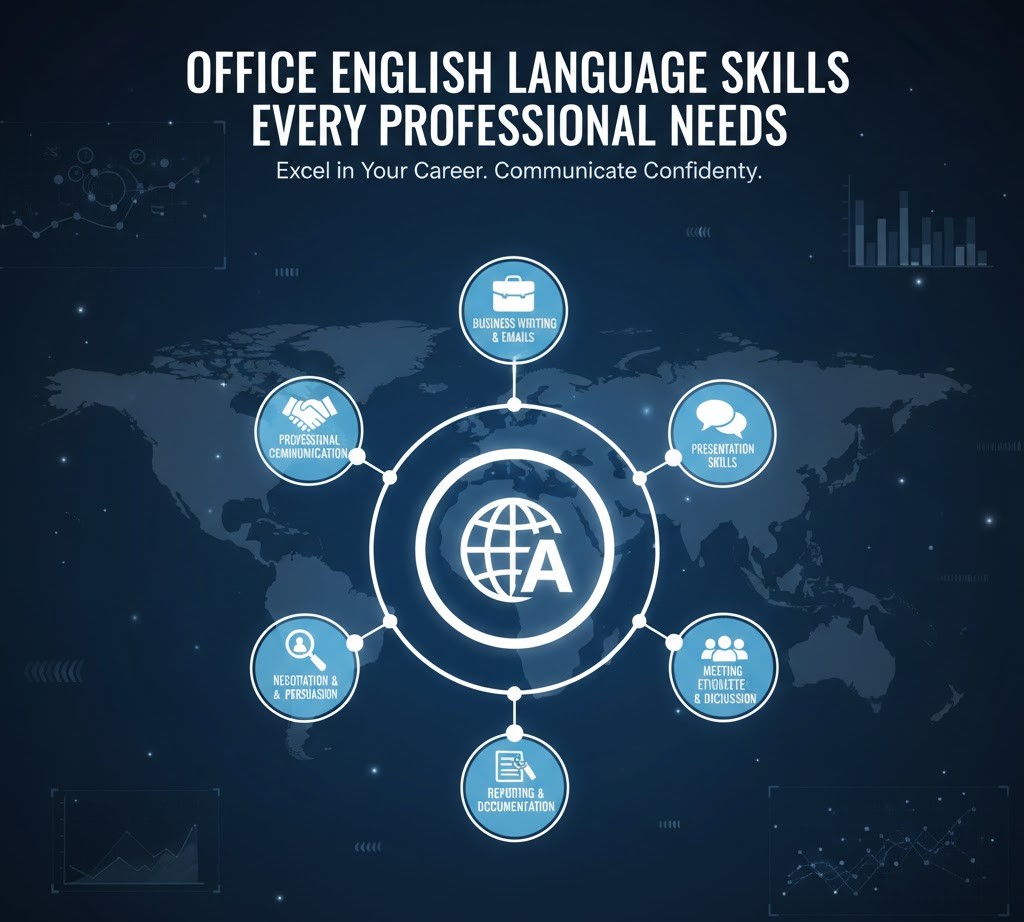
Office English Language Skills Every Professional Needs
Introduction
Imagine this: you have the technical skills for the job, your ideas are solid, and your work ethic is strong but in meetings, emails, or presentations, you struggle to express yourself clearly. You know what you want to say, yet the words don’t always come out right. This is a situation many students and beginners face when they enter professional environments where English is the primary working language.
Office English is not the same as classroom English or casual conversation. It’s a practical, purpose-driven form of communication used to collaborate, solve problems, build relationships, and make decisions at work. Whether you’re a student preparing for your first job, an intern, or a young professional, mastering office English can dramatically improve your confidence and career prospects.
In this article, you’ll learn what office English really means, why it matters in today’s workplaces, and which specific language skills every professional needs. We’ll break down key areas like speaking, writing, listening, and workplace vocabulary, share real-world examples, clear up common myths, and offer practical steps you can start using right away. The goal is simple: to help you communicate clearly, professionally, and confidently in any office setting.
What Office English Really Means (Beyond Grammar Rules)
When people hear “English skills,” they often think of grammar tests, essays, or memorizing vocabulary lists. Office English is very different. It’s about using the right tone, structure, and language for professional situations.
Office English focuses on:
-
Clarity: Saying exactly what you mean, without confusion.
-
Professional tone: Sounding polite, respectful, and confident.
-
Purpose-driven communication: Writing or speaking with a clear goal informing, requesting, persuading, or updating.
For example, saying “Send me the file now” might be grammatically correct, but in an office it can sound rude. A more professional version would be “Could you please send me the file when you get a chance?”
Office English is less about perfection and more about effectiveness. Employers value professionals who can communicate ideas clearly, work well with others, and represent the company professionally often more than flawless grammar.
How Communication Works in a Professional Environment
Before diving into specific skills, it helps to understand how communication flows in offices.
Most workplace communication happens through:
-
Emails and written messages
-
Meetings (in-person or virtual)
-
Presentations and reports
-
Informal discussions with colleagues
-
Client or customer interactions
In these situations, English serves as a tool. You’re not just speaking or writing you’re managing time, expectations, and relationships. Good office English helps you:
-
Avoid misunderstandings
-
Reduce back-and-forth communication
-
Build trust with colleagues and managers
-
Appear organized and reliable
Understanding this context makes it easier to see why certain language skills matter more than others in professional life.
Core Office English Skills Every Professional Needs
Speaking Skills for the Workplace
Speaking English at work isn’t about long speeches. It’s about clear, confident, and polite communication.
Key speaking situations include:
-
Participating in meetings
-
Giving updates on tasks
-
Asking questions or clarifying instructions
-
Speaking with clients or supervisors
Important speaking skills to develop:
-
Clear pronunciation, not necessarily an accent
-
Structured responses (start with the main point, then details)
-
Polite expressions for agreement and disagreement
For example:
-
Agreeing professionally: “I agree with your point, especially about the timeline.”
-
Disagreeing politely: “I see your perspective, but I think we should also consider…”
You don’t need advanced vocabulary. Simple, clear sentences spoken with confidence are far more effective than complex sentences filled with hesitation.
Professional Writing Skills (Emails, Messages, and Reports)
Writing is one of the most important office English skills, especially for beginners. Poorly written emails can create confusion or appear unprofessional.
Strong workplace writing focuses on:
-
Clarity and brevity
-
Logical structure
-
Appropriate tone
A professional email usually includes:
-
A clear subject line
-
A polite opening
-
The main message in short paragraphs
-
A clear action or next step
-
A professional closing
For example, instead of:
“I need update about project because client asking”
A professional version would be:
“I’m writing to check on the current status of the project, as the client has requested an update.”
Good writing doesn’t mean long writing. In fact, the best office emails are often short, direct, and easy to scan.
Listening Skills in Meetings and Conversations
Listening is an underrated office English skill. Many misunderstandings happen not because people speak poorly, but because they don’t listen carefully.
In professional settings, listening means:
-
Understanding different accents and speaking speeds
-
Identifying key points and action items
-
Not interrupting unnecessarily
-
Asking follow-up questions when needed
Active listening phrases can be very helpful, such as:
-
“Just to confirm, you’re asking me to…”
-
“If I understand correctly, the deadline is…”
These phrases show professionalism and prevent costly mistakes.
Workplace Vocabulary and Common Expressions
Office English uses a specific set of vocabulary that may not appear in textbooks. Words like deadline, follow-up, deliverables, feedback, and schedule are common across industries.
It’s also important to understand common expressions, such as:
-
“Let’s touch base” (talk later)
-
“I’ll get back to you” (respond later)
-
“We’re on the same page” (we agree)
You don’t need to use every expression yourself, but understanding them helps you follow conversations and emails more easily.
How Office English Fits into Professional Growth
Strong office English skills directly affect career development. Employees who communicate well are often seen as:
-
More competent
-
More reliable
-
Better leadership candidates
Even in technical roles, communication matters. A skilled developer, designer, or analyst still needs to explain ideas, document work, and collaborate with others.
As professionals move into senior roles, English skills become even more important. Leadership involves:
-
Giving clear instructions
-
Providing feedback
-
Representing teams and companies
Office English is not just a beginner skill it grows with your career.
Real-World Example: Two Employees, Different Outcomes
Consider two new employees with similar technical abilities.
Employee A completes tasks well but sends unclear emails and avoids speaking in meetings.
Employee B asks clear questions, writes short professional emails, and confidently shares updates—even with simple language.
Over time, Employee B is more visible, trusted, and included in important discussions. Promotions and opportunities often follow visibility and communication, not just hard skills.
This is how office English quietly shapes careers.
Common Myths About Office English
Many beginners hold beliefs that slow their progress.
Myth 1: You need perfect grammar to sound professional
In reality, clarity and tone matter more than perfection.
Myth 2: Office English is only for managers
Everyone uses office English, from interns to executives.
Myth 3: A strong accent means poor English
Accent does not equal ability. Clear communication is what matters.
Myth 4: You’ll learn it naturally without effort
Exposure helps, but intentional practice speeds up learning significantly.
Practical Office English Skills Students Should Start Learning Today
If you’re a student or beginner, focus on skills you can use immediately:
-
Writing clear emails and messages
-
Introducing yourself professionally
-
Asking for clarification politely
-
Giving short updates on your work
-
Understanding common office terms
Simple habits make a big difference:
-
Read professional emails carefully
-
Practice rewriting casual sentences into professional ones
-
Watch how professionals communicate in meetings or videos
-
Practice speaking aloud, even alone
Consistency matters more than speed.
How Office English Skills Are Evolving
Workplaces are changing. Remote work, global teams, and digital tools have made English even more important.
Modern office English now includes:
-
Writing concise messages for chat platforms
-
Speaking clearly in virtual meetings
-
Being culturally sensitive in communication
-
Adjusting tone for global audiences
Professionals who can communicate clearly across platforms and cultures are in high demand. Office English is no longer optional—it’s a core professional skill.
Frequently Asked Questions
Is office English different from general English?
Yes. Office English focuses on professional situations, tone, and clarity rather than academic or casual language.
How long does it take to improve office English?
With regular practice, noticeable improvement can happen within a few months.
Do I need advanced vocabulary for office English?
No. Simple, clear words used correctly are more effective than complex vocabulary.
Can introverts succeed with office English?
Absolutely. Office English is about clarity, not loudness or constant speaking.
Is office English useful outside corporate jobs?
Yes. It’s valuable in freelancing, entrepreneurship, customer service, and remote work.
Conclusion
Office English language skills are not about sounding impressive they’re about being understood, respected, and effective. For students and beginners, these skills can be the bridge between having knowledge and being able to use it professionally.
By focusing on clear speaking, professional writing, active listening, and practical vocabulary, you build a foundation that supports your entire career. These skills grow with experience, but the earlier you start, the more confident you become.
In a world where communication defines opportunities, office English is a long-term investment. Master it step by step, use it daily, and you’ll find that your ideas carry further, your confidence grows stronger, and your professional future opens up in ways technical skills alone cannot achieve.
Tags :
No Tags

0 Comments