



What Is Digital Marketing in Simple Words
Introduction
Think about the last time you searched for something online. Maybe it was “best budget smartphones,” “online courses for students,” or even a nearby restaurant. You probably clicked one of the first few results without much thought. That simple action is at the heart of digital marketing.
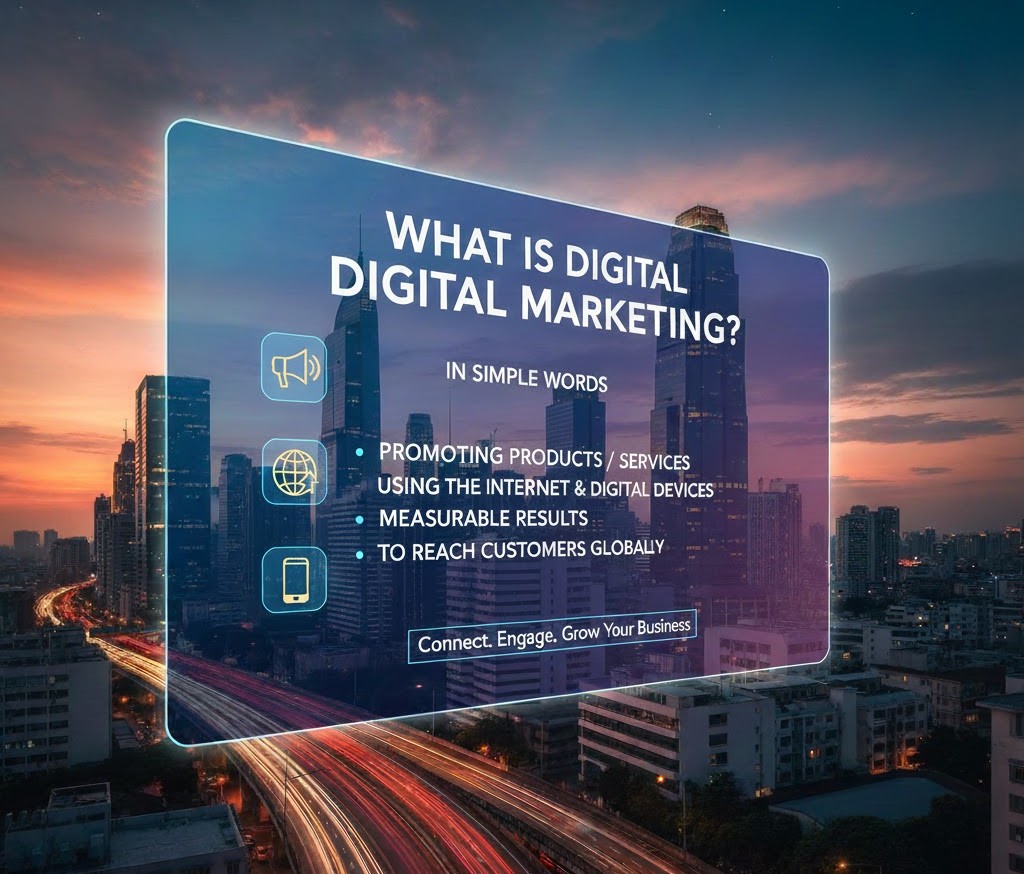
In simple words, digital marketing is how businesses promote their products or services online using search engines, social media, websites, email, and other digital channels. Instead of billboards or newspaper ads, digital marketing meets people where they already spend time: on their phones and laptops.
For students and beginners, digital marketing matters more than ever. It’s one of the fastest-growing career fields, doesn’t require huge investments to start learning, and offers global opportunities. Whether you want a job, a freelance career, or to grow your own business someday, understanding digital marketing gives you a powerful advantage.
In this article, you’ll learn what digital marketing really means, how its most important part SEO (Search Engine Optimization)works, and how everything fits together. We’ll break down complex ideas into simple explanations, use real-world examples, and focus on practical knowledge you can start using today.
What Digital Marketing Really Means (Beyond Definitions)
Most definitions say something like: Digital marketing is the promotion of products or services using digital channels. While that’s correct, it doesn’t explain how it works in real life.
At its core, digital marketing is about connecting the right message with the right people at the right time—online.
Imagine a small clothing brand. Instead of waiting for customers to walk past a physical store, the brand:
-
Shows ads on Instagram where fashion lovers scroll daily
-
Appears on Google when someone searches “affordable summer dresses”
-
Sends emails about discounts to previous customers
-
Creates blog posts to answer common fashion questions
All of that is digital marketing.
One of the most important parts of digital marketing is SEO, because it focuses on earning attention naturally instead of paying for every click.
What SEO Really Means in Digital Marketing
SEO stands for Search Engine Optimization. In simple words, SEO is the process of making your website easier to find on search engines like Google.
When someone searches for something, Google scans millions of pages and decides which ones are most helpful. SEO is about helping Google understand your content so it can show it to the right people.
SEO is not about tricking search engines. Modern SEO is about:
-
Creating useful, clear content
-
Making websites easy to use
-
Building trust and credibility online
For students, SEO is especially valuable because it teaches skills that apply across marketing, content creation, analytics, and even product strategy.
How Search Engines Work (In Simple Terms)
Search engines may seem complicated, but the basic idea is simple.
Step 1: Crawling
Search engines use automated programs (often called bots or spiders) to explore the web. They follow links and discover new pages.
Step 2: Indexing
Once a page is found, Google tries to understand what it’s about. It looks at text, headings, images, and structure, then stores that information in its database (the index).
Step 3: Ranking
When someone searches, Google compares all relevant pages in its index and ranks them based on usefulness, quality, and trustworthiness.
SEO helps at all three stages by making your content easier to crawl, clearer to understand, and more valuable than competing pages.
Key Components of SEO Explained Simply
SEO is usually divided into three main areas. Each one plays a different role, but they work best together.
On-Page SEO: What’s on Your Website
On-page SEO focuses on the content and elements you control directly.
Key ideas include:
-
Writing content that clearly answers user questions
-
Using descriptive headings so readers and search engines understand structure
-
Choosing words people actually search for
-
Making pages easy to read and navigate
For example, a blog post titled “How to Learn Digital Marketing as a Student” should actually explain the topic clearly, not just repeat the phrase many times.
Beginner takeaway:
Focus on writing for humans first. Clear explanations, logical flow, and helpful examples naturally support good SEO.
Technical SEO: How Your Website Works
Technical SEO sounds intimidating, but its goal is simple: make your website easy to use and easy to understand for search engines.
This includes things like:
-
Fast page loading
-
Mobile-friendly design
-
Secure connections (HTTPS)
-
Clean site structure
If a website is slow, broken, or confusing, even great content may not rank well.
Beginner takeaway:
You don’t need to be a developer, but learning basic website performance and structure gives you a strong foundation.
Off-Page SEO: Building Trust Online
Off-page SEO focuses on how other websites and people interact with your site.
The most common example is backlinks—links from other websites to yours. Think of backlinks like recommendations. If trusted sites link to your content, search engines see that as a sign of credibility.
Off-page SEO also includes:
-
Brand mentions
-
Online reviews
-
Social sharing
Beginner takeaway:
Trust takes time. Creating genuinely useful content is the safest way to earn authority naturally.
How SEO Fits Into the Broader Digital Marketing Ecosystem
SEO doesn’t work alone. It supports and is supported by other digital marketing channels.
Here’s how they connect:
-
Content marketing: SEO helps content get discovered
-
Social media: Social sharing increases visibility and engagement
-
Paid ads: SEO insights help choose better keywords for ads
-
Email marketing: SEO content brings users who later join email lists
Think of digital marketing as a system, not separate parts. SEO often acts as the foundation because it brings long-term, sustainable traffic.
Real-World Example: SEO in Action
Imagine a student starting a blog about studying abroad.
At first, only friends visit the site. Then the student writes a detailed article answering a common question: “How much does it cost to study abroad in the USA?”
By:
-
Explaining costs clearly
-
Using real examples
-
Structuring the article well
The post starts appearing in search results. Over time, more students find it, trust the blog, and explore other posts.
No ads. No promotions. Just useful content discovered through SEO.
This is why SEO is powerful it keeps working long after content is published.
Common SEO Myths Beginners Believe
Many students get confused because of outdated or misleading advice.
Myth 1: SEO is about tricking Google
Modern SEO is about helping users, not gaming algorithms.
Myth 2: Results happen overnight
SEO is a long-term strategy. Growth usually takes weeks or months.
Myth 3: You need expensive tools to succeed
Tools help, but understanding users and content matters more.
Myth 4: SEO is only for bloggers
Businesses, freelancers, startups, and even personal brands use SEO.
Practical SEO Skills Students Should Start Learning Today
You don’t need to master everything at once. Start with skills that build real understanding.
Focus on learning:
-
How to research what people search for
-
How to write clear, structured content
-
How to analyze why certain pages rank well
-
Basic website usability and performance concepts
Practice by:
-
Creating a small blog or portfolio site
-
Optimizing a single article deeply instead of many shallow ones
-
Studying search results and noticing patterns
SEO rewards curiosity and patience.
How SEO Careers and Opportunities Are Evolving
SEO is no longer just about keywords. Today, it overlaps with:
-
Content strategy
-
User experience
-
Analytics and data interpretation
-
Brand building
Students with SEO knowledge can work as:
-
SEO specialists
-
Content strategists
-
Digital marketers
-
Freelancers or consultants
As businesses move online, demand for SEO skills continues to grow. It’s a career that values thinking, creativity, and adaptability—not just technical knowledge.
Frequently Asked Questions (FAQs)
Is digital marketing hard to learn for beginners?
No. Digital marketing is beginner-friendly if you start with basics and practice regularly.
How long does SEO take to show results?
Usually weeks to months, depending on competition and content quality.
Can students learn SEO without a technical background?
Yes. Many successful SEO professionals started with no technical experience.
Is SEO still relevant with social media and ads?
Yes. SEO provides long-term, sustainable traffic that complements other channels.
Can SEO be a full-time career?
Absolutely. SEO offers full-time, freelance, and remote opportunities worldwide.
Conclusion
Digital marketing, in simple words, is how businesses and individuals connect with people online. At the heart of it, SEO plays a crucial role by helping content get discovered naturally through search engines.
For students and beginners, learning SEO is not just about rankings or traffic. It’s about understanding how people search, how information is organized online, and how trust is built digitally. These skills stay valuable even as platforms and technologies change.
If you approach SEO with patience, curiosity, and a focus on helping users, you’re not just learning a marketing technique you’re building a long-term professional skill set.
The best time to start is now. Even small steps today can lead to meaningful opportunities tomorrow.
Tags :
No Tags

0 Comments