



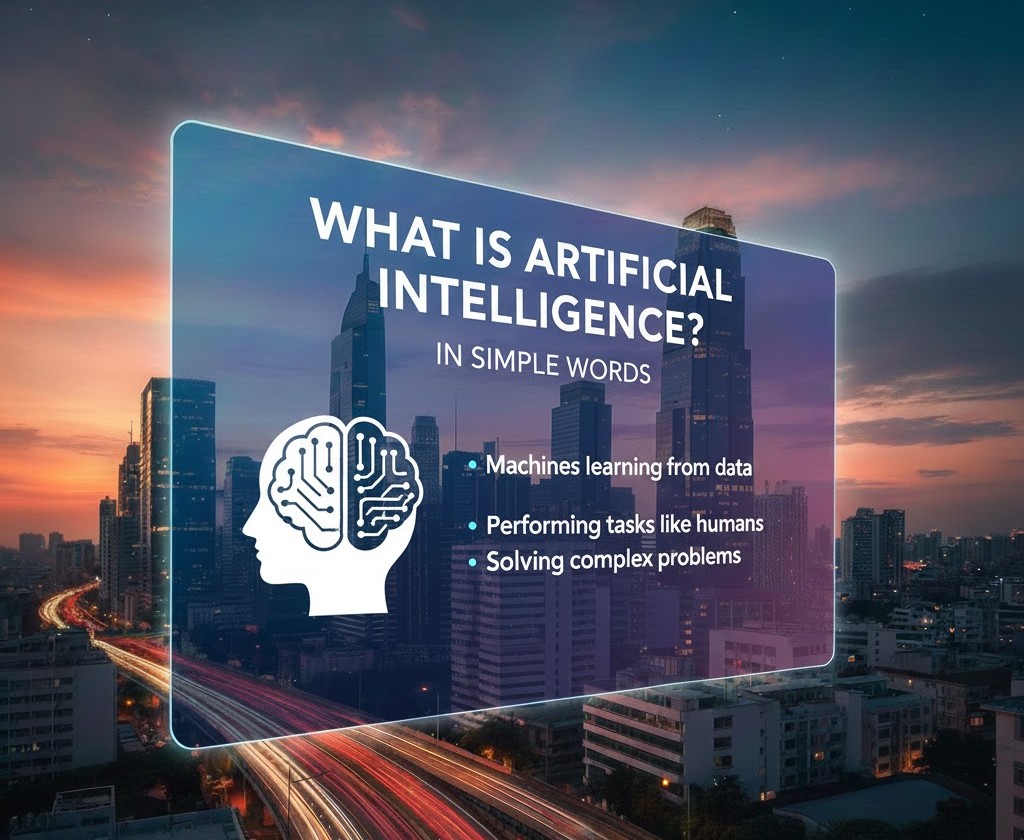
What Is Artificial Intelligence in Simple Words?
Introduction
Have you ever noticed how your phone unlocks when it sees your face, how YouTube seems to know exactly what video you’ll want to watch next, or how Google can finish your sentence before you’ve typed it? None of this is magic. It’s powered by something called artificial intelligence, often shortened to AI.
For students and beginners, AI can sound intimidating. Movies and headlines sometimes make it feel like a mysterious force that only scientists in labs understand. But in reality, artificial intelligence is already part of everyday life, quietly working behind the scenes. You don’t need a computer science degree to understand its basics. You just need someone to explain it clearly, without jargon.
In this article, we’ll break down what artificial intelligence is in simple words, how it works, and why it matters so much today. You’ll learn how AI makes decisions, where you see it in real life, what it can and cannot do, and what skills students should start learning if they’re curious about AI-related careers. By the end, AI should feel less like a buzzword and more like a practical, understandable concept you can actually talk about with confidence.
What Artificial Intelligence Really Means (Beyond the Definition)
At its core, artificial intelligence means teaching machines to think and learn in ways that are similar to humans.
That doesn’t mean machines have feelings or consciousness. Instead, it means they can:
-
Understand information
-
Learn from experience
-
Recognize patterns
-
Make decisions or predictions
A simple way to think about AI is this:
AI is when a computer is programmed to make smart decisions instead of just following fixed instructions.
Traditional software works like a recipe. If this happens, do that. AI is different. It learns from data. The more examples it sees, the better it gets at making decisions.
For example:
-
A calculator always follows the same rules.
-
A music recommendation system learns your taste over time and adapts.
That ability to learn and improve is what makes artificial intelligence special.
How Artificial Intelligence Works (In Simple Terms)
AI may feel complex, but the basic idea is surprisingly straightforward.
Data Is the Fuel
AI systems learn from data. Data can be anything:
-
Photos
-
Text
-
Videos
-
Numbers
-
Voice recordings
The more high-quality data an AI system has, the better it usually performs.
Patterns Are the Goal
AI doesn’t “understand” things the way humans do. Instead, it looks for patterns.
For example:
-
If an AI sees thousands of pictures labeled “cat” and “dog,” it learns patterns that help it tell the difference.
-
If it analyzes millions of emails marked as spam, it learns what spam usually looks like.
Learning Through Feedback
Most AI systems improve through feedback:
-
Correct predictions are reinforced.
-
Wrong predictions are corrected.
Over time, the system becomes more accurate. This is why AI systems often get better the longer they’re used.
Types of Artificial Intelligence You Should Know
Not all AI is the same. For beginners, it helps to understand a few key categories.
Narrow AI (The AI We Use Today)
This is the most common type of AI. It’s designed to do one specific task.
Examples include:
-
Voice assistants
-
Recommendation systems
-
Face recognition
-
Language translation
Narrow AI can be very powerful, but it cannot think outside its assigned role.
General AI (Still Theoretical)
General AI would be able to:
-
Learn any task a human can
-
Think and reason broadly
-
Apply knowledge across different situations
This type of AI does not exist yet. It’s mostly discussed in research and science fiction.
Rule-Based Systems vs Learning Systems
-
Rule-based systems follow strict instructions written by humans.
-
Learning systems adapt based on data and experience.
Modern AI relies much more on learning systems, which makes it flexible and scalable.
Everyday Examples of Artificial Intelligence
One of the best ways to understand AI is to look at where it shows up in daily life.
Smartphones and Apps
-
Face ID and fingerprint unlocking
-
Predictive text and autocorrect
-
Photo tagging and sorting
Social Media and Streaming Platforms
-
Content recommendations
-
Personalized feeds
-
Ad targeting
Online Shopping
-
Product recommendations
-
Dynamic pricing
-
Customer support chat systems
Navigation and Maps
-
Traffic prediction
-
Route optimization
-
Estimated arrival times
Most people use AI dozens of times a day without realizing it.
Artificial Intelligence vs Human Intelligence
It’s important to understand the limits of AI.
What AI Is Good At
-
Processing large amounts of data
-
Finding patterns quickly
-
Repeating tasks without fatigue
-
Making predictions based on past data
What AI Is Not Good At
-
Common sense reasoning
-
Understanding emotions deeply
-
Creativity in the human sense
-
Moral and ethical judgment
AI doesn’t “know” things. It calculates probabilities based on data. Humans still play a critical role in guiding, designing, and supervising AI systems.
How Artificial Intelligence Fits Into the Digital World
AI is not a standalone technology. It works alongside many other digital systems.
AI and the Internet
AI helps:
-
Rank search results
-
Filter harmful content
-
Personalize user experiences
AI and Business
Companies use AI to:
-
Analyze customer behavior
-
Improve decision-making
-
Automate routine tasks
AI and Education
In education, AI supports:
-
Personalized learning paths
-
Automated grading
-
Learning analytics
Understanding AI helps students understand how modern digital systems actually work.
Common Myths About Artificial Intelligence
Beginners often believe things about AI that aren’t true.
Myth 1: AI Will Replace All Jobs
AI will change jobs, but it will also create new ones. Many roles will involve working with AI, not competing against it.
Myth 2: AI Thinks Like Humans
AI processes data, not thoughts. It doesn’t have awareness or emotions.
Myth 3: AI Is Always Objective
AI reflects the data it’s trained on. If the data is biased, the results can be biased too.
Myth 4: You Need Advanced Math to Learn AI
While advanced roles require technical skills, many AI-related careers focus on strategy, ethics, content, design, and communication.
Practical AI Skills Students Can Start Learning Today
You don’t need to become a programmer overnight to understand AI.
Foundational Skills
-
Basic computer literacy
-
Understanding how data works
-
Critical thinking and logic
Technical Exposure (Optional but Helpful)
-
Introductory coding concepts
-
Data analysis basics
-
Understanding algorithms at a high level
Non-Technical Skills That Matter
-
Problem-solving
-
Communication
-
Ethical reasoning
-
Curiosity and adaptability
AI is as much about thinking clearly as it is about technology.
How AI Careers and Opportunities Are Evolving
AI is influencing many career paths, not just technical ones.
Technical Roles
-
Machine learning engineers
-
Data scientists
-
AI researchers
Non-Technical Roles
-
AI product managers
-
Content and training specialists
-
Policy and ethics advisors
-
Digital marketers and analysts
For students, the key is not to fear AI but to learn how it fits into your field of interest.
Frequently Asked Questions About Artificial Intelligence
Is artificial intelligence the same as robotics?
No. Robotics focuses on physical machines, while AI focuses on intelligence. Robots may use AI, but AI can exist without robots.
Can AI think on its own?
AI does not think independently. It follows patterns learned from data and instructions given by humans.
Is AI dangerous?
AI itself is not dangerous. Problems arise from how it’s designed, used, or misused by people.
Do I need to study computer science to work with AI?
Not always. Many roles involve working alongside AI rather than building it from scratch.
Is AI the future?
AI is already part of the present. Its influence will continue to grow across industries.
Conclusion
Artificial intelligence doesn’t have to be confusing or scary. In simple words, AI is about teaching machines to learn from data and make smart decisions. It’s already shaping how we communicate, learn, shop, and work. For students and beginners, understanding AI is less about mastering complex equations and more about understanding how modern technology thinks and adapts.
As AI continues to evolve, the most valuable skill will be knowing how to work with it thoughtfully and responsibly. Whether you pursue a technical career or not, having a clear, realistic understanding of artificial intelligence will give you an edge in a world that increasingly relies on smart systems. Start with curiosity, keep learning, and see AI not as a mystery, but as a tool you can understand and use wisely.
Tags :
No Tags

0 Comments