



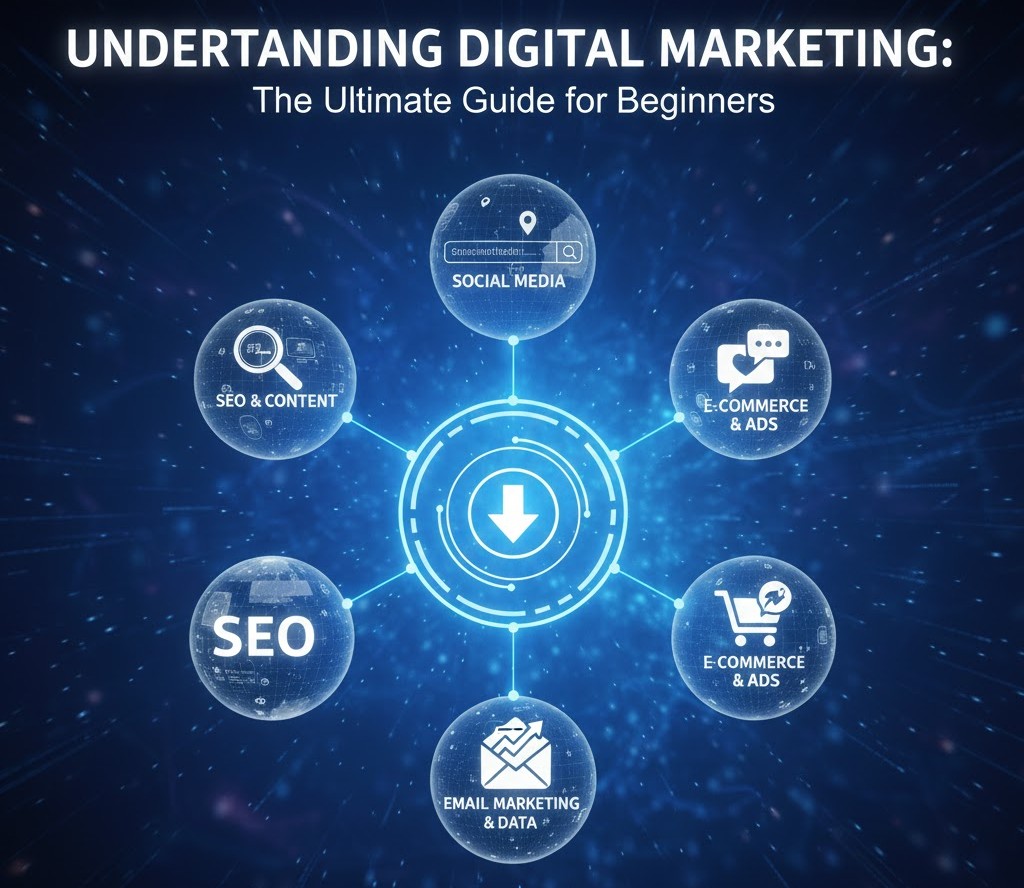
Understanding Digital Marketing: The Ultimate Guide for Beginners
Introduction
Imagine you search for a new pair of sneakers online. Within seconds, Google shows you dozens of options—blogs reviewing the best brands, online stores offering discounts, and videos explaining how to choose the right fit. Have you ever wondered why certain websites appear at the top while others are buried on page five? That’s not luck. It’s digital marketing at work, with search engine optimization (SEO) playing a major role.
For students and beginners, digital marketing can feel overwhelming. It’s full of buzzwords, fast-changing trends, and technical jargon. Yet, at its core, digital marketing is simply about connecting the right message with the right audience at the right time online. SEO matters today because search engines are often the starting point for learning, shopping, and decision-making. If people can’t find you, your ideas, skills, or business may never get noticed.
In this guide, you’ll learn how digital marketing works, with a strong focus on SEO as a foundational skill. We’ll break down how search engines think, what SEO really involves, how it fits into the bigger digital marketing picture, and why learning it now can open doors for your future.
What SEO Really Means in Digital Marketing
When people hear “SEO,” they often think it’s just about adding keywords to a webpage. That’s a small part of a much bigger picture.
SEO, or search engine optimization, is the practice of improving a website so it becomes more visible in organic (non-paid) search results. But beyond definitions, SEO is about understanding user intent. Search engines are trying to answer one question: Which result best satisfies this searcher’s need?
From a digital marketing perspective, SEO sits at the intersection of:
-
Content creation
-
User experience
-
Technical performance
-
Brand authority
A well-optimized page isn’t just written for algorithms. It’s designed for humans first clear, helpful, fast, and trustworthy. SEO teaches marketers how people search, what questions they ask, and how to structure information so it’s easy to find and understand.
For students, this mindset is powerful. Learning SEO means learning how audiences behave online.
How Search Engines Work (In Simple Terms)
Search engines like Google follow a three-step process: crawl, index, and rank.
Crawling: Discovering Content
Search engines use automated programs (often called crawlers or bots) to scan the web. These bots follow links from page to page, discovering new and updated content.
Indexing: Organizing Information
Once a page is crawled, its content is analyzed and stored in a massive database known as an index. This is like a digital library where every page is categorized based on topic, relevance, and quality signals.
Ranking: Choosing the Best Results
When someone types a search query, the search engine quickly scans its index and ranks pages based on hundreds of factors, such as:
-
Relevance to the query
-
Content quality and depth
-
Page speed and mobile usability
-
Trust signals like backlinks
The goal isn’t to reward websites it’s to help users. Understanding this helps beginners stop chasing shortcuts and start focusing on value.
Key Components of SEO
SEO is usually divided into three main areas. Each solves a different problem but works best when aligned.
On-Page SEO: Optimizing What Users See
On-page SEO focuses on the content and structure of individual pages. The problem it addresses is clarity—both for users and search engines.
Key elements include:
-
Content quality: Clear explanations, original insights, and useful information
-
Headings and structure: Logical flow using H1, H2, and H3 headings
-
Keyword context: Using relevant terms naturally, not excessively
-
Internal linking: Connecting related pages to guide readers
Beginner takeaway: Write content as if you’re explaining a topic to a friend. If it makes sense to a human, it usually makes sense to a search engine.
Technical SEO: Making Your Site Easy to Use and Access
Technical SEO deals with how well a website functions behind the scenes. Even great content can struggle if a site is slow or confusing.
Common technical considerations include:
-
Page loading speed
-
Mobile-friendliness
-
Secure connections (HTTPS)
-
Clean URLs and site structure
The insight here is simple: search engines prefer websites that offer a smooth user experience. Technical SEO isn’t about coding mastery at first—it’s about awareness.
Beginner takeaway: Learn the basics of how websites work and why performance matters.
Off-Page SEO: Building Trust and Authority
Off-page SEO focuses on reputation. Search engines look for signals that others trust and value your content.
The most important signal is backlinks—links from other websites to yours. Think of them as recommendations. A link from a respected site carries more weight than dozens from low-quality sources.
Other off-page factors include:
-
Brand mentions
-
Social sharing (indirect influence)
-
Online reviews
Beginner takeaway: Authority is earned, not built overnight. Focus on creating content worth sharing.
How SEO Fits into the Broader Digital Marketing Ecosystem
SEO doesn’t exist in isolation. It works alongside other digital marketing channels to create long-term growth.
-
Content marketing: SEO guides what topics people care about
-
Social media marketing: Content discovered through search can be shared socially
-
Paid advertising: SEO insights improve ad targeting and landing pages
-
Email marketing: Search-optimized content feeds email campaigns
In practice, SEO often acts as the foundation. It brings consistent traffic over time, while other channels amplify reach and engagement.
For students, this shows why SEO knowledge transfers easily into other marketing roles.
Real-World Examples of SEO in Action
Consider a small online tutoring website. At first, it relies on social media posts for traffic. Growth is slow and inconsistent.
After researching what students search for, the site creates in-depth guides like “How to Prepare for SAT Math” and “Beginner Tips for Online Learning.” Over months, these pages begin ranking on Google.
The result?
-
Steady organic traffic
-
Lower dependence on paid ads
-
Increased credibility
This is the long game of SEO. Results take time, but they compound.
Common SEO Myths Beginners Believe
Many students start with misunderstandings that can slow progress.
Myth 1: SEO is a one-time task
In reality, SEO is ongoing. Content, competition, and search behavior change.
Myth 2: More keywords mean better rankings
Keyword stuffing hurts readability and trust.
Myth 3: SEO is only technical
Technical aspects matter, but content and user value matter more.
Myth 4: Results are instant
SEO rewards patience and consistency, not quick hacks.
Understanding these myths early saves frustration later.
Practical SEO Skills Students Should Start Learning Today
You don’t need advanced tools or years of experience to begin. Focus on skills that build strong foundations.
-
Writing clear, structured content
-
Understanding search intent
-
Basic website structure and navigation
-
Analyzing why top-ranking pages perform well
-
Learning how to research topics, not just keywords
These skills improve communication, critical thinking, and digital literacy valuable in any career.
How SEO Careers and Opportunities Are Evolving
SEO has grown beyond a niche role. Today, SEO professionals work as:
-
Content strategists
-
Digital marketing managers
-
Growth marketers
-
Freelancers and consultants
As search expands into voice, video, and local results, SEO skills continue to adapt. Employers value people who understand both data and human behavior.
For students, this means SEO is not just a job it’s a gateway skill into the broader digital economy.
FAQs: Common SEO Questions Students Ask
What is SEO in simple words?
SEO is the process of helping your content appear higher in search engine results so more people can find it naturally.
How long does it take to learn SEO?
Basic concepts can be learned in weeks, but mastery comes from practice and real-world experience.
Is SEO hard for beginners?
It can seem complex, but when broken into steps, it’s very learnable.
Do I need coding skills for SEO?
Not at the start. Basic technical awareness is enough for beginners.
Is SEO still a good career choice?
Yes. As long as people use search engines, SEO skills will remain valuable.
Conclusion
Digital marketing may seem vast, but SEO provides a clear starting point. It teaches you how people search, how content is discovered, and how trust is built online. For students and beginners, SEO is more than a marketing tactic—it’s a way of thinking about information, audiences, and value.
By understanding how search engines work, learning the core components of SEO, and avoiding common myths, you set yourself up for long-term success. These skills don’t become obsolete overnight. They grow as the digital world grows.
Whether your goal is a marketing career, freelancing, or simply understanding the online world better, learning SEO today is an investment in your future. Start small, stay curious, and keep learning.
Tags :
No Tags

0 Comments