



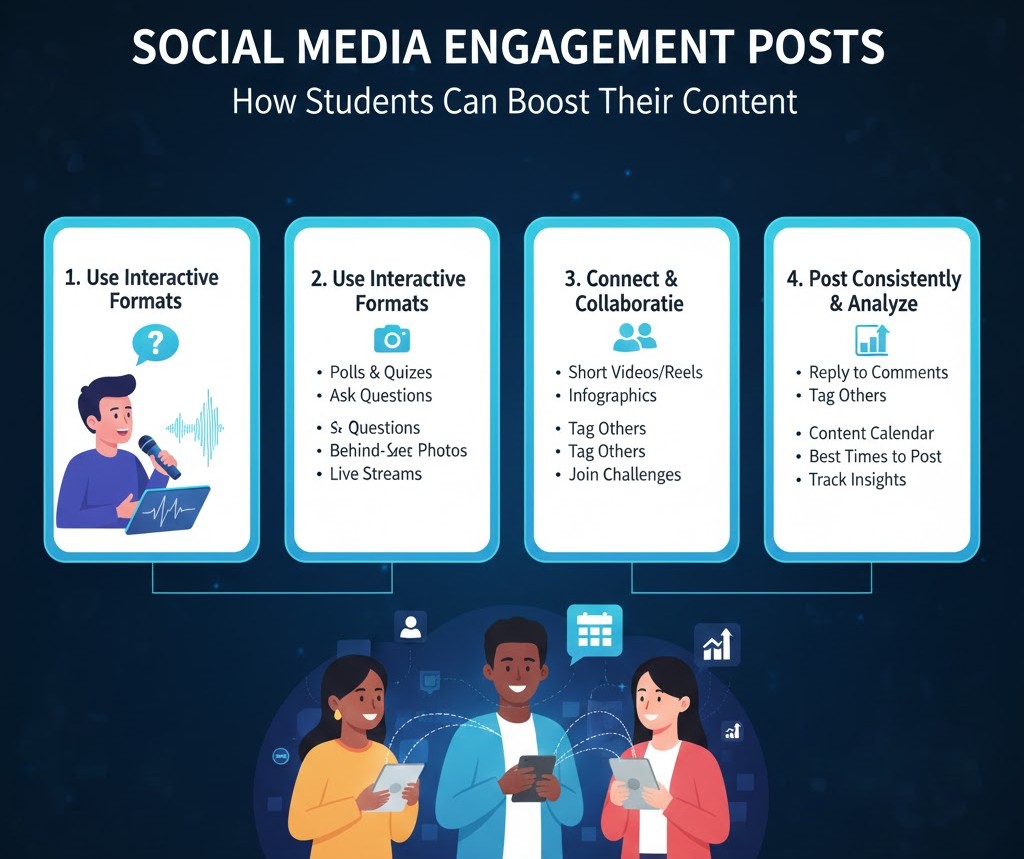
Social Media Engagement Posts: How Students Can Boost Their Content
Introduction
If you’ve ever spent hours crafting the “perfect” post only to get a handful of likes you’re far from alone. In fact, surveys from Sprout Social and Hootsuite show that engagement is the number-one challenge reported by young content creators and student-led brands. That’s because social media today isn’t just about posting frequently; it’s about earning reactions, conversations, and shares in an algorithm-driven world where attention spans have dropped to around eight seconds.
Whether you’re growing a personal brand, running a campus club page, or building a portfolio for future internships, understanding how engagement works is a career-ready skill. The platforms may change TikTok trends burn fast, Instagram updates weekly, and YouTube never stops evolving but the principles behind high-engagement content remain surprisingly consistent.
In this guide, you’ll learn the proven strategies used by social media professionals, digital marketers, and successful student creators. We’ll explore engagement psychology, platform-specific techniques, content formulas, and real-world examples giving you the clarity and confidence to create posts that genuinely connect.
What Is Social Media Engagement and Why Does It Matter?
Engagement refers to the measurable interactions users have with your content likes, comments, shares, saves, clicks, duets, reactions, and more. Every platform uses these signals to decide what becomes visible and what gets buried.
For students, engagement matters because:
-
It increases reach and algorithm visibility.
-
It builds digital communication skills valued by employers.
-
It strengthens your personal or academic brand.
-
It helps student organizations attract new members.
-
It improves networking and collaborative opportunities.
According to Meta and TikTok’s public documentation, posts with meaningful interactions (comments, shares, and watch time) are pushed to broader audiences more than posts with passive metrics like likes. In short: engagement is the fuel that turns content into impact.
Understanding the Psychology of Engagement
Before diving into techniques, it helps to know why people engage. Based on studies from the American Psychological Association (APA) and digital behavior researchers, users interact with content because it triggers at least one of these responses:
1. Emotional Activation
Joy, nostalgia, surprise, and even mild controversy motivate reactions.
2. Identity Expression
People engage with posts that reflect their values, humor, culture, or experiences.
3. Social Belonging
Posts that create community “tag a friend,” “your dorm roommate,” “every engineering student ever” often perform well.
4. Curiosity
Humans can’t resist incomplete information. That’s why hooks and teasers work.
5. Practical Usefulness
If users find a post helpful study hacks, Canva templates, campus life tips they’ll save or share it.
Students who understand these drivers can create not just content, but content that feels clickable.
Proven Strategies to Boost Social Media Engagement (Student Edition)
H2: Develop a Clear Content Strategy Before Posting
Even casual creators benefit from intentional planning. High-performing student pages like college ambassadors, university clubs, studygram accounts, and side-hustle creators usually follow a structure.
H3: Define Your Core Themes
Select 2–4 content pillars, such as:
-
Study tips
-
College lifestyle
-
Mental health motivation
-
Tech and productivity
-
Fashion or fitness
-
Creative projects
-
Career development
When your audience knows what to expect, they engage more consistently.
H3: Identify Your Audience’s Micro-Problems
Great engagement comes from solving small but relatable issues:
-
“How do I stay focused during a long lecture?”
-
“What budget apps actually work for students?”
-
“How do I make my résumé look professional in 10 minutes?”
Answering these regularly builds trust and authority.
H2: Use High-Impact Hooks That Stop the Scroll
The first 1–3 seconds determine whether content gets ignored or engaged with. Algorithms track how long users pause on your post known as scroll-stop rate.
Examples of Student-Friendly Hooks
-
“Nobody tells college freshmen this, but…”
-
“If you’re studying for finals, try this hack.”
-
“Three apps that saved my GPA.”
-
“Things I wish I knew before choosing my major.”
Hooks should be emotional, helpful, or curiosity-driven.
H2: Create Platform-Specific Engagement Content
Every platform has its own engagement culture. Posting the same thing everywhere doesn’t work.
H3: Instagram
Best for: photos, Reels, carousels, campus life content
Top engagement formats:
-
Carousel posts with tips or mini-lessons
-
Aesthetic study setups
-
Relatable memes
-
Reels with trending audio
-
Polls and quizzes in Stories
Pro tip: Instagram boosts content that drives saves, because saves signal long-term value.
H3: TikTok
Best for: short-form storytelling, humor, quick tips
Top engagement formats:
-
First-person confessions (“POV: You’re a college student on a budget…”)
-
How-to mini tutorials
-
Duets and stitches
-
Behind-the-scenes campus moments
-
Day-in-the-life vlogs
TikTok’s algorithm rewards completion rate and rewatches, so keep content dynamic and concise.
H3: YouTube / YouTube Shorts
Best for: longer narratives, tutorials, academic topics
Top engagement formats:
-
Study-with-me videos
-
Productivity hacks
-
Student life experiences
-
Project walk-throughs for portfolio building
-
Career advice series
Comments and watch time matter the most for visibility.
H3: LinkedIn
Best for: career-focused students
Top engagement formats:
-
Project highlights
-
Internship stories
-
Academic achievements
-
Lessons learned from challenges
This platform values authenticity over perfection.
H2: Use Engagement Boosters That Algorithms Love
H3: Ask Questions That Spark Conversation
Questions dramatically increase comment rate.
Examples:
-
“What’s one college habit you wish you learned earlier?”
-
“Which major is the hardest and why?”
-
“Which app do you use most for studying?”
H3: Share Relatable Stories
Storytelling builds emotional engagement.
Instead of posting:
“Study hard.”
Try:
“I failed my midterm last semester and almost changed majors. Here’s what helped me turn everything around.”
Narratives generate empathy and discussion.
H3: Add Call-to-Actions (CTAs) Without Sounding Pushy
Avoid robotic CTAs like “engage with this post.”
Use natural CTAs:
-
“Save this for later finals week.”
-
“Share this with your study partner.”
-
“Try this and tell me if it works for you.”
H2: Optimize Content for Maximum Watch Time and Retention
Algorithms reward content that keeps users on the platform.
H3: Keep It Visually Dynamic
On TikTok/Instagram:
-
Switch angles
-
Add captions
-
Include pattern interrupts
-
Use quick transitions
On Instagram/LinkedIn:
-
Use carousels instead of single images
-
Add bold, scannable text
H3: Write Captions with Depth
Short captions may get likes, but long captions often receive more comments especially when they tell stories or offer guidance.
H2: Post Consistently (But Not Excessively)
According to Buffer and Later Media, the sweet spot for students is:
-
Instagram: 3–5 feed posts/week, daily Stories
-
TikTok: 3–7 short videos/week
-
YouTube: 1 high-quality video/week
-
LinkedIn: 2–3 posts/week
Consistency trains the algorithm and builds audience expectation but burnout kills creativity. Work smarter, not harder.
H2: Use Analytics to Improve Engagement Over Time
Even students need data literacy today.
Track Metrics That Matter Most
-
Engagement rate
-
Saves and shares
-
Comment types (supportive? questions? arguments?)
-
Watch time and retention
-
Click-through rates
Pattern Recognition
Ask yourself:
-
What content gets the most saves?
-
Which topics spark the most conversation?
-
Which posts get shared the most during exam season?
Your analytics reveal exactly what your audience values.
H2: Leverage Trends Intelligently (Not Blindly)
Trends can skyrocket engagement, but only when used strategically.
Smart Trend Rules
-
Join trends early, within 24–48 hours.
-
Adapt trends to your niche (“Student Life Edition”).
-
Add educational or relatable value.
-
Avoid trends that don’t fit your brand voice.
The goal is meaningful engagement not chasing viral fame.
H2: Collaborate With Other Students and Micro-Creators
Cross-engagement is extremely powerful for student creators.
Collaboration Ideas
-
Duo study sessions
-
Joint tips videos
-
Campus tour exchanges
-
Debates (“Is morning studying better?”)
-
Shared meme series
Collaboration introduces your content to new audiences and strengthens community.
FAQs (People Also Ask Style)
1. What types of social media posts get the highest engagement for students?
Posts that are relatable, educational, emotional, or funny generally perform best—especially short-form videos, carousels, memes, and personal stories.
2. How often should students post to grow engagement?
Posting 3–5 times per week on major platforms like TikTok and Instagram is enough to maintain consistency without overwhelming your schedule.
3. Do hashtags still matter?
Yes especially on TikTok and Instagram. Use a mix of broad and niche hashtags for maximum reach.
4. How do I increase comments on my posts?
Ask genuine questions, start conversations, and share personal experiences that invite responses.
5. Which platform is best for student creators?
TikTok for reach, Instagram for community, YouTube for long-term growth, and LinkedIn for career opportunities.
Tags :
No Tags

0 Comments