



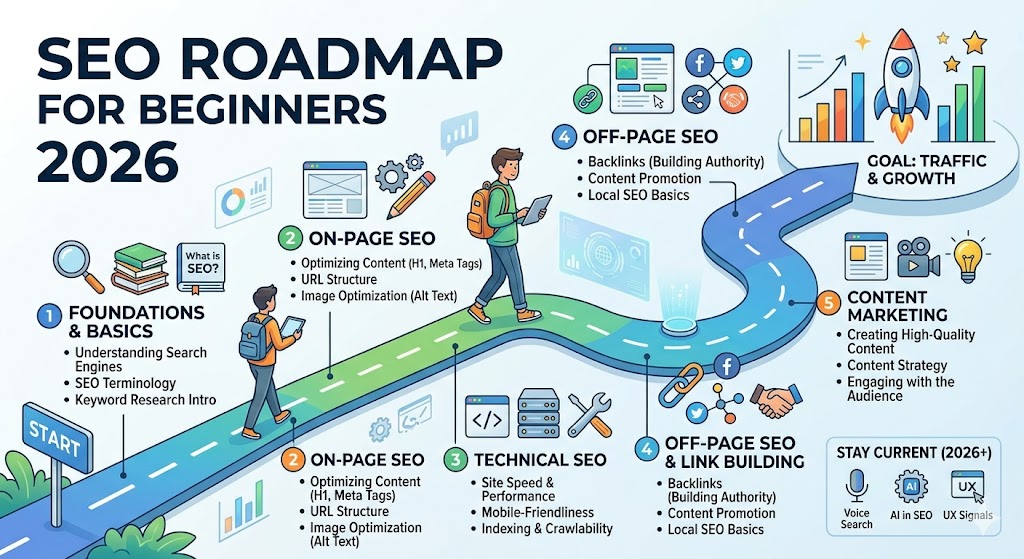
SEO Roadmap for Beginners 2026
Introduction
Imagine you publish a blog post, launch a small online store, or create a portfolio website. You share it with friends, post it on social media, and wait. Days pass. Weeks pass. Almost no one finds it.
This is where SEO changes everything.
Search Engine Optimization (SEO) is the reason some websites appear at the top of Google while others remain invisible. In 2026, SEO is no longer just a marketing tactic for big companies it’s a foundational digital skill for students, freelancers, entrepreneurs, and content creators. Whether you want to build a personal brand, earn online, or work in digital marketing, understanding SEO gives you leverage.
In this roadmap, you’ll learn what SEO really means (beyond textbook definitions), how search engines work in simple terms, the core components of SEO, common myths beginners believe, and the practical skills you should start building today. Think of this as your structured starting point for mastering SEO in 2026.
What SEO Really Means in Digital Marketing
Most beginners define SEO as “ranking on Google.” That’s technically true but it’s incomplete.
SEO is about earning visibility by being genuinely useful.
At its core, SEO sits at the intersection of:
-
User intent (what people are searching for)
-
Content quality (how well you answer that need)
-
Technical performance (how accessible your website is)
-
Authority and trust (how credible your site appears)
In modern digital marketing, SEO isn’t isolated. It supports content marketing, branding, e-commerce, affiliate marketing, and even social media strategies. When someone searches “best budget laptops for students,” the results they see are the outcome of strong SEO practices.
In 2026, SEO is less about tricks and more about:
-
Understanding search intent
-
Solving real problems
-
Building trust over time
If you approach SEO as a long-term asset not a shortcut you’re already ahead of most beginners.
How Search Engines Work (In Simple Terms)
To succeed in SEO, you need to understand what happens behind the scenes.
Search engines like Google operate in three main stages:
1. Crawling
Search engines use automated bots (often called spiders) to discover content across the web. These bots follow links from one page to another.
If your site isn’t properly linked or accessible, search engines may never find it.
2. Indexing
Once a page is discovered, it’s analyzed and stored in a massive database called an index. Think of this as a digital library.
Google evaluates:
-
Page content
-
Keywords and context
-
Images and media
-
Page structure
-
Technical elements
If your page provides value and meets quality standards, it gets indexed.
3. Ranking
When someone types a query, Google scans its index and ranks pages based on:
-
Relevance to the search query
-
Authority and trust
-
User experience
-
Page speed and mobile-friendliness
-
Content depth and clarity
The goal isn’t just to match keywords. It’s to provide the best possible answer.
Beginner takeaway: SEO works when you align your content with how search engines evaluate usefulness and trust.
Key Components of SEO
SEO isn’t one single task. It has three major pillars: on-page SEO, technical SEO, and off-page SEO.
Let’s break them down.
On-Page SEO
On-page SEO refers to everything you control directly on your website.
1. Search Intent
Before writing anything, ask:
What is the user actually trying to achieve?
There are four main types of intent:
-
Informational (learn something)
-
Navigational (find a specific website)
-
Transactional (buy something)
-
Commercial investigation (compare options)
If someone searches “how to start a blog,” they want a step-by-step guide not a product page.
Matching intent is the foundation of modern SEO.
2. Keyword Research
Keywords are still important but context matters more.
In 2026, effective keyword research focuses on:
-
Long-tail keywords (more specific phrases)
-
Topic clusters
-
Related search queries
-
People Also Ask questions
Instead of targeting one keyword repeatedly, build content around a complete topic.
3. Content Quality
High-quality SEO content:
-
Clearly answers the question
-
Is well-structured with headings
-
Uses examples and practical insights
-
Avoids fluff and repetition
-
Is easy to read on mobile devices
Search engines increasingly evaluate user engagement signals. If people leave quickly, that’s a negative sign.
4. On-Page Optimization Basics
Make sure to optimize:
-
Title tags
-
Meta descriptions
-
Headings (H1, H2, H3)
-
Internal links
-
Image alt text
-
URL structure
These elements help both users and search engines understand your page.
Beginner takeaway: On-page SEO is about clarity, structure, and relevance.
Technical SEO
Technical SEO ensures your website functions properly for both users and search engines.
You don’t need to be a developer but you must understand the basics.
1. Website Speed
Slow websites lose rankings and visitors. Page speed affects:
-
User experience
-
Bounce rate
-
Conversion rate
Compress images, use clean themes, and avoid unnecessary plugins.
2. Mobile Optimization
Most searches now happen on mobile devices. Your site must:
-
Load quickly on phones
-
Be easy to navigate
-
Have readable fonts
-
Avoid intrusive popups
Google uses mobile-first indexing, meaning it primarily evaluates the mobile version of your site.
3. Site Structure
A clear structure helps search engines understand your content hierarchy.
Best practices:
-
Logical categories
-
Clear navigation
-
Internal linking between related posts
-
XML sitemap submission
4. Security
HTTPS is essential. Secure websites build trust and rank better than unsecured ones.
Beginner takeaway: Technical SEO removes barriers. If your site is difficult to crawl or slow to load, even great content won’t perform well.
Off-Page SEO
Off-page SEO focuses on building authority and trust outside your website.
1. Backlinks
Backlinks are links from other websites to yours. They act like votes of confidence.
However, quality matters more than quantity.
One strong backlink from a reputable site is more valuable than dozens of low-quality links.
2. Brand Signals
Search engines consider brand credibility. Mentions across:
-
News websites
-
Blogs
-
Forums
-
Social platforms
All contribute to authority.
3. Relationship Building
In 2026, off-page SEO is increasingly relationship-driven:
-
Guest posting
-
Collaborations
-
Digital PR
-
Expert roundups
Beginner takeaway: Build trust organically. Avoid buying backlinks or using spam tactics they can harm your site long term.
How SEO Fits Into the Digital Marketing Ecosystem
SEO does not operate in isolation.
It connects with:
-
Content marketing (blogs, guides, case studies)
-
Social media (driving traffic and brand awareness)
-
Email marketing (nurturing organic traffic)
-
Paid advertising (testing keyword ideas)
-
E-commerce optimization
For example, a student running an online store can:
-
Use SEO to attract organic traffic
-
Use email marketing to retain visitors
-
Use social media to amplify content
SEO often becomes the foundation — the traffic engine that fuels other channels.
Real-World Example
Consider a college student who starts a blog about budgeting tips for students.
Instead of writing random articles, they:
-
Research common search queries.
-
Create a detailed guide: “How to Save Money as a College Student in 2026.”
-
Optimize headings and structure.
-
Improve page speed.
-
Share it with student communities.
Over months, the article starts ranking. Traffic grows steadily without paying for ads.
That’s the power of compounding SEO. It takes time but results are sustainable.
Common SEO Myths Beginners Believe
Myth 1: SEO Is Dead
SEO evolves — it doesn’t die. As long as people use search engines, optimization will matter.
Myth 2: More Keywords = Higher Rankings
Keyword stuffing hurts readability and rankings. Natural language works better.
Myth 3: SEO Gives Instant Results
SEO is long-term. Expect progress over months, not days.
Myth 4: You Need to Be a Coding Expert
Basic technical knowledge helps, but most students can learn essential SEO without advanced programming.
Practical SEO Skills Students Should Learn Today
If you’re starting in 2026, focus on these high-impact skills:
1. Search Intent Analysis
Learn how to analyze search results and understand why pages rank.
2. Content Structuring
Practice writing clear, well-organized articles with strong headings.
3. Basic Analytics
Understand how to read traffic data and user behavior metrics.
4. Keyword Research
Use research tools to find opportunities and evaluate competition.
5. Technical Basics
Learn about site speed, indexing, and mobile optimization.
6. Writing for Humans
SEO writing is not robotic. It’s persuasive, helpful, and clear.
Students who master these fundamentals become highly employable in digital marketing roles.
SEO Careers and Opportunities in 2026
SEO is no longer limited to “SEO Specialist” roles.
Career paths include:
-
Content strategist
-
Technical SEO analyst
-
Digital marketing manager
-
E-commerce optimization specialist
-
Affiliate marketer
-
Freelance SEO consultant
As AI tools generate more content, human expertise becomes even more valuable. Companies need professionals who understand strategy, intent, and quality not just automation.
For students, SEO offers:
-
Remote work opportunities
-
Freelance income
-
Global clients
-
Career flexibility
It’s one of the few digital skills where your portfolio can matter more than your degree.
FAQs About SEO for Beginners
1. How long does it take to learn SEO?
You can understand the basics in 2–3 months with consistent study and practice. Mastery takes ongoing learning and real-world experience.
2. Is SEO difficult for beginners?
It can feel overwhelming at first, but when broken into components content, technical, and authority it becomes manageable.
3. Do I need a website to learn SEO?
Yes, ideally. Practical experience is essential. Even a simple blog is enough to start experimenting.
4. Can students earn money with SEO?
Yes. Many students earn through freelancing, affiliate marketing, blogging, and managing SEO for small businesses.
5. Is SEO still relevant in 2026?
Absolutely. As online competition increases, structured optimization becomes even more important.
Conclusion
SEO in 2026 is not about gaming algorithms. It’s about understanding people, building trust, and creating genuinely useful content.
For beginners and students, SEO offers something powerful: long-term leverage. Unlike paid ads that stop when the budget ends, well-optimized content can generate traffic for years.
If you follow this roadmap learning search intent, mastering on-page fundamentals, understanding technical basics, and building authority you’ll develop a skill set that remains relevant across industries.
Start small. Launch a blog. Optimize one article. Track its progress. Improve. Repeat.
SEO rewards patience, consistency, and clarity. And for students willing to invest time in learning it properly, the opportunities in 2026 and beyond are enormous.
Tags :
No Tags

0 Comments