



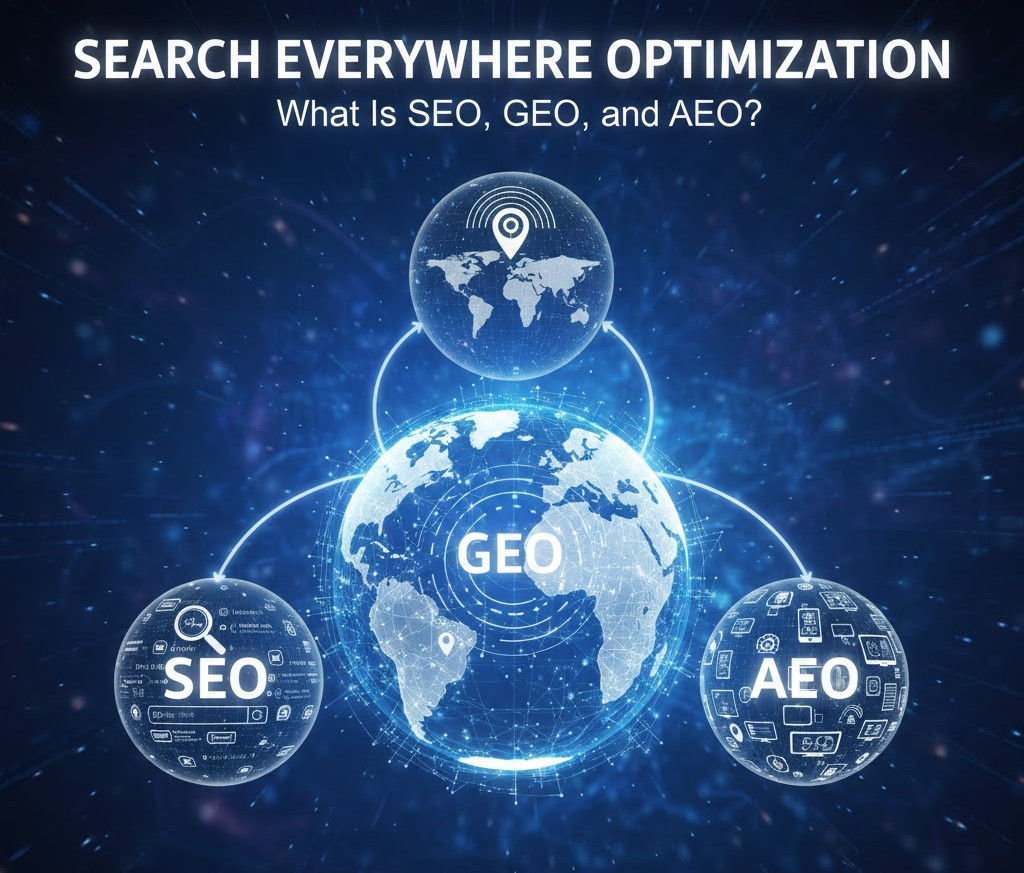
Search Everywhere Optimization: What Is SEO, GEO, and AEO?
Introduction
Think about the last time you searched for something online. Maybe you typed a question into Google, asked Siri for directions, watched a YouTube tutorial, or scrolled TikTok to learn a quick tip. You probably didn’t think twice about how those results appeared but behind every answer, video, or recommendation is a complex system deciding what you see first.
For students and beginners, this is where digital marketing and especially search optimization becomes powerful.
For years, SEO (Search Engine Optimization) was mainly about ranking websites on Google. Today, that’s no longer enough. Search now happens everywhere: on search engines, social platforms, AI assistants, voice search, maps, marketplaces, and apps. This shift has given rise to a broader concept known as Search Everywhere Optimization, which includes SEO, GEO, and AEO.
In this guide, you’ll learn what each of these terms really means, how they work together, and why understanding them is a valuable skill for students planning careers in marketing, content, business, or technology. No jargon overload just clear explanations, real-world examples, and practical insights to help you understand modern search from the ground up.
What Search Everywhere Optimization Really Means
Search Everywhere Optimization is not a replacement for SEO. It’s an evolution.
At its core, it recognizes one simple truth: people no longer search in just one place.
Today, users look for answers on:
-
Google and Bing
-
YouTube and TikTok
-
Voice assistants like Alexa or Siri
-
AI-powered tools and chat interfaces
-
Google Maps and local apps
-
Amazon and other marketplaces
Search Everywhere Optimization focuses on making content discoverable, understandable, and trustworthy across all these platforms, not just traditional search engines.
To understand this concept clearly, let’s break it into its three main pillars:
-
SEO – Search Engine Optimization
-
GEO – Generative Engine Optimization
-
AEO – Answer Engine Optimization
Each serves a different role, but together they shape how information is found in the modern digital world.
What Is SEO in Digital Marketing (Beyond the Definition)
SEO is often explained as “optimizing a website to rank higher on Google.” While that’s technically true, it barely scratches the surface.
In practice, SEO is about helping search engines understand your content and trust it enough to show it to users.
Search engines have one primary goal: deliver the most useful, relevant, and reliable result for every search. SEO aligns your content with that goal.
What SEO Really Involves
Good SEO balances three things:
-
Relevance – Does your content match what the user is searching for?
-
Quality – Is your content helpful, accurate, and well-written?
-
Trust – Does your site appear credible and authoritative?
SEO is not about tricking Google. It’s about communication clearly signaling what your content is about and why it deserves attention.
How Search Engines Work (In Simple Terms)
To understand SEO, you need a basic idea of how search engines operate.
1. Crawling
Search engines use automated programs called crawlers to discover content across the web. They follow links, read pages, and collect information.
2. Indexing
Once content is discovered, it’s stored in a massive database called an index. If your page isn’t indexed, it won’t appear in search results.
3. Ranking
When someone searches, the search engine scans its index and ranks results based on hundreds of factors, including relevance, quality, speed, and usability.
SEO helps at every stage — from making sure your pages can be crawled to ensuring they rank competitively.
Key Components of SEO
On-Page SEO: Optimizing What Users See
On-page SEO focuses on content and structure within a webpage.
Key elements include:
-
Clear, descriptive headings
-
Well-written, original content
-
Natural use of keywords
-
Internal links that guide readers
-
Helpful images with descriptive text
From an educator’s perspective, on-page SEO is about writing for humans first, then making small adjustments so search engines understand your work.
Technical SEO: Optimizing How Websites Work
Technical SEO happens behind the scenes.
It ensures that:
-
Pages load quickly
-
Sites work well on mobile devices
-
URLs are clean and logical
-
Security (HTTPS) is in place
-
Pages can be crawled and indexed properly
Students don’t need to become developers, but understanding the basics helps you communicate better with technical teams.
Off-Page SEO: Building Trust and Authority
Off-page SEO focuses on how others perceive your site.
The most important factor here is backlinks when other reputable websites link to your content. These act like votes of confidence.
Off-page SEO also includes:
-
Brand mentions
-
Reviews
-
Social sharing
-
Online reputation
In short, off-page SEO tells search engines, “Others trust this content.”
How SEO Fits into the Bigger Digital Marketing Picture
SEO doesn’t exist in isolation.
It supports and connects with:
-
Content marketing – SEO gives content visibility
-
Social media – Social signals help content spread
-
Paid advertising – SEO insights improve ad targeting
-
Email marketing – Optimized content feeds email campaigns
-
Brand building – Consistent visibility builds trust over time
For students, this means SEO is a foundational skill. Once you understand it, learning other digital marketing channels becomes easier.
What Is AEO: Answer Engine Optimization
AEO focuses on optimizing content to directly answer user questions.
Instead of ranking for long articles alone, AEO aims to appear in:
-
Featured snippets
-
Voice search results
-
“People Also Ask” sections
-
AI-generated answers
How AEO Changes Content Writing
AEO encourages:
-
Clear, concise answers
-
Structured content with headings
-
Natural language
-
Question-based formatting
For example, instead of only writing long explanations, you also include short, direct answers within your content.
AEO reflects how people search today often asking full questions instead of typing keywords.
What Is GEO: Generative Engine Optimization
GEO is one of the newest concepts in search.
Generative engines summarize and generate answers based on large sets of online information. GEO focuses on making your content easy to reference, trustworthy, and context-rich, so it’s more likely to be used in generated responses.
What GEO Prioritizes
-
Strong topical authority
-
Clear explanations
-
Accurate, up-to-date information
-
Credible sources and context
GEO doesn’t replace SEO. It builds on it by emphasizing depth, clarity, and expertise.
For students, this highlights an important lesson: surface-level content is no longer enough.
Real-World Example: How Search Everywhere Optimization Works Together
Imagine a student searching for “how to learn digital marketing.”
-
SEO helps a blog article rank on Google
-
AEO helps that article appear in a featured snippet answering the question directly
-
GEO increases the chances that insights from the article are referenced in generated summaries
-
Video platforms surface related tutorials
-
Social platforms recommend short clips on the same topic
One search intent. Multiple platforms. One optimization strategy.
That’s Search Everywhere Optimization in action.
Common SEO Myths Beginners Believe
Many students enter SEO with misconceptions.
Some common myths include:
-
SEO is just about keywords
-
Results happen overnight
-
SEO is free and requires no effort
-
Technical skills are mandatory
-
SEO is dying
In reality, SEO is evolving, not disappearing. The fundamentals quality, relevance, trust matter more than ever.
Practical SEO Skills Students Should Start Learning Today
If you’re just starting out, focus on skills that build long-term value.
Begin with:
-
Understanding search intent
-
Writing clear, helpful content
-
Basic keyword research
-
On-page optimization
-
Content structure and readability
-
Analytics fundamentals
These skills apply across SEO, AEO, and GEO — and remain valuable as platforms change.
How SEO Careers and Opportunities Are Evolving
SEO careers today are broader than ever.
Roles now include:
-
SEO content strategist
-
Technical SEO specialist
-
Search experience optimizer
-
Content editor
-
Digital marketing analyst
Search Everywhere Optimization has expanded opportunities for writers, strategists, analysts, and educators not just technical experts.
For students, this means SEO can fit many career paths, not just one.
FAQs: Common Questions Students Ask
Is SEO hard to learn for beginners?
SEO is complex, but not hard to start. Beginners can learn fundamentals quickly with practice and real-world examples.
How long does SEO take to show results?
SEO is a long-term strategy. Results typically appear over weeks or months, not days.
Do I need coding skills for SEO?
Basic technical understanding helps, but most SEO roles don’t require advanced coding.
Is SEO still relevant in the age of AI?
Yes. SEO now supports AI-driven discovery through AEO and GEO rather than replacing it.
Can students build SEO skills without a job?
Absolutely. Personal blogs, practice projects, and internships are common starting points.
Conclusion
Search has changed and it will keep changing.
What hasn’t changed is the need for clear, helpful, trustworthy information. SEO, AEO, and GEO are simply different ways of ensuring that information reaches the people who need it, wherever they’re searching.
For students and beginners, learning Search Everywhere Optimization isn’t just about rankings or traffic. It’s about understanding how the internet works, how people seek answers, and how digital visibility is created.
Mastering these concepts builds a foundation that supports careers in marketing, content creation, business, and technology. Start with curiosity, practice consistently, and focus on helping users the rest follows naturally.
Tags :
No Tags

0 Comments