



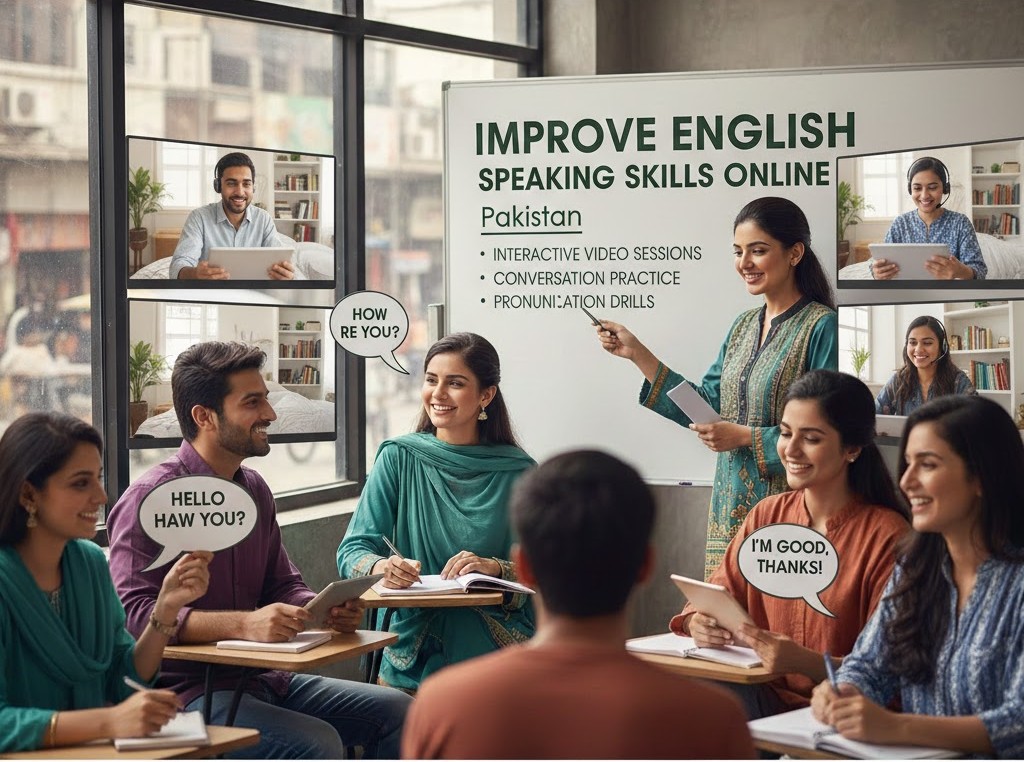
Improve English Speaking Skills Online in Pakistan
Introduction
Have you ever understood English perfectly while reading or listening, but struggled to speak confidently when it was your turn? You’re not alone. Across Pakistan, millions of students know grammar rules and vocabulary, yet hesitate when speaking in class, interviews, or everyday conversations. The problem isn’t intelligence or effort it’s usually the lack of the right practice and environment.
Today, the internet has changed everything. You no longer need expensive academies or native-speaking tutors to improve your English. With the right online tools, strategies, and habits, you can build strong speaking skills from your own home, at your own pace. The challenge is knowing what actually works and what simply wastes time.
In this article, you’ll learn how to improve English speaking skills online in Pakistan in a realistic, practical way. We’ll explore how spoken English really develops, the best online methods for beginners, common mistakes students make, and how you can turn English into a long-term personal and professional advantage. Whether you’re a student, job seeker, or simply someone who wants to speak more confidently, this guide will give you a clear path forward.
Why English Speaking Skills Matter More Than Ever
In Pakistan, English is no longer just a school subject. It’s a gateway skill. It affects your academic performance, your career options, and even your confidence in social situations.
Universities increasingly use English as the medium of instruction. Job interviews in banking, IT, freelancing, marketing, and customer service often require fluent communication. Freelance platforms like Upwork and Fiverr reward professionals who can communicate clearly with international clients. Even on social media and YouTube, creators who speak good English often reach larger audiences.
But here’s the truth many students don’t hear: fluency does not come from memorizing grammar books. It comes from regular, meaningful speaking practice. That’s exactly where online learning can make a powerful difference.
How Spoken English Really Develops (Beyond Grammar Rules)
Many beginners believe that if they “learn grammar first,” speaking will automatically become easy. In reality, speaking is a skill, not just knowledge.
Think about how children learn their first language. They listen a lot. They repeat words. They make mistakes. Over time, their brain naturally starts forming patterns. The same process works for English.
Spoken English develops through three core processes:
-
Input: Listening to real English (videos, conversations, podcasts).
-
Practice: Speaking regularly, even if you make mistakes.
-
Feedback: Noticing errors and improving gradually.
Online learning works best when it supports all three. Watching English videos without speaking won’t make you fluent. Speaking without listening to correct English can lead to bad habits. Balance is everything.
The Advantages of Learning English Speaking Online in Pakistan
Online learning is especially powerful for Pakistani students because it removes several common barriers.
First, it’s affordable. Many high-quality resources are free or low-cost compared to traditional academies. Second, it’s flexible. You can practice early in the morning, late at night, or between classes. Third, it provides exposure. Through the internet, you can listen to different accents, cultures, and real-life conversations that local environments often lack.
Perhaps most importantly, online learning reduces fear. Many students feel shy speaking English in front of classmates. Practicing alone, with apps, or in small online groups builds confidence before facing real-world situations.
On-Page Skills: What You Should Focus on First as a Beginner
Just like building a house requires a strong foundation, improving English speaking requires focusing on the right core skills first.
Vocabulary for Real Life, Not Exams
Many students memorize long word lists that they never use. Instead, focus on practical vocabulary. Learn words related to your daily life: education, technology, shopping, travel, work, and hobbies.
For example, instead of memorizing rare words, learn how to say:
-
“I’m running late for class.”
-
“Can you explain that again?”
-
“I’m interested in learning graphic design.”
This approach helps your brain connect English with real situations, making speaking more natural.
Pronunciation and Clarity
Pakistani learners often understand English but struggle with pronunciation. This doesn’t mean you need a “perfect accent,” but clarity matters.
Online tools like pronunciation videos, slow-speaking podcasts, and shadowing exercises (repeating after native speakers) can significantly improve how you sound. Record yourself occasionally and compare your speech with the original audio. This simple habit can transform your fluency over time.
Sentence Patterns Over Grammar Rules
Instead of focusing on complex grammar terms, focus on sentence patterns. For example:
-
“I want to + verb” → I want to learn English.
-
“I am thinking about + noun/verb-ing” → I am thinking about applying for university.
-
“Can you help me with…?” → Can you help me with this assignment?
By practicing patterns, you naturally start using correct grammar without overthinking.
Technical Side of Online Learning: Setting Up Your Environment
Improving English speaking online is not just about what you study, but also how you set up your learning system.
Your smartphone can become your best learning tool if used intentionally. Create a daily routine. Even 30–40 minutes of focused practice can be more effective than three hours of unfocused scrolling.
Use headphones for better listening. Choose a quiet corner at home for speaking practice. Keep a notebook or digital notes app for new phrases. These small technical habits create consistency, and consistency is what builds fluency.
Internet quality matters too. If possible, use stable connections for live speaking sessions. When live practice isn’t possible, download videos or audio and practice offline.
Off-Platform Practice: The Missing Piece Most Students Ignore
Many learners rely only on apps and videos. They watch, they listen, they understand—but they still can’t speak confidently. The reason is simple: they don’t practice real output.
You must actively speak. Talk to yourself in English while doing daily activities. Describe what you’re doing: “I’m making tea,” “I need to finish this assignment,” “Today was a productive day.” This may feel strange at first, but it trains your brain to think in English.
If possible, find a speaking partner online. Many students in Pakistan are also looking for practice partners. Even 10–15 minutes of conversation per day can accelerate progress dramatically.
How English Speaking Fits Into the Bigger Picture of Your Career
English is not just a subject it’s a career skill. Strong communication often separates average candidates from successful ones.
In freelancing, clients prefer professionals who can explain ideas clearly. In corporate jobs, presentations, emails, and meetings require confident speaking. In higher education, interviews and discussions demand fluency. Even entrepreneurship benefits from communication when pitching ideas or building networks.
When you improve your English speaking, you’re not just learning a language. You’re increasing your opportunities. You’re becoming more competitive in a global marketplace.
Real-Life Examples: What Progress Actually Looks Like
Consider a university student from Lahore who struggled to speak English in class. Instead of joining an expensive academy, she started watching English YouTube channels daily, practiced shadowing for 20 minutes, and joined a small WhatsApp speaking group. Within six months, her hesitation reduced, her pronunciation improved, and she began participating in class discussions confidently.
Or think of a freelance beginner in Karachi who couldn’t communicate with international clients. He practiced common client conversation phrases, recorded voice messages daily, and used online speaking platforms twice a week. Within a few months, he started getting better reviews simply because his communication improved.
These are not extraordinary stories. They’re examples of consistent, focused practice.
Common Myths About Learning English Speaking Online
“You need a native teacher to become fluent”
While good teachers help, they are not the only path. Many fluent speakers learned through self-study, online resources, and consistent practice.
“You must have perfect grammar before speaking”
This belief stops many students from ever starting. You don’t need perfection. You need progress. Speaking with small mistakes is far better than not speaking at all.
“Fluency happens quickly if you use the right app”
There is no magic app. Improvement takes time. Apps are tools, not shortcuts. Your effort matters more than the platform.
“My accent is a problem”
Your accent is part of your identity. The goal is clarity, not sounding British or American. Clear communication is always more important than imitation.
Practical Skills Students Should Start Building Today
If you’re serious about improving your English speaking online in Pakistan, focus on skills that give real results.
Build a daily speaking habit, even if it’s just 10 minutes. Learn functional phrases used in real conversations. Improve listening by consuming content slightly above your level. Practice thinking in English instead of translating from Urdu. Keep track of your progress weekly, not daily.
Also, develop confidence. Confidence grows from action. Every time you speak, you’re training your brain and strengthening your ability.
How Opportunities Are Evolving for English Speakers in Pakistan
The demand for English communication skills is growing. Remote jobs, global freelancing, online businesses, digital marketing, customer support, content creation, and virtual assistance all rely heavily on communication.
More Pakistani students are now working with international clients than ever before. Companies are hiring remote teams. Startups are expanding globally. Those who can speak clearly and professionally stand out immediately.
In the coming years, English fluency will not be a “nice to have” skill. It will be a basic requirement for many career paths. Starting now gives you a long-term advantage.
FAQs About Improving English Speaking Skills Online in Pakistan
How long does it take to become fluent in spoken English?
It depends on your starting level and consistency. With daily practice, most beginners notice clear improvement within three to six months, and strong fluency within one to two years.
Can I improve my English speaking without joining an academy?
Yes. Many learners successfully improve using online videos, speaking partners, self-practice, and free resources. Consistency matters more than location.
What is the best way to practice speaking if I have no partner?
Talk to yourself, record voice notes, repeat after videos, and use online speaking communities. You don’t need a physical partner to start practicing.
Is watching English movies enough to improve speaking?
Movies help with listening, but they are not enough on their own. You must actively speak and use what you learn to see real improvement.
Should I focus on British or American English?
Focus on clarity and consistency. Choose one style for learning if you like, but being understood clearly is more important than following a specific accent.
Conclusion
Improving English speaking skills online in Pakistan is no longer difficult, expensive, or out of reach. What it requires is not perfection, but persistence. When you understand how speaking skills actually develop through listening, practice, and feedback you stop chasing shortcuts and start building real ability.
The internet gives you access to global English, flexible learning, and endless opportunities to practice. But tools alone are not enough. Your daily habits, your willingness to speak despite mistakes, and your commitment to gradual improvement make the real difference.
English fluency is not just about language. It’s about confidence, opportunity, and growth. Every sentence you practice today is an investment in your future self. Start where you are, use what you have, and keep going. With consistent effort, the ability you admire in others will slowly, naturally become your own.
Tags :
No Tags

0 Comments