



Importance of Backlinks in SEO
Introduction
Imagine two websites publishing similar articles about the same topic. One receives links and references from well-known websites, while the other has no mentions anywhere on the internet. Which one do you think Google trusts more?
Search engines often treat links from other websites as signals of trust and authority. These links, commonly known as backlinks, are one of the most influential factors in determining how well a page ranks in search results.
For students and beginners learning digital marketing, understanding backlinks is essential. While SEO includes many elements—such as content quality, website speed, and user experience backlinks remain one of the strongest signals that search engines use to evaluate credibility.
In this guide, we’ll explore the importance of backlinks in SEO, how they influence search rankings, and why they are considered the backbone of off-page optimization. You’ll also learn how search engines evaluate links, what makes a backlink valuable, and how beginners can start building high-quality links the right way.
By the end of this article, you’ll have a clear understanding of why backlinks matter and how they fit into the bigger picture of SEO and digital marketing.
What Backlinks Really Mean in SEO
At its simplest, a backlink is a link from one website to another. But in the world of search engines, a backlink is much more than just a hyperlink.
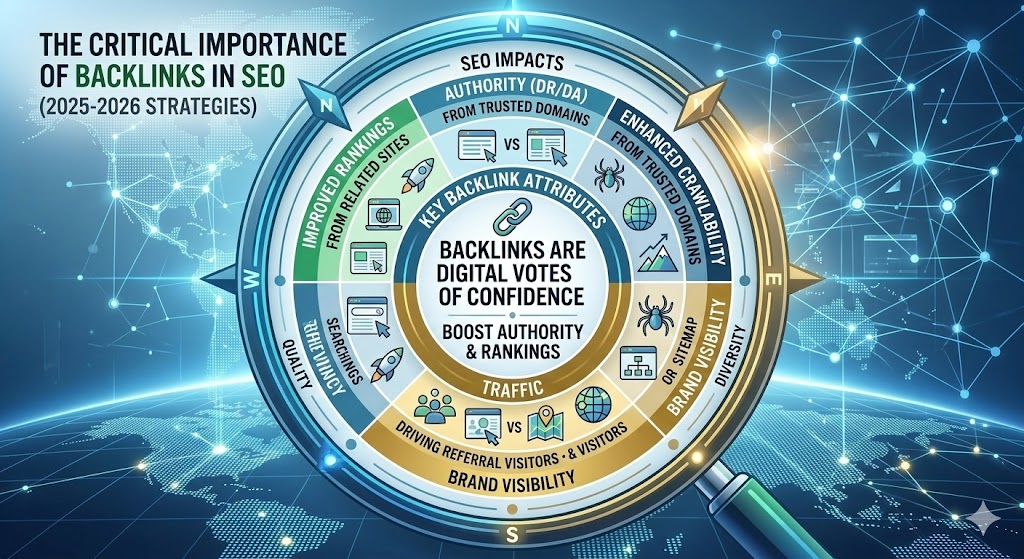
Think of backlinks as votes of confidence.
When one website links to another, it is essentially saying:
“This content is useful, trustworthy, or worth referencing.”
Search engines like Google analyze these links to determine how credible and authoritative a page is.
However, not all backlinks are equal. A link from a respected news website or educational institution carries much more weight than a link from a small, low-quality site.
This is why SEO professionals often say:
Quality matters far more than quantity when it comes to backlinks.
For beginners, it’s helpful to remember that backlinks help search engines answer two important questions:
-
Can this website be trusted?
-
Is this content important enough to rank higher in search results?
The more trustworthy signals a website receives, the stronger its chances of ranking well.
How Search Engines Use Backlinks to Rank Websites
To understand why backlinks are important, we first need to understand how search engines evaluate web pages.
Search engines like Google use complex algorithms that analyze hundreds of factors when ranking websites. Among these factors, backlinks have historically been one of the most powerful signals.
The concept originates from Google’s PageRank algorithm, which treated links as indicators of importance.
A Simple Way to Understand This
Imagine the internet as a giant network of connected documents.
Every time a website links to another page, it creates a connection. Search engines map these connections to understand which pages are influential within a topic.
Pages that receive many high-quality links are often viewed as:
-
More trustworthy
-
More authoritative
-
More valuable to users
As a result, these pages are more likely to appear higher in search results.
Why Backlinks Are So Important for SEO
Backlinks influence SEO in several powerful ways. Understanding these benefits helps beginners see why link building is such a central part of digital marketing.
1. Backlinks Build Website Authority
One of the biggest advantages of backlinks is that they help build domain authority.
When reputable websites link to your content, search engines interpret it as a sign that your site is credible.
For example:
-
A technology blog linking to your article about web development strengthens your credibility.
-
A marketing website referencing your SEO guide increases your authority in that topic.
Over time, this authority helps your entire website rank better.
2. Backlinks Improve Search Rankings
Backlinks are strongly correlated with higher search rankings.
Many SEO studies consistently show that top-ranking pages tend to have more high-quality backlinks than lower-ranking pages.
This happens because backlinks help search engines determine:
-
Content relevance
-
Content popularity
-
Website credibility
In simple terms, backlinks help search engines decide which pages deserve visibility.
3. Backlinks Help Search Engines Discover Content
Search engines use automated bots called crawlers to discover new web pages.
Backlinks act like pathways that guide these crawlers across the internet.
When a popular website links to your page, search engines can discover and index your content much faster.
For new websites, this is especially important because links help search engines find your pages in the first place.
4. Backlinks Drive Referral Traffic
Backlinks don’t only help SEO—they can also bring direct visitors to your website.
If a popular website links to your content, readers may click the link and visit your page.
This is known as referral traffic, and it can lead to:
-
New readers
-
Potential customers
-
Greater brand exposure
Sometimes a single backlink from a high-traffic website can send hundreds or even thousands of visitors.
Types of Backlinks You Should Understand
Not every backlink has the same value. In fact, some links can even harm your SEO if they come from spammy or manipulative sources.
Here are the main types beginners should know.
DoFollow Links
These are the most valuable backlinks in SEO.
A dofollow link passes ranking authority (often called “link juice”) from one website to another.
Search engines treat these links as genuine recommendations.
NoFollow Links
A nofollow link tells search engines not to pass authority to the linked page.
These links still have value because they can:
-
Bring referral traffic
-
Improve brand visibility
-
Diversify your backlink profile
Many websites including social media platforms use nofollow links by default.
Editorial Links
These are naturally earned links placed within content.
For example:
-
A blog referencing your research
-
A news website citing your article
-
A tutorial linking to your guide
Editorial links are considered the most powerful and trustworthy backlinks.
Guest Post Links
Guest posting involves writing articles for other websites in your industry.
In return, you typically receive a link back to your site.
When done ethically, guest posting can help:
-
Build authority
-
Expand your audience
-
Strengthen your backlink profile
Backlinks in the Bigger SEO Picture
Backlinks are important, but they are only one part of SEO.
Successful SEO requires a combination of multiple elements working together.
On-Page SEO
On-page SEO focuses on optimizing content and pages within your website.
Examples include:
-
Keyword optimization
-
High-quality content
-
Clear headings
-
Internal linking
-
User-friendly structure
Without strong content, backlinks alone cannot sustain long-term rankings.
Technical SEO
Technical SEO ensures that your website functions properly for search engines and users.
Key factors include:
-
Website speed
-
Mobile responsiveness
-
Secure HTTPS connection
-
Proper indexing
-
Structured data
If a website has technical problems, backlinks may not produce the desired ranking results.
Off-Page SEO
Off-page SEO refers to actions taken outside your website to improve rankings.
Backlinks are the most important element of off-page SEO.
Other off-page factors include:
-
Brand mentions
-
Online reputation
-
Social signals
-
Influencer partnerships
Together, these signals help search engines understand how your brand is perceived across the web.
A Real-World Example of Backlink Impact
Consider a small blog about digital marketing that publishes a helpful guide on SEO basics.
Initially, the article receives little traffic.
But then something interesting happens.
A well-known marketing website references the guide and links to it in an article. Soon after, a few other blogs discover the guide and link to it as well.
Within weeks:
-
Search engines detect these backlinks.
-
The article’s credibility increases.
-
Rankings improve.
-
Organic traffic grows steadily.
This chain reaction demonstrates how backlinks can dramatically influence visibility.
Common Backlink Myths Beginners Believe
Many beginners misunderstand how backlinks work. Let’s clear up a few common myths.
Myth 1: More Backlinks Always Mean Better Rankings
Quantity alone is not enough.
A few links from trusted websites are often more valuable than hundreds from low-quality sites.
Myth 2: Buying Backlinks Is a Safe Shortcut
Buying links from spammy websites can lead to search engine penalties.
Search engines are very good at detecting manipulative link schemes.
Myth 3: Backlinks Are the Only SEO Factor
Backlinks are important, but they cannot replace:
-
Quality content
-
Good website structure
-
Strong user experience
SEO works best when all elements are optimized together.
Practical Backlink Strategies for Beginners
Students who want to learn SEO should focus on ethical and sustainable link-building strategies.
Here are beginner-friendly approaches.
Create Valuable Content
High-quality content naturally attracts links.
Examples include:
-
In-depth guides
-
Research studies
-
Tutorials
-
Infographics
-
Case studies
If content solves real problems, other websites are more likely to reference it.
Write Guest Articles
Contributing articles to reputable blogs in your industry helps build credibility and backlinks.
Focus on value, not promotion.
Editors prefer guest posts that educate readers rather than advertise services.
Build Relationships in Your Industry
Networking plays a big role in link building.
Engage with:
-
Bloggers
-
Journalists
-
Industry communities
-
Social media creators
Strong relationships often lead to natural mentions and links.
Use Digital PR Techniques
Digital PR involves sharing stories, insights, or research that journalists and bloggers want to reference.
Examples include:
-
Industry surveys
-
Expert opinions
-
Unique data insights
This strategy can earn high-authority backlinks from media outlets.
Why Backlinks Still Matter in Modern SEO
Search engines have evolved dramatically over the years.
Artificial intelligence, machine learning, and advanced ranking signals now play a huge role in determining search results.
Yet backlinks remain essential because they represent something algorithms still value:
Human trust and recommendation.
When one website voluntarily links to another, it signals genuine value.
As long as the internet continues to function as a network of interconnected information, backlinks will remain a critical ranking factor.
FAQs
What is a backlink in SEO?
A backlink is a link from one website to another. Search engines use backlinks as signals of trust and authority, which can help improve search rankings.
Are backlinks still important for SEO in 2026?
Yes. Despite many algorithm changes, backlinks remain one of the most important ranking factors because they help search engines evaluate credibility and relevance.
How many backlinks does a website need to rank?
There is no fixed number. Ranking depends on the quality and relevance of backlinks, not just the quantity.
Can bad backlinks harm SEO?
Yes. Links from spammy or low-quality websites can negatively affect your site’s reputation and potentially lead to search penalties.
How can beginners start building backlinks?
Beginners can build backlinks by creating valuable content, writing guest posts, networking with industry professionals, and sharing insights that others want to reference.
Conclusion
Backlinks remain one of the foundations of successful SEO. They act as signals of trust, authority, and relevance—helping search engines determine which pages deserve visibility in search results.
For students and beginners, understanding backlinks is essential because they reveal how the internet’s information network truly works. When websites link to each other, they create a web of credibility that search engines analyze to rank content effectively.
However, the key lesson is that not all links are equal. A few high-quality backlinks from trusted sources can have far more impact than hundreds of weak or spammy links.
In the long run, the most sustainable approach to backlinks is simple: create valuable content, build genuine relationships, and contribute knowledge that others naturally want to reference.
As digital marketing continues to grow, SEO skills including link building will remain in high demand. For students exploring career opportunities in digital marketing, mastering backlinks is not just an academic concept it’s a practical skill that can open doors to exciting opportunities in the digital world.
Tags :
No Tags

0 Comments