



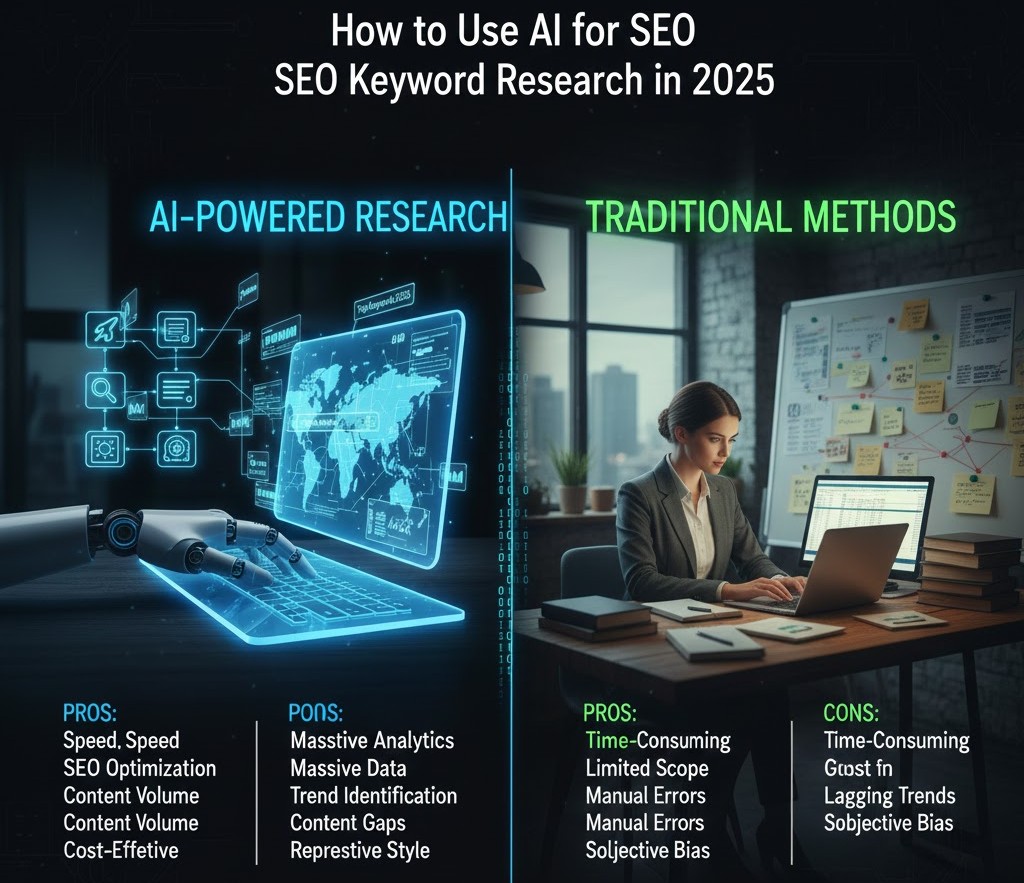
How to Use AI for SEO Keyword Research in 2025
Introduction
If you’ve ever stared at a blank SEO plan wondering “Which keywords should I target?” you’re not alone. Students entering digital marketing in 2025 face a landscape completely transformed by artificial intelligence. Traditional keyword research methods still matter, but AI has become the engine powering faster insights, deeper analysis, and more accurate search predictions.
Why? Because search behavior has shifted. Users now ask conversational questions, voice searches are longer and more specific, and Google’s core updates reward content that truly understands intent, not just phrases. That means SEO in 2025 is no longer about collecting huge lists of keywords it’s about understanding the audience behind the search and predicting what they’ll need next.
In this guide, you’ll learn exactly how to use AI for keyword research, step by step even if you’re a beginner. You’ll discover how advanced tools interpret search intent, cluster topics, uncover hidden opportunities, and help you create content that ranks naturally. With real examples, expert-level explanations, and tactical advice, this article will give you the same strategic approach used by modern SEO professionals.
How AI Transformed Keyword Research in 2025
In the past, keyword research meant typing a phrase into a tool like Google Keyword Planner and choosing terms with the right search volume. But today’s search engines use machine learning, semantic understanding, and deep context.
AI helps us:
-
Analyze thousands of keywords in seconds
-
Identify semantic relationships (entities, topics, clusters)
-
Predict emerging search trends
-
Understand intent with higher accuracy
-
Create keyword maps tailored to websites or content goals
These capabilities align directly with Google's evolving algorithms, especially after the 2024–2025 Helpful Content Update, which prioritizes intent-matched, experience-based, and contextually rich content.
Students entering SEO in 2025 should think of AI as a partner — not a shortcut. It accelerates research but still relies on your judgment and creativity.
Why Keyword Research in 2025 Requires More Than Just “Keywords”
Google now analyzes:
-
User intention
-
The depth of topical coverage
-
Entity relationships
-
Content structure
-
Expertise signals
This means winning SEO strategies require topic research, not keyword stuffing.
AI tools help uncover:
1. Search Intent
Is the user trying to learn, buy, compare, or troubleshoot?
2. Semantic Context
Related concepts like:
-
AI keyword clustering
-
Search journey mapping
-
Topical authority
-
NLP topics
-
People Also Ask trends
3. Competitor Gaps
AI highlights where competitors rank weakly or miss subtopics entirely.
4. Audience Behavior
AI can pull insights from Reddit, Quora, YouTube comments, and social conversations.
This is why keyword research in 2025 is more human than ever even though AI is doing the heavy lifting.
How to Use AI for SEO Keyword Research (Step-by-Step, Student-Friendly)
Below is a practical, easy-to-follow blueprint for using AI tools effectively. Students can follow all steps using free or affordable platforms.
Step 1: Start With a Core Topic, Not a Keyword
Before opening any tool, define your primary idea.
For example:
“AI for SEO”
AI tools like ChatGPT, Perplexity, or Gemini can expand this into related themes:
-
AI keyword clustering
-
SERP prediction
-
Search intent detection
-
Competitor semantic gaps
-
Zero-click search optimization
This creates the foundation for an entire content strategy — not just a single article.
Step 2: Use AI to Generate Seed Keywords
AI excels at brainstorming variations you might not think of.
Ask an AI tool:
“Give me 50 seed keywords related to using AI for SEO in 2025, separated by intent.”
AI will classify them into:
-
Informational
-
Commercial
-
Navigational
-
Transactional
-
Educational (helpful for students!)
This instantly organizes your research, saving hours of manual work.
Step 3: Use AI Tools to Analyze Search Intent
Modern tools like:
-
ChatGPT Search Analysis Plugins
-
Surfer AI
-
Ahrefs / SEMrush AI Insights
-
Keyword Insights AI
-
NeuralText
These tools understand Google’s latent intent behind keywords.
Example:
Keyword: “AI keyword tool”
AI discovers intents such as:
-
Compare tools
-
How to use tools
-
Free vs paid tools
-
Best AI tools for beginners
This prevents targeting irrelevant terms and increases ranking potential.
Step 4: Cluster Keywords Using AI (Essential for 2025)
Keyword clustering is one of the most valuable skills in modern SEO. AI tools group keywords by similarity, topic, and user intent.
Tools like:
-
Keyword Insights AI
-
Cluster AI
-
WriterZen
-
SEMrush Keyword Clustering
AI groups related terms into clusters such as:
Cluster Example: “AI for Keyword Research”
-
How to use AI for keyword research
-
AI keyword research tools
-
Best AI keyword generators
-
AI vs human keyword research
-
Keyword clustering with AI
Each cluster becomes a content hub — boosting topical authority.
Step 5: Use AI to Analyze Competitors on a Deeper Level
Competition analysis in 2025 is not just about checking who ranks.
AI reveals deeper insights like:
-
Uncovered subtopics
-
Missing entities
-
Weak content sections
-
Thin or outdated articles
-
SERP volatility (algorithm sensitivity)
-
Topical gaps Google wants addressed
Example prompt:
“Analyze the top 10 pages ranking for ‘AI keyword research’ and identify what they didn’t cover.”
This gives you an instant advantage, especially as a student learning SEO.
Step 6: Use AI to Discover Long-Tail & Voice Search Keywords
Voice search and conversational queries dominate 2025.
Ask AI tools to generate:
-
Long-tail phrases
-
Natural-language questions
-
PAA-style queries
-
Voice-search variations
-
“Search journey” queries
Example PAA-like questions:
-
“Can AI replace manual keyword research?”
-
“How accurate is AI keyword analysis?”
-
“Is AI keyword clustering required for SEO?”
These long-tail terms often have low competition but high conversion rates.
Step 7: Use AI to Predict Trending Keywords (2025+)
AI tools analyze datasets from:
-
Google Trends
-
Social media
-
Video search
-
News
-
User behavior signals
This helps predict future trends such as:
-
“AI-driven search behavior mapping”
-
“Prompt-based keyword analysis”
-
“Entity-first SEO strategy”
Students who understand emerging trends build stronger, future-proof skills.
Step 8: Use AI Tools to Build Topical Maps
Topical maps are essential for ranking entire websites, especially after Google's Core Updates.
AI tools help create:
-
Topic clusters
-
Pillar pages
-
Supporting articles
-
Internal linking plans
For example, from “AI SEO Keyword Research,” AI generates a 20–30 page map automatically.
This is how modern SEO agencies build authority quickly.
Step 9: Use AI to Validate Keywords Using Multiple Data Sources
Students often make the mistake of trusting one tool.
In 2025, AI cross-validation is key.
Validation sources:
-
Search volume accuracy
-
Keyword difficulty
-
SERP competition
-
Content depth required
-
Intent satisfaction
-
Existing authority
Tools like Ahrefs, SEMrush, Moz, SearchAtlas, and WriterZen provide more reliable data when combined.
Step 10: Let AI Help You Prioritize Keywords by Strategic Value
AI can prioritize keywords based on:
-
Difficulty vs. opportunity
-
Your domain strength
-
Your target audience
-
Search value
-
Competition analysis
Example prioritization categories:
High Priority – achievable, high-converting keywords
Medium Priority – competitive but worthwhile
Long-term Opportunities – emerging trends worth tracking
This gives students a roadmap, not just a list.
Step 11: Use AI to Create Outline Drafts Based on Keyword Clusters
AI tools create outlines that include:
-
Main topics
-
Subtopics
-
Semantic entities
-
PAA questions
-
Content angles for EEAT
But remember:
You must edit, refine, and add personal experience to avoid thin or generic content.
Step 12: Use AI to Maintain SEO Integrity (Spam-Free Content)
Google’s 2024 Spam & Helpful Content updates target:
-
Over-optimized text
-
AI-generated fluff
-
Keyword stuffing
-
Template-based content
To stay safe:
-
Add original insights
-
Use personal examples
-
Include expert references
-
Keep natural rhythm
-
Maintain human-like writing
AI helps efficiency, but human editing creates authenticity.
Real Case Study: How AI Reduced Keyword Research Time by 80%
A group of digital marketing students at a US university used AI tools to conduct keyword research for a class project.
Before AI:
-
6 hours for manual research
-
3 hours for clustering
-
2 hours for competitor analysis
After AI tools:
-
30 minutes to generate clusters
-
45 minutes to analyze competitors
-
20 minutes to build topical map
They cut their research time from 11 hours to under 2 hours with far deeper, more accurate results.
This is the power of AI in 2025.
Conclusion
AI is no longer optional in SEO it’s the foundation of modern keyword research. In 2025, students who understand how to combine AI tools with human strategy will have a major advantage in digital marketing.
AI helps you:
-
Predict search behavior
-
Map user intent
-
Cluster keywords
-
Analyze competitors
-
Build topical authority
-
Optimize content for EEAT
But your creativity, understanding of human needs, and ability to personalize content are what truly make your SEO strategy unbeatable.
Keyword research in 2025 belongs to those who understand both AI intelligence and human intention and if you master both, you’ll be ahead of 90% of beginners in the field.
FAQs (People Also Ask Style)
1. Can AI replace traditional keyword research completely?
No. AI accelerates keyword research but still requires human validation, especially for intent and content quality.
2. What is the best AI tool for keyword clustering?
Keyword Insights AI, WriterZen, and Cluster AI are currently among the most accurate.
3. Is AI keyword research beginner-friendly?
Absolutely. Most tools include guided workflows perfect for students.
4. Does Google penalize AI-generated keyword research?
No. Google penalizes low-quality, unhelpful content not the research method.
5. What’s the biggest keyword research trend in 2025?
Semantic clustering and entity-based SEO are the most impactful trends.
Tags :
No Tags

0 Comments