



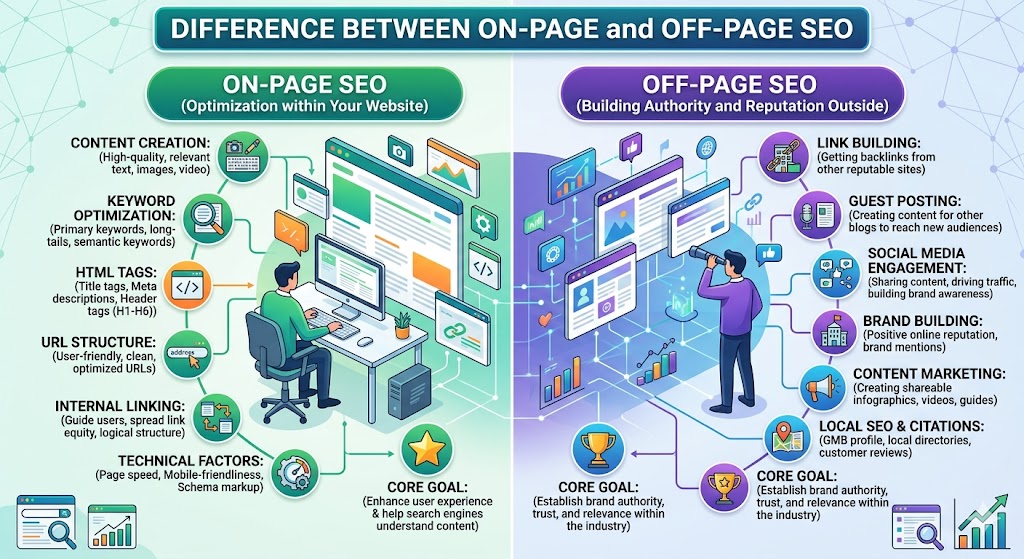
Difference Between On-Page and Off-Page SEO
Have you ever searched something on Google and wondered why certain websites always appear at the top while others remain buried on page three or four? It’s not random. It’s not luck. And it’s definitely not magic.
Behind those rankings is a carefully structured strategy called Search Engine Optimization (SEO) — one of the most powerful skills in digital marketing today.
For students exploring careers in marketing, freelancing, blogging, or entrepreneurship, understanding SEO isn’t optional anymore. Whether you want to grow a personal brand, promote a business, or work remotely for global clients, SEO gives you leverage. And at the heart of SEO lies a crucial distinction: on-page SEO vs. off-page SEO.
In this guide, you’ll learn what these two concepts really mean, how search engines evaluate websites, how SEO fits into digital marketing as a whole, and how you can start building practical SEO skills today.
What SEO Really Means in Digital Marketing
Most beginners define SEO as “ranking on Google.” That’s technically correct — but it’s incomplete.
SEO is about helping search engines understand your content and helping users find exactly what they’re looking for.
Think of Google as a massive digital library. Every time someone types a query, Google’s job is to:
-
Find relevant pages
-
Evaluate their quality and trustworthiness
-
Rank them in order of usefulness
SEO is the process of aligning your website with those goals.
But SEO isn’t just one activity. It’s made up of multiple layers:
-
On-page SEO – What you control on your website
-
Technical SEO – How your website functions behind the scenes
-
Off-page SEO – How other websites and people signal trust toward you
To truly understand the difference between on-page and off-page SEO, we need to first understand how search engines actually work.
How Search Engines Work (In Simple Terms)
Search engines operate in three main steps:
1. Crawling
Search engine bots (also called spiders) scan the internet by following links from one page to another.
2. Indexing
If the page is useful and accessible, it gets stored in Google’s index — a massive database of web pages.
3. Ranking
When someone searches, Google uses algorithms to determine which indexed pages best answer the query.
These algorithms consider hundreds of factors, but most fall into two categories:
-
Signals from your website itself (on-page)
-
Signals from other websites about you (off-page)
Let’s break those down.
What Is On-Page SEO?
On-page SEO refers to everything you optimize directly on your website to improve search rankings and user experience.
It’s fully within your control.
Key Elements of On-Page SEO
1. Content Quality
Search engines prioritize helpful, well-written, and original content.
Good content:
-
Answers real questions
-
Is structured clearly
-
Provides depth and context
-
Matches search intent
For example, if someone searches “difference between on-page and off-page SEO,” they expect:
-
A clear comparison
-
Practical examples
-
Actionable tips
Thin or generic content won’t perform well.
2. Keyword Optimization
Keywords are the phrases people type into search engines.
On-page SEO includes:
-
Using primary keywords naturally
-
Including related terms and variations
-
Avoiding keyword stuffing
-
Placing keywords in headings, title tags, and meta descriptions
But modern SEO is less about repeating words and more about covering topics comprehensively.
3. Title Tags and Meta Descriptions
These are what users see in search results.
A strong title tag:
-
Clearly describes the page
-
Includes the main keyword
-
Encourages clicks
4. Headings Structure (H1, H2, H3)
Headings organize your content and help search engines understand hierarchy.
Clear structure improves:
-
Readability
-
User engagement
-
Ranking potential
5. Internal Linking
Linking to other relevant pages on your website helps:
-
Spread authority
-
Improve crawlability
-
Keep users engaged longer
6. User Experience (UX)
Google tracks behavior signals like:
-
Time spent on page
-
Bounce rate
-
Mobile usability
-
Page speed
If users leave quickly, that’s a negative signal.
What Is Off-Page SEO?
If on-page SEO is about what you say about yourself, off-page SEO is about what others say about you.
Off-page SEO refers to activities done outside your website to build authority, trust, and reputation.
The Core of Off-Page SEO: Backlinks
A backlink is when another website links to your content.
Think of backlinks as votes of confidence.
If a respected website links to you, search engines interpret that as:
“This site must be valuable.”
But not all backlinks are equal.
A link from:
-
A reputable industry blog → High value
-
A random spam site → Low or harmful value
Quality matters far more than quantity.
Other Off-Page SEO Factors
1. Brand Mentions
Even when a site mentions your brand without linking, it can strengthen authority signals.
2. Social Signals
While social media links don’t directly boost rankings strongly, they:
-
Increase visibility
-
Drive traffic
-
Encourage backlinks
3. Guest Blogging
Writing articles for reputable websites helps:
-
Build credibility
-
Earn backlinks
-
Expand audience reach
4. Digital PR
Getting featured in news sites or industry publications dramatically boosts authority.
Key Difference Between On-Page and Off-Page SEO
Here’s the fundamental difference:
-
On-page SEO = Optimization within your website
-
Off-page SEO = Reputation built outside your website
On-page SEO answers:
“Is this content relevant and useful?”
Off-page SEO answers:
“Can we trust this website?”
Both are essential. You can’t rank long-term with only one.
A website with amazing content but no backlinks struggles to compete.
A website with many backlinks but poor content won’t retain users.
SEO success happens when both work together.
Where Does Technical SEO Fit?
Technical SEO supports both on-page and off-page efforts.
It includes:
-
Website speed
-
Mobile responsiveness
-
Secure HTTPS connection
-
Clean URL structure
-
XML sitemaps
-
Fixing broken links
If technical SEO is weak:
-
Search engines may struggle to crawl your site
-
Users may leave due to slow loading
Technical SEO is like the foundation of a house. Without it, everything else becomes unstable.
How SEO Fits Into Digital Marketing
SEO is not isolated. It connects with:
-
Content marketing
-
Social media marketing
-
Email marketing
-
Paid advertising
-
Branding
For example:
A blog optimized with strong on-page SEO can:
-
Rank on Google
-
Be shared on social media
-
Capture email subscribers
-
Build brand authority
SEO often delivers long-term traffic without continuous ad spending. That’s why businesses prioritize it.
Real-World Example
Imagine two online stores selling sneakers.
Store A:
-
Well-written product descriptions
-
Optimized titles and headings
-
Fast website
-
No backlinks
Store B:
-
Basic content
-
Strong backlinks from fashion blogs
-
Good social presence
Store B may rank faster due to authority.
But Store A, with strong on-page SEO, will convert visitors better.
The real winner?
A store that combines both strategies.
Common SEO Myths Beginners Believe
Myth 1: SEO Is Just About Keywords
Wrong. It’s about solving problems better than competitors.
Myth 2: More Backlinks = Better Rankings
Not if they’re low-quality or spammy.
Myth 3: SEO Works Overnight
SEO is long-term. It requires patience and consistency.
Myth 4: Once You Rank, You’re Done
Competitors are always optimizing. SEO is ongoing.
Practical SEO Skills Students Should Start Learning
If you’re a student, here’s where to begin:
-
Learn keyword research basics
-
Practice writing optimized blog posts
-
Understand search intent
-
Study website structure
-
Learn basic HTML tags
-
Build a simple website or blog
-
Analyze competitor content
-
Learn how backlinks work
You don’t need advanced tools at first. You need understanding.
Create content. Test. Improve.
How SEO Careers and Opportunities Are Evolving
SEO is no longer limited to bloggers.
Career paths include:
-
SEO Specialist
-
Content Strategist
-
Technical SEO Analyst
-
Digital Marketing Manager
-
Freelance SEO Consultant
-
Affiliate Marketer
-
E-commerce Optimization Expert
Remote work opportunities are expanding globally.
With AI-driven search evolving, SEO professionals now focus more on:
-
Topic authority
-
User intent
-
Structured content
-
Trust and expertise
Students who start learning SEO early gain a strong competitive advantage.
FAQs About On-Page and Off-Page SEO
1. Which is more important: on-page or off-page SEO?
Both are equally important. On-page ensures relevance; off-page builds trust. You need both for strong rankings.
2. Can I rank without backlinks?
It’s possible in low-competition niches, but in competitive markets, backlinks are usually necessary.
3. How long does SEO take to show results?
Typically 3–6 months for noticeable improvements, depending on competition and strategy.
4. Is social media part of off-page SEO?
Indirectly, yes. It increases visibility and can help earn backlinks.
5. Is SEO still relevant with AI search tools?
Absolutely. Search engines still rely on authority, structure, and quality content core SEO principles.
Conclusion
The difference between on-page and off-page SEO is simple in theory but powerful in practice.
On-page SEO ensures your content is relevant, structured, and valuable.
Off-page SEO builds your website’s reputation and authority in the wider digital world.
Together, they create a system that helps search engines trust you and users choose you.
For students, learning SEO is more than understanding rankings it’s about understanding how information flows on the internet. It’s a skill that applies to blogging, freelancing, startups, and corporate careers alike.
SEO rewards patience, clarity, and strategy. And those who master both on-page and off-page fundamentals position themselves for long-term digital success.
The earlier you start, the greater your advantage.
Tags :
No Tags

0 Comments