



Content Marketing vs Social Media Marketing: How to Boost Your Online Visibility
Introduction
If you’ve ever wondered why some brands seem to dominate your feeds while others barely show up, you’re not alone. In today’s digital landscape, visibility isn’t accidental it’s engineered. And two of the most powerful tools behind that visibility are content marketing and social media marketing. Students stepping into marketing, entrepreneurship, or digital communications often find these terms confusing, especially because they overlap yet serve distinct strategic roles.
Here’s why this topic matters: whether you’re planning to start a side hustle, grow your personal brand, or pursue a career in marketing, understanding the difference between content marketing and social media marketing will help you create smarter strategies strategies that feel human, deliver value, and actually get seen.
In this guide, we’ll break down how each approach works, when to use them, and how you can combine them to build authentic online visibility. Using real examples, expert insights, and practical tips, you’ll walk away with a clear blueprint you can apply immediately.
Content Marketing vs Social Media Marketing: Understanding the Core Difference
What Is Content Marketing?
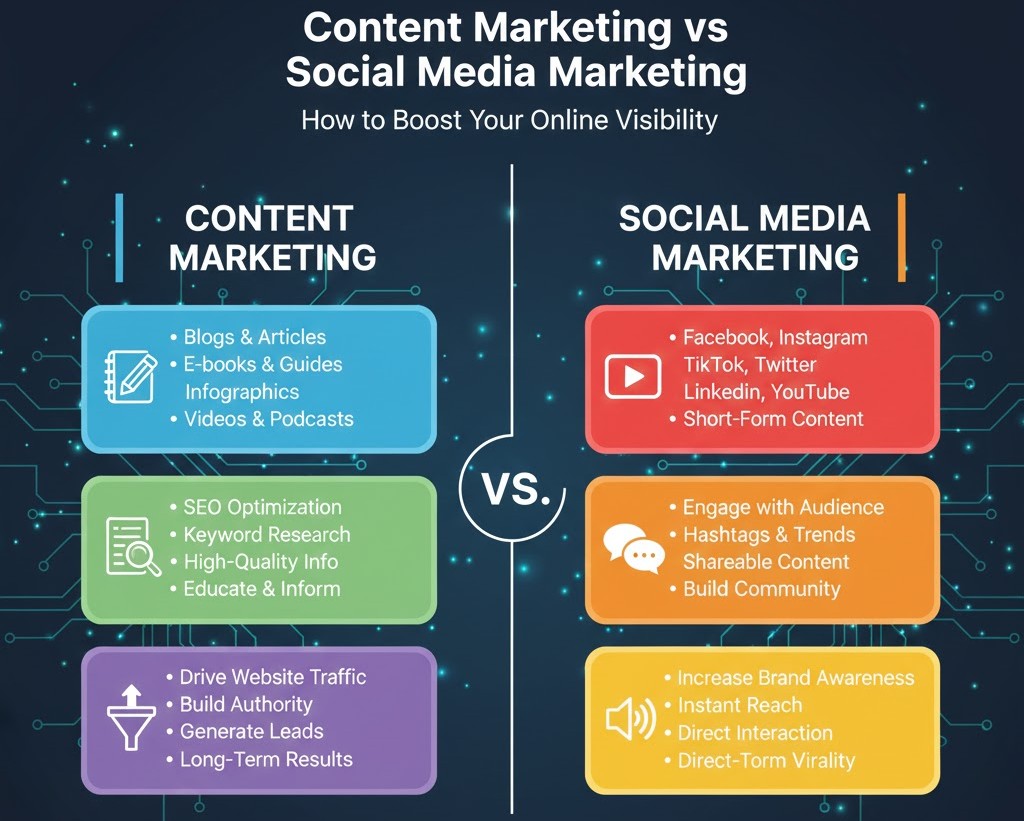
Content marketing is a long-term strategy focused on creating valuable content that answers questions, solves problems, and builds trust. The Content Marketing Institute defines it as a strategic approach centered on consistently producing relevant, helpful content that attracts and nurtures a clearly defined audience.
Content marketing typically includes:
-
Blog articles
-
Video tutorials
-
Guides and eBooks
-
Email newsletters
-
Infographics
-
Podcasts
-
Case studies
The goal isn’t immediate attention it’s sustainable, compounding growth. Think of it like planting seeds that grow into a long-term ecosystem of trust, authority, and organic visibility.
Why It Matters
Studies from HubSpot and SEMrush repeatedly show that brands investing in content marketing enjoy:
-
Lower cost per lead
-
Higher long-term organic traffic
-
Better search engine rankings
-
A stronger authority footprint
For students building their portfolio or launching a small project, content marketing offers a cost-effective way to build credibility.
What Is Social Media Marketing?
Social media marketing focuses on using platforms like TikTok, Instagram, YouTube, Facebook, X (Twitter), LinkedIn, and others to promote content, attract engagement, and spark conversations.
Unlike content marketing, which prioritizes long-term value, social media marketing is more immediate and fast-paced. It thrives on:
-
Short-form video
-
Trend-based content
-
Reels & Stories
-
Live sessions
-
Influencer collaborations
-
Community interaction
Why It Matters
Platforms like TikTok and Instagram have algorithm-driven virality built in. This means a well-made piece of social content can reach millions overnight something content marketing typically cannot do alone.
Key Differences Between Content Marketing and Social Media Marketing
Understanding their differences is critical for choosing the right strategy.
1. Purpose and Approach
| Factor | Content Marketing | Social Media Marketing |
|---|---|---|
| Goal | Long-term visibility & authority | Quick engagement & reach |
| Longevity | Evergreen | Short life span |
| Format | In-depth educational content | Short, fast, interactive content |
| Audience Behavior | Search intent-driven | Discovery-driven |
Content marketing builds trust.
Social media marketing builds awareness.
Both matter but they serve different stages of the buyer or learning journey.
2. Where the Audience Finds You
Content marketing thrives on search behavior. Someone types:
-
“How to start a YouTube channel as a student”
-
“Best study hacks for college”
-
“How to create a content calendar”
… and your content appears.
Social media marketing relies on algorithmic discovery, meaning your content appears based on user interests, behaviors, and trends not necessarily what they search for.
3. Content Depth
A 2,000-word guide (like this one) builds deep trust.
A 20-second video builds quick attention.
Both matter.
But depth and speed are not the same.
Why Students Need Both: Visibility from Two Angles
Whether you're building a personal brand, launching a project, or preparing for a marketing career, combining both approaches gives you a massive advantage.
Content Marketing Helps You:
-
Build authority in your niche
-
Demonstrate expertise (great for LinkedIn portfolios)
-
Improve visibility on Google
-
Earn opportunities (collabs, internships, freelance work)
Social Media Marketing Helps You:
-
Grow faster
-
Test ideas quickly
-
Connect with communities
-
Develop communication & branding skills
In the 2024–2025 marketing landscape, employers and clients value students who understand both ecosystems.
How to Use Content Marketing to Boost Visibility
H2: Build Value-Driven, Searchable Content
Students often ask: “What should I publish?”
The answer is simple: publish content that solves real problems.
Examples:
-
Tutorials explaining academic concepts
-
Career or study advice backed by your own experience
-
Explainers about your major (e.g., “How coding works for beginners”)
-
Personal reflections that teach a lesson
-
Reviews or breakdowns of tools you actually use
Expert Insight
Marketing expert Ann Handley often emphasizes:
“Good content isn’t about storytelling. It’s about telling a true story well.”
That means authenticity is your biggest advantage.
H2: Follow an SEO-First Content Strategy
Search engines love helpful, original content.
To rank well in today’s Google Core Updates, you must be:
-
Helpful: Answer real questions
-
Experienced: Include personal insights
-
Trustworthy: Use credible data & examples
-
Clear: Write for people, not algorithms
Actionable Student Tip
Use this simple framework when writing:
Problem → Explanation → Insight → Actionable Solution
Example:
Problem: Students struggle with time management.
Explanation: Why it happens.
Insight: What experts/your experience says.
Solution: Provide a step-by-step method.
This structure aligns with Google’s Helpful Content System and improves readability.
H2: Use Long-Form Content as a Visibility Engine
Once you publish an in-depth article, you can repurpose it into:
-
10 short-form videos
-
5 LinkedIn posts
-
2 infographics
-
A podcast episode
-
Instagram carousel slides
This is how one piece of content becomes an entire visibility ecosystem, giving you more presence with less effort.
How to Use Social Media Marketing to Boost Visibility
H2: Create Platform-Native Content
People use each platform differently.
For students, this is especially important because your audience might be classmates, young professionals, or recruiters.
Examples:
-
TikTok: short, dynamic, relatable
-
Instagram: polished visuals, carousels, lifestyle content
-
LinkedIn: professional insights, achievements, portfolio posts
-
YouTube: long-form tutorials, study vlogs, learning content
You don’t need to be everywhere you need to be where your audience pays attention.
H2: Leverage Trends But In Your Voice
Trends can give you a quick boost, but they should never replace authenticity.
You should adapt trends to your niche:
-
Study hacks using trending audio
-
“Day in the life of a marketing student”
-
“My simple system to learn faster”
-
“What I wish I knew before choosing my major”
Your story is your competitive advantage nobody else can copy it perfectly.
H2: Consistency > Virality
Most algorithms reward creators who post consistently.
Students often quit early because they assume “nobody cares.”
But the data says otherwise:
Creators who post consistently for 90 days see dramatic growth, even without "viral" hits.
Actionable Student Tip
Use a simple schedule:
-
3–4 short videos weekly
-
1–2 longer posts (LinkedIn or YouTube)
-
Daily engagement (comments, replies, shares)
Visibility compounds like interest slow at first, exponential later.
The Power of Combining Both Approaches
The most successful brands and creators in 2025 aren’t choosing between content marketing and social media marketing. They’re blending them strategically.
Here’s a real-world example:
Example: A Student Running a Study Tips Page
-
Content Marketing:
-
Publishes a long-form guide on “10 Evidence-Based Study Techniques.”
-
Posts it on a simple website or Medium page.
-
Optimizes it for search.
-
-
Social Media Marketing:
-
Turns each study technique into a 20-second TikTok.
-
Shares carousel summaries on Instagram.
-
Discusses the science behind each technique on LinkedIn.
-
-
Result:
-
Google traffic grows weekly
-
Social media boosts fast discovery
-
Portfolio demonstrates subject expertise
-
Recruiters see a consistent, knowledgeable online presence
-
This hybrid approach is the future of digital visibility.
Conclusion
In a digital world where attention spans are short but competition is high, visibility requires strategy not luck. Content marketing helps you build long-term credibility, authority, and search visibility. Social media marketing helps you grow faster, connect with audiences, and stay culturally relevant.
For students, combining both approaches is a powerful way to develop your personal brand, attract career opportunities, and build skills that employers increasingly value. The brands and creators winning in 2025 aren’t asking “content or social?” they’re using both intentionally.
Your online presence is your modern résumé.
And each piece of content is a step toward building the future you want.
FAQs (People Also Ask Style)
1. Which is better for beginners: content marketing or social media marketing?
Start with social media for faster results, then use content marketing to build long-term authority.
2. Can students start content marketing without a website?
Yes. Medium, LinkedIn Articles, and Substack are free and effective places to publish.
3. How often should I post on social media to grow?
Aim for 3–5 times per week, focusing on quality and consistency.
4. How do I know what content my audience wants?
Use search queries, platform analytics, comments, and PAA questions on Google.
5. Why is long-form content still relevant in 2025?
Google’s Helpful Content and Core Updates reward deep, original, experience-driven content over shallow posts.
Tags :
No Tags

0 Comments