



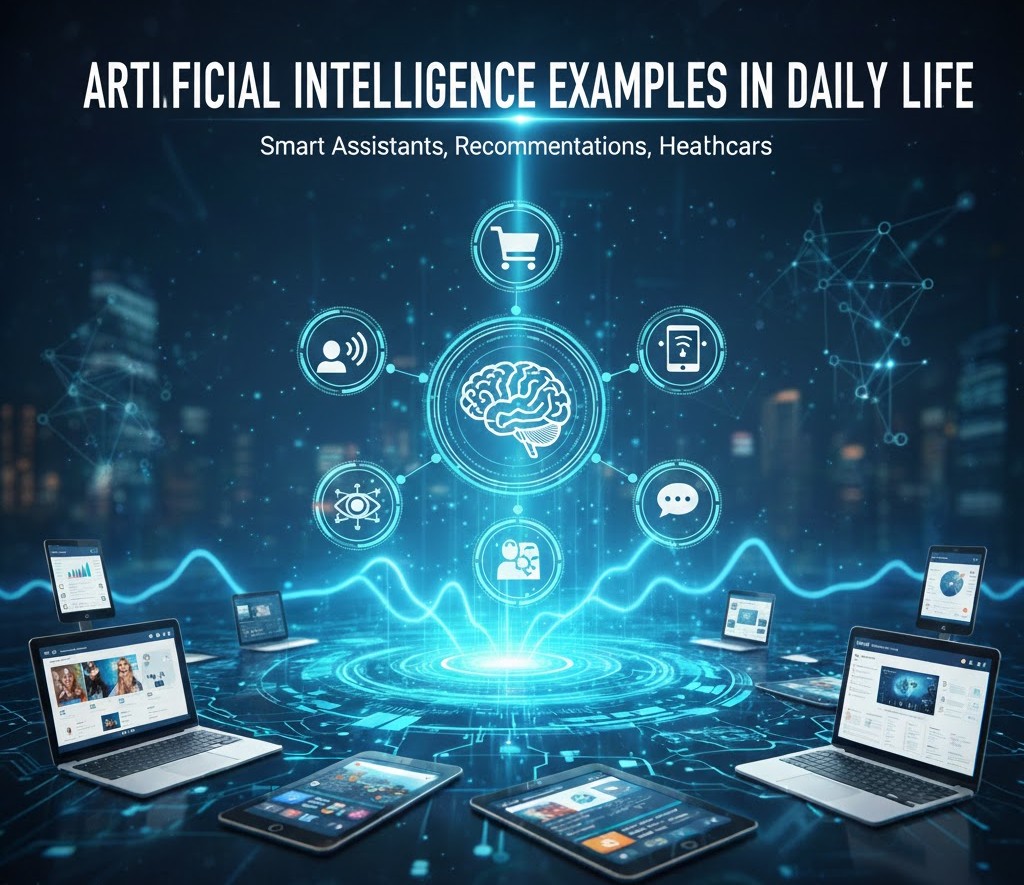
Artificial Intelligence Examples in Daily Life
Introduction
Think about the last normal day you had. You unlocked your phone with your face, searched something on Google, watched recommended videos on YouTube, used Google Maps to avoid traffic, or chatted with a customer support bot without even realizing it. What do all these moments have in common? They are powered by artificial intelligence.
For many students and beginners, artificial intelligence (AI) sounds like something futuristic, complicated, or reserved for scientists working in high-tech labs. In reality, AI is already deeply woven into everyday life. It quietly works in the background, making apps smarter, services faster, and decisions more personalized.
Understanding AI is no longer optional. Just like learning how the internet or smartphones work became essential over time, basic AI awareness is now a valuable skill for students in almost every field. In this article, you will learn what artificial intelligence really means beyond textbook definitions, how it works in simple terms, and most importantly clear, real-world examples of AI in daily life that you can relate to instantly.
By the end, you will see AI not as a confusing buzzword, but as a practical technology shaping the world you already live in.
What Artificial Intelligence Really Means (Beyond Definitions)
At its core, artificial intelligence refers to machines or software that can think, learn, and make decisions in ways that resemble human intelligence. But that definition alone doesn’t tell the full story.
AI is not about robots taking over the world. Most AI systems today are designed to perform specific tasks extremely well, not to think like humans in every way. This is called narrow AI. It focuses on solving one problem at a time, such as recognizing speech, recommending products, or predicting traffic.
What makes AI powerful is its ability to learn from data. Instead of being programmed with fixed rules for every situation, AI systems analyze large amounts of information, find patterns, and improve their performance over time. The more data they process, the better they become.
For students, the key takeaway is this:
AI is not magic. It is a combination of data, algorithms, and computing power working together to solve real-world problems efficiently.
How AI Works in Simple Terms
To understand AI examples in daily life, it helps to know how AI works without getting technical.
Most AI systems follow a simple process:
-
Input: The system receives data (text, images, voice, location, clicks, or behavior).
-
Processing: AI analyzes the data using learned patterns.
-
Decision or Prediction: The system makes a choice or suggestion.
-
Feedback: The result improves future performance.
For example, when you search for something online, the search engine looks at:
-
Your keywords
-
Past searches
-
Popular results
-
Location and timing
Then it predicts which results will be most useful to you. That prediction is AI in action.
Artificial Intelligence Examples in Daily Life
AI in Smartphones and Mobile Apps
Your smartphone is one of the best everyday examples of artificial intelligence.
Face and fingerprint recognition use AI to identify unique patterns in your face or fingerprint. The system compares your features with stored data and decides whether to unlock the device.
Voice assistants like Siri or Google Assistant rely on AI for:
-
Speech recognition
-
Understanding your intent
-
Responding naturally
Even features like autocorrect, predictive text, and camera enhancements are AI-driven. When your phone suggests the next word while typing or improves low-light photos automatically, AI is working behind the scenes.
Beginner takeaway: AI improves convenience by learning how you use your phone and adapting to your habits.
AI in Search Engines and Online Browsing
Search engines are powered by advanced AI systems designed to deliver the most relevant results.
When you type a query, AI considers:
-
The meaning behind the words
-
Your search history
-
Freshness of content
-
Quality and credibility of sources
This is why two people searching the same term may see slightly different results.
AI also powers:
-
Autocomplete suggestions
-
Featured answers
-
Spell correction
For students, this means search engines are no longer just keyword matchers. They aim to understand intent, not just words.
AI in Social Media Platforms
Social media feeds don’t show posts randomly. AI decides what you see.
Platforms like Instagram, TikTok, and Facebook use AI to analyze:
-
Posts you like or share
-
Videos you watch longer
-
Accounts you interact with
-
Time spent on content
Based on this data, AI predicts what content will keep you engaged and shows more of it.
AI is also used for:
-
Face recognition in photos
-
Content moderation
-
Targeted advertising
Real-world insight: The reason your feed feels “addictive” is because AI continuously learns what captures your attention.
AI in Online Shopping and E-commerce
Every time an online store recommends products, AI is at work.
Common AI-driven features include:
-
“Recommended for you” sections
-
Personalized emails
-
Dynamic pricing
-
Chat-based customer support
For example, if you search for shoes, AI remembers that interest and may suggest similar products later. It can also predict what you might need next based on past purchases.
For beginners, this shows how AI improves business decisions by understanding customer behavior.
AI in Navigation and Transportation
Apps like Google Maps and Uber rely heavily on artificial intelligence.
AI analyzes:
-
Traffic patterns
-
Road closures
-
Accidents
-
Historical travel data
It then predicts the fastest route and estimated arrival time. Ride-hailing apps use AI to match drivers and passengers efficiently, adjust prices during high demand, and optimize routes.
Self-driving car research is also built on AI systems that recognize objects, signs, and road conditions in real time.
AI in Education and Learning Tools
AI is changing how students learn.
Examples include:
-
Personalized learning platforms
-
Grammar and writing assistants
-
Automated quizzes and feedback
-
Language learning apps
These systems adapt content based on your strengths and weaknesses. If you struggle with a topic, AI may provide extra practice or simpler explanations.
For students, AI makes learning more flexible, accessible, and personalized.
AI in Healthcare and Fitness
AI plays a growing role in health-related daily activities.
Fitness apps use AI to:
-
Track activity patterns
-
Suggest workouts
-
Monitor sleep quality
Healthcare systems use AI to analyze medical images, predict disease risks, and support doctors in diagnosis. While doctors make final decisions, AI helps process data faster and more accurately.
This shows how AI supports human expertise rather than replacing it.
AI in Entertainment and Streaming Services
When Netflix recommends a movie or Spotify creates a playlist you love, that’s AI at work.
These platforms analyze:
-
What you watch or listen to
-
How long you engage
-
What you skip or repeat
Based on this, AI predicts content you are likely to enjoy. This personalization is why no two users have identical recommendations.
How AI Fits into the Bigger Technology Ecosystem
Artificial intelligence does not work alone. It connects with:
-
Cloud computing
-
Big data
-
Internet of Things (IoT)
-
Mobile technology
Together, these systems create smarter digital experiences. AI acts as the “brain” that makes sense of data collected from various sources.
Understanding this connection helps students see AI as part of a larger digital landscape, not an isolated invention.
Common Myths About Artificial Intelligence
Many beginners believe myths that create unnecessary fear or confusion.
-
Myth: AI will replace all jobs
Reality: AI changes jobs, but also creates new roles. -
Myth: AI thinks like humans
Reality: AI follows patterns, not emotions or consciousness. -
Myth: Only programmers need AI knowledge
Reality: Basic AI understanding benefits students in every field.
Practical AI Skills Students Should Start Learning
You don’t need advanced math or coding to start.
Beginner-friendly skills include:
-
Understanding how AI systems make decisions
-
Data literacy and critical thinking
-
Ethical awareness of technology
-
Basic automation tools
-
Prompting and interaction with AI systems
These skills help students adapt to future workplaces shaped by intelligent technology.
How AI Careers and Opportunities Are Evolving
AI-related careers are expanding beyond technical roles.
Opportunities now include:
-
AI content specialists
-
Data analysts
-
Product managers
-
Digital marketers
-
Ethics and policy roles
Students who understand AI concepts early will have a competitive advantage, even in non-technical fields.
FAQs: Artificial Intelligence in Daily Life
What is a simple example of AI in daily life?
Voice assistants like Google Assistant or Siri are simple, common examples of AI used every day.
Is AI dangerous for students to learn about?
No. Learning AI basics helps students use technology responsibly and understand how decisions are made.
Do I need programming skills to understand AI?
Not at the beginner level. Conceptual understanding is enough to start.
How does AI affect future jobs?
AI will automate some tasks but also create new roles that require human judgment and creativity.
Can AI make mistakes?
Yes. AI depends on data quality and design, which is why human oversight is important.
Conclusion
Artificial intelligence is no longer a distant concept from science fiction. It is already part of your daily routine from the phone in your pocket to the apps you use, the content you consume, and the routes you travel. Understanding AI examples in daily life helps students see technology more clearly and use it more wisely.
For beginners, the goal is not to master complex algorithms, but to build awareness. When you know how AI works and where it appears, you become a smarter user, learner, and future professional. AI will continue to evolve, but those who understand it early will adapt faster and make better decisions.
As a student, learning about AI today is an investment in your future. The world is becoming more intelligent and so should you.
Tags :
No Tags

0 Comments