



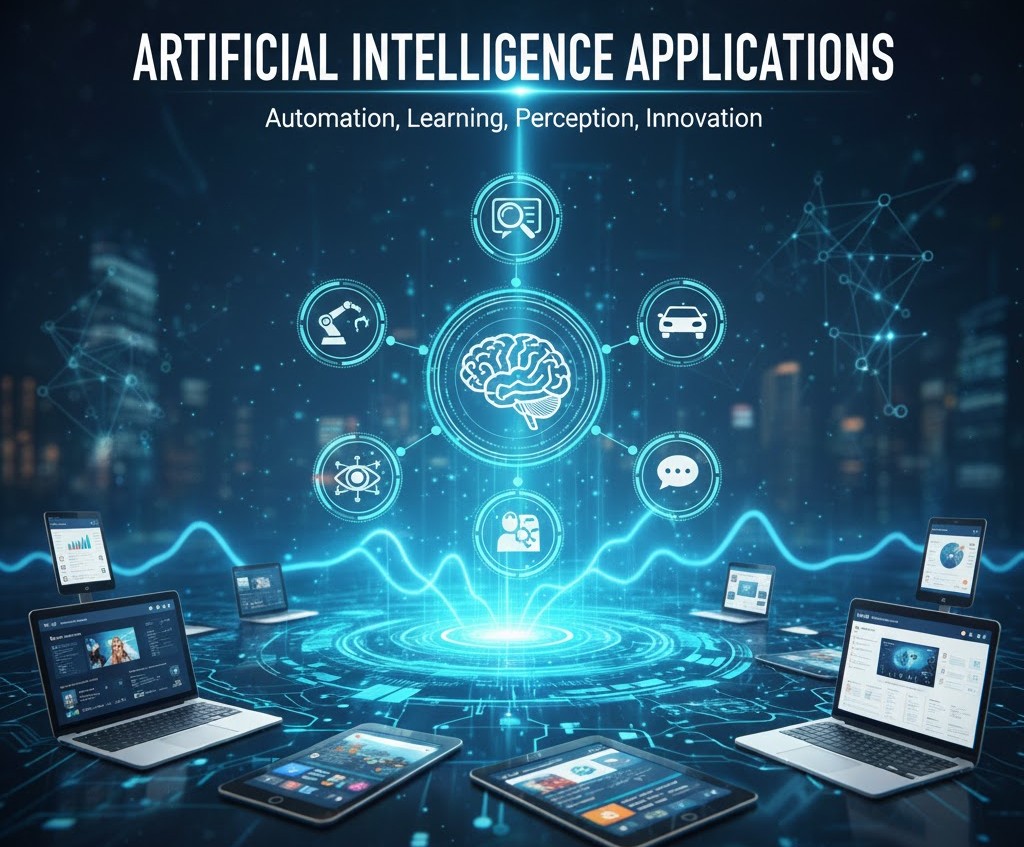
Artificial Intelligence Applications
Introduction
Imagine opening your phone in the morning and seeing weather predictions tailored to your commute, movie recommendations that actually match your taste, or a navigation app that reroutes you before you even notice traffic. None of this feels futuristic anymore it feels normal. Behind the scenes, artificial intelligence is quietly powering these everyday experiences.
For students and beginners, artificial intelligence (AI) can seem intimidating. It’s often portrayed as something reserved for researchers, engineers, or science-fiction movies. In reality, AI is already embedded in tools, services, and careers across nearly every industry. Understanding how AI is applied in the real world is no longer optional; it’s becoming a basic form of digital literacy.
In this article, you’ll learn what artificial intelligence really means beyond technical definitions, how AI systems work in simple terms, and where AI is being used today from healthcare and education to marketing and finance. We’ll also explore common myths, practical skills students can start learning now, and how AI-related career opportunities are evolving. The goal is clarity, not complexity, so you can confidently understand and talk about AI as a modern, practical technology.
What Artificial Intelligence Really Means (Beyond Definitions)
At its core, artificial intelligence refers to computer systems designed to perform tasks that normally require human intelligence. These tasks include recognizing patterns, understanding language, making decisions, and learning from experience.
What’s important for beginners to understand is that AI is not a single technology. It’s a broad umbrella that includes several approaches, such as:
-
Machine learning, where systems learn from data instead of being explicitly programmed
-
Natural language processing, which allows machines to understand and generate human language
-
Computer vision, enabling systems to interpret images and videos
-
Predictive analytics, which focuses on forecasting future outcomes based on past data
Most AI applications today are narrow and task-specific. They don’t “think” like humans. Instead, they excel at doing one thing very well such as detecting spam emails, recommending products, or identifying faces in photos.
For students, this distinction matters. AI isn’t magic or consciousness. It’s applied mathematics, data, and logic, combined in ways that solve real problems at scale.
How AI Systems Work in Simple Terms
You don’t need a computer science degree to grasp how AI works conceptually. At a high level, most AI systems follow a simple pattern.
First, they are trained on large amounts of data. This data could be images, text, numbers, or user behavior. Next, the system looks for patterns within that data. Finally, it uses those patterns to make predictions or decisions when it encounters new information.
For example, an AI-powered email filter learns what spam looks like by analyzing millions of emails. Over time, it becomes better at spotting suspicious patterns, even in messages it has never seen before.
The key takeaway for beginners is this:
AI systems are only as good as the data they learn from. Poor data leads to poor outcomes, which is why bias, accuracy, and data quality are such important topics in AI discussions.
Major Applications of Artificial Intelligence Today
AI in Healthcare
Healthcare is one of the most impactful areas for AI applications. AI systems are used to analyze medical images, predict disease risks, and support doctors in making more accurate diagnoses.
For instance, AI models can detect early signs of conditions like cancer or heart disease by identifying patterns that may be difficult for humans to notice. In hospitals, AI is also used for scheduling, patient monitoring, and optimizing resource use.
For students interested in medicine or biology, AI doesn’t replace doctors it augments their capabilities, helping them make better decisions faster.
AI in Education
Education has been transformed by AI-driven personalization. Learning platforms can now adapt content based on a student’s pace, strengths, and weaknesses.
Common applications include:
-
Personalized learning recommendations
-
Automated grading for quizzes and assignments
-
Intelligent tutoring systems that provide instant feedback
AI also helps educators analyze student performance data to identify gaps in understanding. For beginners, this shows how AI can enhance learning rather than replace teachers.
AI in Business and Marketing
Businesses rely heavily on AI to understand customers and make smarter decisions. In marketing, AI analyzes user behavior to deliver personalized ads, emails, and product recommendations.
Retailers use AI to forecast demand, manage inventory, and optimize pricing. Customer support teams use AI-powered chat systems to handle routine questions efficiently.
For students pursuing business, marketing, or entrepreneurship, understanding AI is becoming just as important as understanding spreadsheets or presentations.
AI in Finance and Banking
The finance industry was one of the earliest adopters of AI. Today, AI is used to detect fraud, assess credit risk, and automate trading strategies.
Banks analyze transaction patterns to spot unusual behavior in real time, reducing fraud and improving security. AI-driven financial tools also help individuals with budgeting, investing, and financial planning.
This shows how AI thrives in data-rich environments where speed and accuracy are critical.
AI in Transportation and Smart Cities
Navigation apps, ride-sharing platforms, and traffic management systems all rely on AI. These systems analyze real-time data to predict traffic, optimize routes, and improve safety.
In smart cities, AI is used to manage energy consumption, monitor infrastructure, and improve public services. Even if fully autonomous vehicles are still evolving, AI already plays a major role in transportation efficiency.
AI in Entertainment and Media
Streaming platforms use AI to recommend movies, music, and shows based on user preferences. Video games use AI to create more realistic opponents and adaptive gameplay.
In journalism and media, AI assists with content moderation, trend analysis, and even basic report generation. For creative students, AI becomes a tool not a replacement for human creativity.
How AI Fits Into the Broader Digital Ecosystem
Artificial intelligence does not operate in isolation. It works alongside cloud computing, big data, cybersecurity, and the internet of things.
For example, smart devices collect data, cloud platforms store and process it, and AI models analyze it to generate insights. This interconnected ecosystem means that AI skills are valuable across many digital roles, not just technical ones.
Understanding AI conceptually helps students collaborate better with engineers, analysts, designers, and decision-makers in real-world environments.
Real-World Example: AI in E-Commerce Recommendations
Consider an online shopping platform. When you browse products, add items to your cart, or read reviews, you generate data. AI systems analyze this behavior alongside millions of other users.
Based on patterns, the platform predicts what you might want next. The result is personalized product recommendations that improve user experience and increase sales.
This example highlights how AI delivers value by combining data, pattern recognition, and prediction without any human intervention at the moment of decision.
Common AI Myths Beginners Often Believe
Many beginners approach AI with misconceptions that create unnecessary fear or confusion.
One common myth is that AI will replace all jobs. In reality, AI tends to automate tasks, not entire professions. New roles emerge as technology evolves.
Another myth is that AI systems are always objective. Since AI learns from human-generated data, it can reflect existing biases if not designed carefully.
Finally, many believe AI requires advanced math to understand. While technical roles do involve math, most students can start by learning concepts, applications, and ethical implications without heavy technical depth.
Practical AI Skills Students Can Start Learning Today
You don’t need to build complex algorithms to begin your AI journey. Practical, beginner-friendly skills include:
-
Understanding how data is collected and used
-
Learning basic concepts like training data, models, and predictions
-
Exploring AI-powered tools used in business, design, or education
-
Developing critical thinking about ethical and social implications
Students from non-technical backgrounds can also focus on AI strategy, communication, policy, or user experience areas where human judgment remains essential.
How AI Careers and Opportunities Are Evolving
AI-related careers are expanding beyond traditional engineering roles. Today, organizations need professionals who can bridge the gap between technology and real-world needs.
Emerging roles include AI product managers, data analysts, AI ethicists, and domain specialists who apply AI in fields like healthcare, education, or finance.
For students, this means flexibility. You don’t have to become a programmer to work with AI you need to understand how it works, where it adds value, and how to use it responsibly.
Frequently Asked Questions
Is artificial intelligence hard to learn for beginners?
AI concepts are accessible to beginners when explained clearly. You can start with applications and real-world examples before moving into technical details.
Do I need coding skills to work with AI?
Not always. Many roles focus on strategy, analysis, or implementation rather than building models from scratch.
Where is AI used the most today?
AI is widely used in healthcare, finance, marketing, education, transportation, and entertainment.
Will AI replace human creativity?
AI can assist creativity, but human insight, emotion, and originality remain essential.
Conclusion
Artificial intelligence is no longer a distant or abstract concept. It’s a practical, powerful technology shaping how we learn, work, shop, and communicate. For students and beginners, understanding AI applications is about gaining awareness, not mastering complexity overnight.
By learning how AI works, where it’s applied, and what problems it solves, you build a foundation that stays relevant across industries. AI rewards curiosity, adaptability, and critical thinking skills that matter regardless of your career path.
As technology continues to evolve, those who understand AI conceptually will be better prepared to use it responsibly and creatively. The best time to start learning is not when AI feels “advanced,” but when it feels understandable.
Tags :
No Tags

0 Comments