



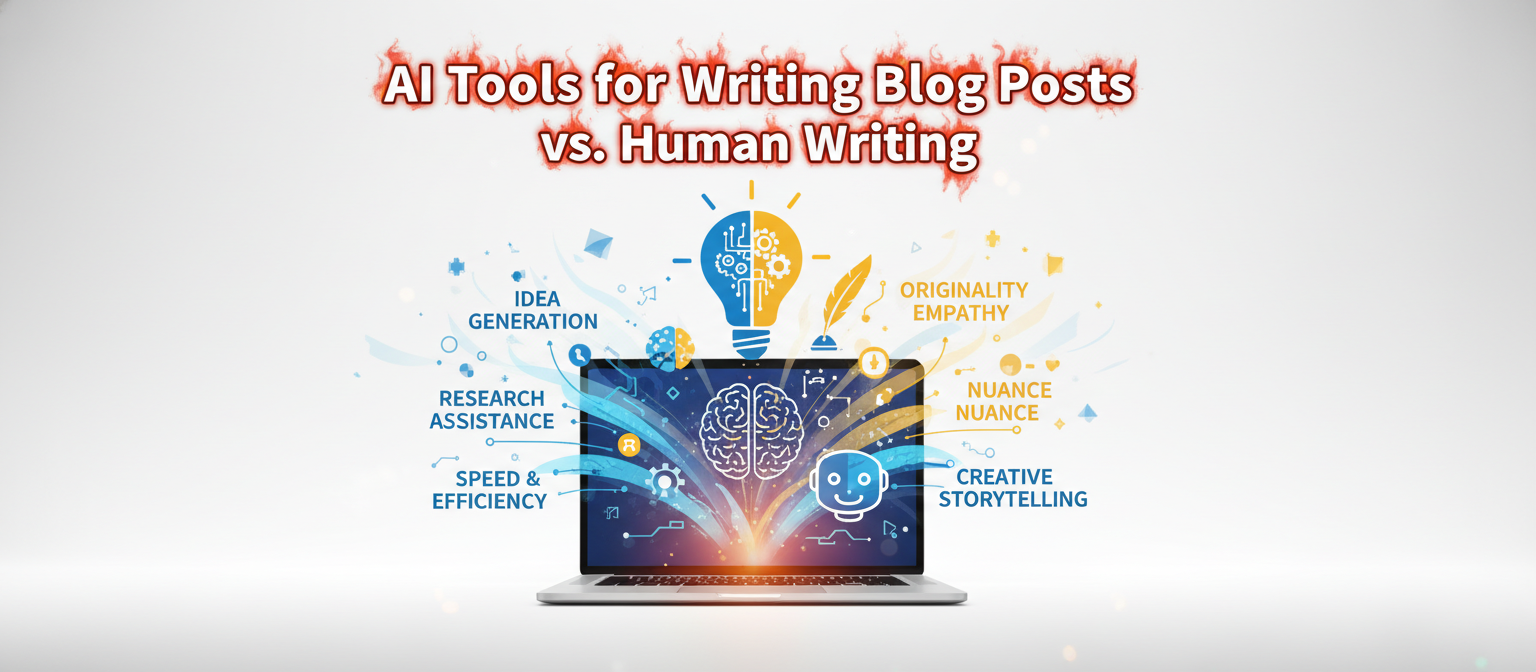
AI Tools for Writing Blog Posts vs. Human Writing
Introduction
If you’ve ever stared at a blank screen, blinking cursor mocking you while a blog post deadline creeps closer, you’re not alone. Today’s students juggle classes, assignments, part-time work, and internships so it’s no surprise many turn to AI writing tools for help. According to recent digital learning surveys, more than 60% of US students now use at least one AI writing assistant weekly. But the rise of AI has also raised an important question: Can AI truly replace human writing or should it only support it?
Understanding this matters. While AI tools can speed up the writing process, they also come with limitations students must navigate carefully. And in an academic or professional setting where originality, critical thinking, and authenticity matter, relying blindly on AI can actually hold you back.
In this guide, you’ll get a clear, expert-backed comparison of AI writing tools vs. human writing, including pros, cons, real examples, and practical advice tailored specifically for students. You’ll also learn how Google, educators, and content experts evaluate writing today and what this means for your digital and academic success.
AI Tools vs. Human Writing: The Complete Breakdown
What AI Writing Tools Actually Do (and Don’t Do)
AI writing tools like ChatGPT, Claude, and Jasper generate text based on patterns from massive datasets. They excel at tasks like:
-
Drafting introductory paragraphs
-
Summarizing long content
-
Brainstorming topic ideas
-
Organizing content using logical structure
-
Polishing tone and readability
-
Speeding up research and outlining
But it’s crucial to note:
AI does not think. AI predicts.
It predicts the next likely word based on probability, not insight.
Human writing, on the other hand, comes from lived experiences, emotions, creativity, reasoning, and personal voice something AI still cannot replicate with depth.
H2: Pros of AI Tools for Writing Blog Posts (Especially for Students)
1. AI Saves Time A Lot of It
Time-saving is the biggest advantage for students. What may take an hour to draft manually can often be done in minutes with AI.
Example:
If you’re writing a blog post for a marketing assignment, AI can instantly generate a structured outline with subpoints like “audience segmentation,” “competitive analysis,” and “content funnel strategy.”
This removes the cognitive load of starting from scratch.
Actionable Tip:
Use AI for the first draft, then rewrite 40–60% in your own words to maintain originality and meet academic standards.
2. Helps Overcome Writer’s Block
AI can generate multiple ideas, intros, or title variations instantly. For students who struggle with creativity on a deadline, this is a major benefit.
Think of AI as a brainstorming buddy not the author.
3. Offers Instant Editing & Feedback
Modern AI tools can analyze:
-
Readability
-
Tone
-
Grammatical issues
-
Sentence clarity
-
SEO opportunities
This makes AI a practical companion for polishing your writing before submission or publishing.
4. Great for Research Summaries
Some AI systems can simplify complex research papers, especially useful for students in fields like psychology, business, or computer science.
But remember:
AI summaries aren’t always accurate. Always verify with credible sources.
H2: Cons of AI Writing Tools (What Students Must Be Careful About)
1. AI Can Sound Generic or Repetitive
AI often produces text that lacks personality, original thought, and emotional nuance. Professors and recruiters can detect this quickly even without AI detectors.
Google’s 2024–2025 updates also prioritize content that demonstrates:
-
Experience
-
Expertise
-
Original insight
-
First-hand examples
AI alone cannot supply these.
2. Risk of Incorrect or Outdated Information
AI may “hallucinate” meaning it creates information that sounds credible but isn’t accurate.
For students, this is risky because:
-
Statistics may be wrong
-
Sources may be fabricated
-
Explanations may miss key context
Actionable Tip:
Never trust AI facts blindly. Cross-check with .edu, .gov, or reliable journal websites.
3. May Violate Academic Integrity Policies
Many US institutions treat unedited AI writing as plagiarism.
Universities like Stanford and Harvard now require AI usage disclosure, and their guidelines emphasize that students must:
-
Maintain original thought
-
Use AI only as a tool
-
Avoid submitting AI-generated work as-is
Failing to follow these guidelines can result in academic penalties.
4. AI Lacks Emotional Intelligence
AI cannot understand:
-
Culture
-
Personal experience
-
Humor nuance
-
Human values
-
Storytelling depth
For students writing narrative assignments or persuasive essays, human emotion and originality are essential.
H2: Pros of Human Writing (Why Humans Still Win in Key Areas)
1. Deep Understanding & Critical Thinking
Humans can analyze, synthesize, and interpret information AI can’t.
For example, if a professor asks you to “argue your position on social media’s impact on teen mental health,” AI can give you facts, but only you can describe:
-
Your personal viewpoint
-
Classroom discussions
-
Real-life observations
-
Ethical considerations
These are the elements professors grade for.
2. Authentic Voice
Readers connect with authenticity something only a human can deliver.
Human writing has:
-
Variations in rhythm
-
Personal tone
-
Humor
-
Relatable stories
-
Context-based emotional depth
This is what builds trust.
3. Creativity & Original Thought
Whether you’re writing a college blog, a scholarship essay, or a personal reflection, creativity matters. Human metaphors, storytelling, and insights come from lived experience.
AI cannot create meaning; it can only mimic it.
H2: Cons of Human Writing
1. Time-Consuming
Students already have limited time. Writing a strong blog post or essay can take hours.
2. Writer’s Block
Humans get stuck. Inspiration doesn’t always arrive on schedule.
3. Editing Blind Spots
Humans sometimes miss their own errors or overlook structural issues. AI editors can help fill this gap.
H2: Side-by-Side Comparison Table
| Feature/Ability | AI Tools | Human Writers |
|---|---|---|
| Speed | Very Fast | Slow–Moderate |
| Creativity | Limited | High |
| Emotional depth | Low | High |
| Accuracy | Inconsistent | Reliable |
| Originality | Moderate (with prompts) | Very High |
| Understanding context | Surface-level | Deep |
| Academic integrity | Risky | Safe |
| Cost | Often Free/Low | Time Cost |
H2: When Students Should Use AI And When They Shouldn’t
Use AI for:
-
Brainstorming ideas
-
Creating outlines
-
Generating initial drafts
-
Improving grammar
-
Summarizing dense academic texts
-
Structuring large research papers
-
Converting notes into readable content
Avoid AI for:
-
Personal essays
-
Reflective assignments
-
Class-specific insights
-
Quoted citations
-
Research arguments
-
Projects requiring original thought
-
Anything graded heavily on creativity
Balanced Approach = Best Results
AI should be used as a support tool, not a substitute for your own thinking.
H2: How Google Evaluates AI Content (Why This Matters for Students Writing Blogs)
Google’s 2024–2025 updates emphasize:
-
Experience (first-hand examples)
-
Expertise (deep knowledge)
-
Authoritativeness (credibility)
-
Trustworthiness (accuracy + transparency)
This means:
If your blog post sounds generic or automated, it won’t rank.
Google doesn’t punish AI it punishes low-quality AI.
To meet Google’s standards, you should:
-
Add personal anecdotes
-
Include real data from credible sources
-
Provide practical advice
-
Demonstrate real understanding
-
Avoid AI-sounding phrases
This is how students can use AI and still rank high.
H2: Expert Insight What Professionals Say
Content strategists, educators, and digital marketers overwhelmingly agree:
“AI is incredible for efficiency, but it cannot replace human insight.”
John Mueller, Google Search Advocate
“Students must use AI responsibly — not as a replacement for thinking, but as a scaffold for better writing.”
Dr. Emily Chen, Professor of Digital Literacy
“AI-generated writing is useful, but AI-assisted writing is powerful.”
Neil Patel, Marketing Expert
These perspectives highlight a consistent message:
Humans + AI together create the strongest writing.
Conclusion
AI writing tools have changed the way students approach blog writing, academic tasks, and digital communication. They offer undeniable advantages speed, structure, clarity, and support during writer’s block. But they also come with limitations that students must navigate carefully: lack of depth, academic risks, and sometimes questionable accuracy.
Human writing still holds the crown when it comes to creativity, insight, emotion, authenticity, and critical thinking. That’s why the best approach isn’t choosing between AI or humans it’s learning how to combine both intelligently.
If you use AI as a brainstorming partner, research assistant, and editor while keeping your ideas, voice, and reasoning at the center you’ll not only write better, but you’ll also develop the cognitive and communication skills that matter in classrooms and careers.
The future of writing isn’t AI vs. humans.
It’s AI-empowered humans thoughtful, original, and creative.
FAQs (People Also Ask Style)
1. Is AI writing cheating for students?
Not if used responsibly. Using AI for brainstorming, outlining, or editing is allowed in most schools, but submitting AI-generated work as-is is considered plagiarism.
2. Which is better for blog writing: AI or humans?
AI is better for speed and structure; humans are better for creativity and authenticity. A hybrid approach is ideal.
3. Are AI detectors accurate?
Not always. They can mislabel human writing as AI and vice versa. Focus on originality instead of worrying about detectors.
4. Can AI replace human writers completely?
No. AI cannot replicate emotional depth, personal perspective, or original insights all essential for high-quality writing.
5. How can students use AI safely?
Use AI for drafts, summaries, grammar checks, and idea generation but always revise heavily and add personal insights.
Tags :
No Tags

0 Comments