



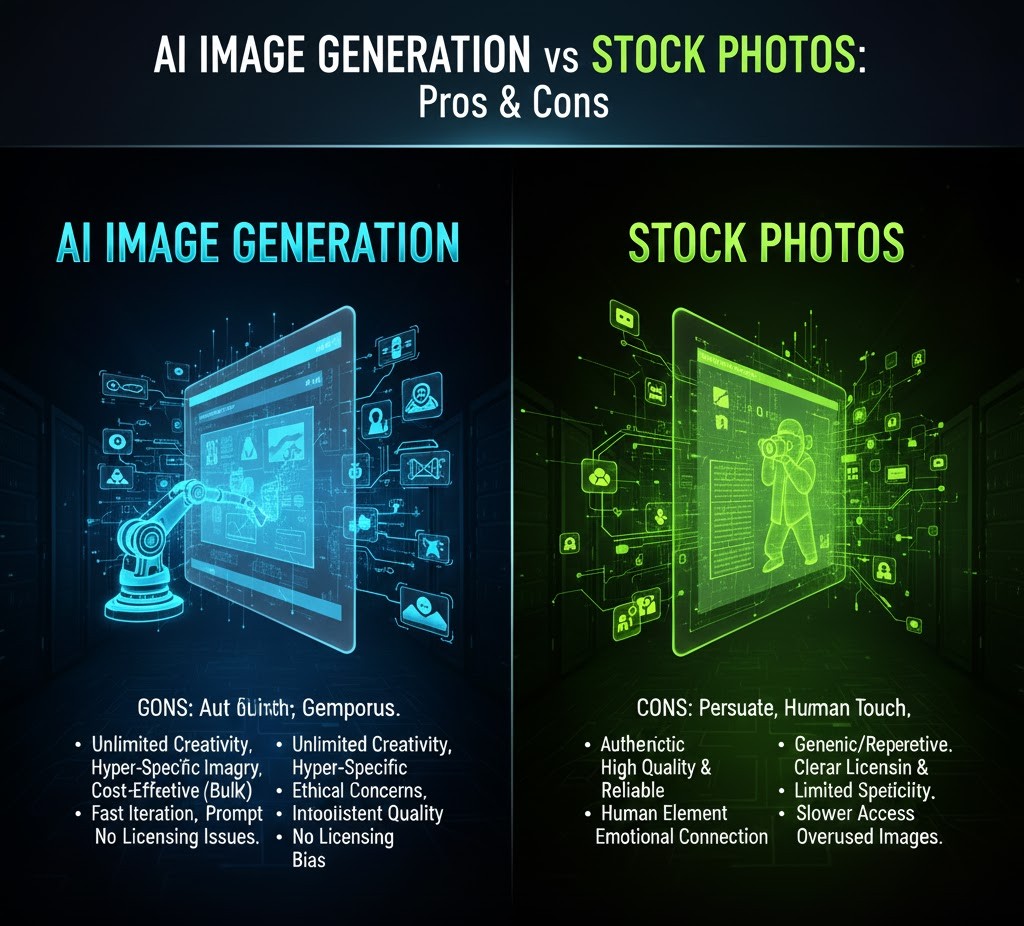
AI Image Generation Models vs. Stock Photos: Pros, Cons
Introduction
If you’ve ever struggled to find the “perfect” photo for a class project, presentation, blog post, or creative assignment, you’re not alone. Students often spend hours digging through stock photo sites, only to settle for images that feel overused, generic, or wildly expensive. Recently, however, AI image generation tools like Midjourney, DALL·E, Adobe Firefly, and Stable Diffusion have started to reshape the entire visual-content world offering unlimited image possibilities in seconds.
This shift matters more than you might think. Visuals influence how people learn, remember information, and engage with content. Whether you’re preparing a slide deck for school, building a portfolio, or creating content for a student-led startup, the choice between AI-generated images and traditional stock photos can directly affect the credibility, effectiveness, and originality of your work.
In this article, we’ll break down the pros and cons of AI image generators vs. stock photography, using real-world examples, expert insights, and current industry trends (as of 2024–2025). By the end, you’ll know exactly when to use each option, what pitfalls to avoid, and how to choose the most ethical, high-quality visuals for any academic or creative project.
AI Image Generation vs. Stock Photos: A Detailed Comparison
What Are AI Image Generation Models?
AI image generation models use machine learning to create entirely new images from text prompts. Instead of searching a gallery, you describe what you want and the AI produces it.
Popular AI tools include:
-
Midjourney (highly aesthetic, artistic visuals)
-
DALL·E 3 / 4 (strong realism and prompt accuracy)
-
Adobe Firefly (built for brand-safe, commercial use)
-
Stable Diffusion (open-source, customizable)
These models trained on billions of images, patterns, and visual styles, allowing them to generate complex imagery that doesn’t exist in real life.
What Are Stock Photos?
Stock photos are pre-shot images available through libraries like:
-
Shutterstock
-
Getty Images
-
Adobe Stock
-
Freepik
-
Unsplash (free)
They’re created by real photographers, curated by agencies, and intended for personal, academic, or commercial use depending on licensing.
H2: Pros of AI Image Generation Models
H3: 1. Unlimited Creativity and Customization
Unlike stock photos, AI images aren’t limited by what already exists. Students can generate:
-
fictional scenes
-
futuristic environments
-
characters of any age, style, or background
-
infographic-style visuals
-
hyper-realistic or stylized art
Example:
If you're creating a presentation about climate change, you can prompt AI to generate “a classroom on Mars showing how climate models predict Earth’s future.” Good luck finding that on Shutterstock.
H3: 2. Faster Results for Assignments
Need a visual in five minutes before deadline? AI delivers instantly.
No scrolling endlessly through pages of stock images.
H3: 3. Often More Affordable
Many AI tools offer:
-
free tiers
-
student discounts
-
pay-per-use credit systems
Compared to stock photos costing $10–$300 per image, AI is significantly cheaper for students.
H3: 4. Unique Visual Identity
Stock images are reused thousands of times, which weakens originality.
AI gives students the ability to create distinctive visuals that set their work apart — crucial for:
-
portfolio projects
-
design assignments
-
social media content
-
student startups
H3: 5. Iteration Without Limits
With stock photos, if an image is “almost perfect,” you’re stuck.
With AI, you can regenerate variations until you get exactly what you imagined.
H2: Cons of AI Image Generation Models
H3: 1. Risk of Inaccuracies or "AI Artifacts"
AI can produce:
-
incorrect hands or fingers
-
warped backgrounds
-
unrealistic lighting
-
text that looks broken
For academic assignments requiring accuracy, these flaws can hurt credibility.
H3: 2. Ethical and Copyright Concerns
A huge debate continues in 2024–2025 about:
-
whether AI models trained on copyrighted images
-
how much AI art is considered “original”
-
legal limitations for commercial or public use
Expert Insight:
According to the U.S. Copyright Office, purely AI-generated images cannot be copyrighted unless there’s significant human creativity involved.
This matters if students plan to sell or publish their work.
H3: 3. Bias or Inappropriate Outputs
AI models may unintentionally reinforce biases. For example:
-
portraying certain professions as specific genders
-
underrepresentation of minority groups
-
distorted cultural imagery
Students working on sensitive or inclusive projects must review outputs carefully.
H3: 4. Requires Learning Prompting Skills
Not everyone immediately masters AI prompting.
To get professional results, students must learn:
-
prompt engineering
-
style commands
-
lighting terms
-
aspect ratios
It’s a skill — and it takes practice.
H2: Pros of Stock Photos
H3: 1. Human-Captured, High-Quality Realism
Stock images are taken by trained photographers using professional equipment.
They excel at:
-
accurate lighting
-
real environments
-
authentic human expressions
-
natural physical details
For school assignments needing realism, stock photos remain a reliable choice.
H3: 2. Clear Licensing and Legal Protection
Stock sites typically offer:
-
royalty-free licenses
-
clear usage rights
-
legal indemnification
This is important for:
-
published research
-
student magazines
-
competitions
-
commercial student projects
H3: 3. No Weird Rendering Artifacts
Unlike AI, stock images don’t generate:
-
extra limbs
-
distorted text
-
inconsistent shadows
What you see is what you get.
H3: 4. Great for Everyday Scenes
If you need a simple visual such as:
-
a classroom
-
students studying
-
a person working on a laptop
-
campus life
stock photos offer a huge collection of ready-to-use images.
H2: Cons of Stock Photos
H3: 1. Generic or Overused Imagery
Students often complain about stock photos because:
-
they feel staged
-
the same models appear everywhere
-
images look “too perfect”
-
they lack personality
This can make creative projects feel less original.
H3: 2. Limited Availability for Niche Topics
Need something unusual?
Stock libraries rarely offer:
-
futuristic science
-
specific conceptual metaphors
-
custom characters
-
fantasy settings
AI easily handles these.
H3: 3. Can Be Expensive
Many students cannot afford:
-
subscription packages
-
premium images
-
extended licenses
AI is more budget-friendly for regular usage.
H3: 4. Not Easily Editable
Editing stock photos often requires:
-
Photoshop skills
-
time-consuming adjustments
-
permission for modifications depending on license
AI generates customizable visuals instantly.
H2: AI Images vs. Stock Photos: Which Should Students Choose?
Choosing between AI and stock photos depends on your project’s purpose, accuracy requirements, and time constraints.
When AI Image Generation Is the Better Choice
✔ Creative storytelling
✔ Conceptual or abstract ideas
✔ Unique portfolio visuals
✔ Fiction, sci-fi, fantasy, or “unreal” scenarios
✔ Projects requiring fast turnaround
✔ Student startups needing distinctive branding
Example:
A digital marketing student creating a mock ad campaign will benefit from AI-generated product shots tailored to their exact concept.
When Stock Photos Are the Better Choice
✔ Academic research
✔ Real-world case studies
✔ School newspapers or magazines
✔ Realistic environments or professions
✔ Sensitive topics requiring accuracy
✔ Legal-safe, risk-free publication
Example:
A nursing student preparing a research poster should use stock photos instead of AI to ensure realism and credibility.
H2: Future Trends: What Students Should Expect (2025 and Beyond)
Based on insights from the MIT Technology Review, Stanford HAI, Adobe, and various AI research labs, here are trends shaping the near future:
1. Hybrid Models Will Become Common
Students may combine:
-
AI images for creativity
-
Stock images for realism
Some platforms already merge both libraries.
2. Better Copyright-Safe AI
Adobe’s Firefly and Getty’s AI tools use fully licensed, legally compliant training datasets — setting a new standard.
3. Realistic AI Quality Will Improve Dramatically
By 2025, AI images will:
-
fix hand/text issues
-
mimic real camera lenses
-
support accurate anatomical rendering
4. Universities Will Teach Prompt Engineering
Many US universities (e.g., NYU, Stanford) are integrating AI literacy and prompt engineering into visual communication coursework.
5. Ethical Guidelines Will Continue to Evolve
Students must stay updated on:
-
fair use
-
attribution
-
disclosure policies
-
academic integrity rules
Tags :
No Tags

0 Comments