



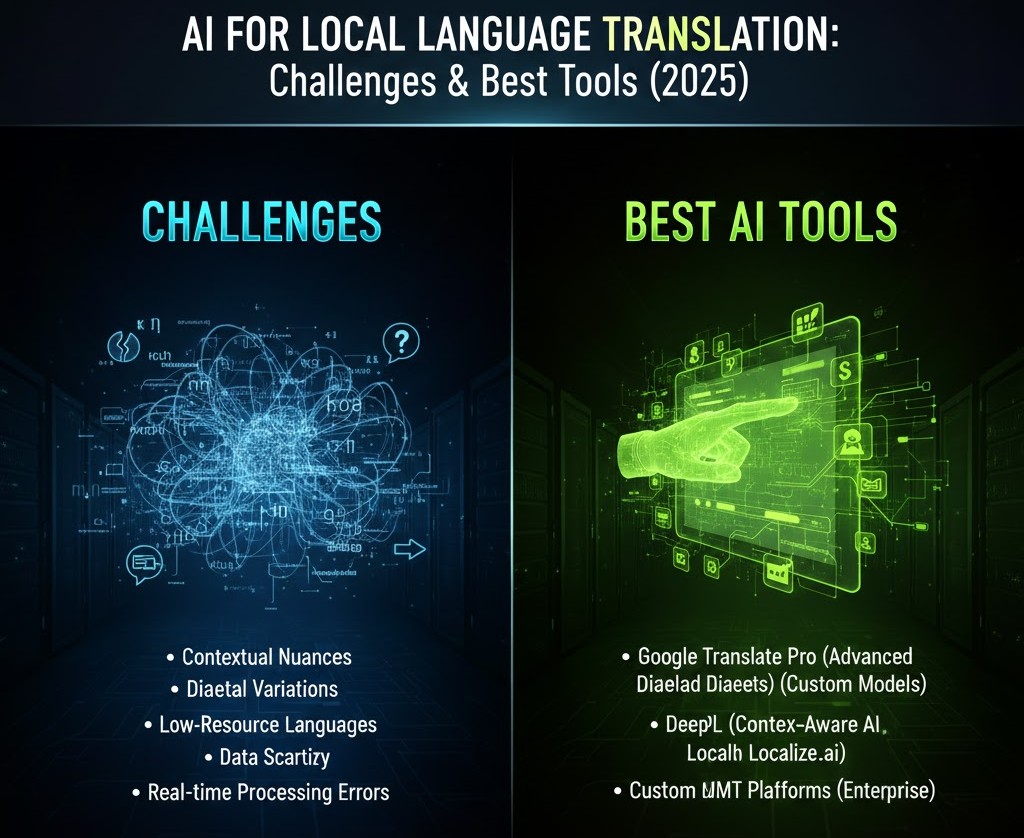
AI for Local Language Translation: Challenges & Best Tools (2025)
Introduction
If you’ve ever tried translating an idiom from your local language into English and watched it turn into a confusing jumble, you already understand why language technology is such a fascinating and sometimes messy field. Despite how far artificial intelligence has come, local language translation remains one of its toughest challenges. This isn’t just about converting words. It’s about capturing emotion, context, culture, and the invisible threads that make one language completely different from another.
For students who rely on digital tools for research, communication, study abroad programs, or cross-cultural projects, understanding how AI handles language is incredibly valuable. We’re living in an era where AI-driven translation tools, from Google Translate to DeepL to emerging open-source models, are reshaping how global communication works. But these tools aren’t perfect especially when dealing with local, indigenous, or low-resource languages.
In this in-depth guide, you’ll learn why AI translation is so difficult, what makes local languages particularly challenging, which tools are leading the way, and how students can use them effectively. We’ll also explore real-world examples, breakthroughs from linguistic experts, and actionable strategies for improving translation accuracy not just relying on automation blindly. Let’s dive in.
The Growing Importance of AI for Local Language Translation
Globalization Meets Linguistic Diversity
The world is more interconnected than ever. International student programs, remote learning, and virtual classrooms create daily situations where multilingual communication is essential. According to the U.S. Census Bureau, over 350 languages are spoken in American homes. Add social media content, academic papers, and global collaboration—and you get an urgent need for better translation tools.
Local languages often carry cultural histories, regional expressions, and unique syntactic structures. AI needs to “understand” these nuances not just swap vocabulary if it hopes to produce meaningful translations.
The Rise of Low-Resource Language Models
While English, Spanish, and Mandarin have massive datasets available, many local or indigenous languages have limited digital presence. AI models thrive on data, and without it, translations become inaccurate or biased. A 2023 study from MIT highlighted that the majority of AI systems still ignore low-resource languages, leaving millions at a disadvantage.
Why AI Struggles With Local Language Translation
1. Limited Training Data
AI models learn from patterns. If a language has few written documents online like many tribal, indigenous, or regional dialects—the AI can’t detect consistent patterns.
Examples:
-
Pashto expressions that vary strongly by region
-
Native American languages with minimal digitized corpora
-
African regional dialects with inconsistent spelling rules
Without data, the model guesses and often gets it wrong.
2. Cultural Context and Idioms
Language carries culture. A simple idiom like:
“Break a leg.”
makes perfect sense to English speakers but is confusing (and alarming!) when translated literally.
Local languages often have layered meanings embedded in folklore, humor, or tradition. AI struggles to understand:
-
Sarcasm
-
Humor
-
Metaphors
-
Storytelling patterns
-
Honorifics and respect-based speech
-
Politeness levels
This is where human translation still outperforms machines.
3. Morphological Complexity
Some languages pack a lot of meaning into single words. For example:
-
Agglutinative languages (e.g., Turkish, Korean) attach many suffixes.
-
Polysynthetic languages (e.g., Inuit languages) can express entire sentences in a single word.
AI can misinterpret these structures without high linguistic sophistication.
4. Code-Switching
In multilingual regions, speakers often combine English with local words:
-
“I’m going to the bazaar, want anything?”
-
“This assignment is tough yaar.”
AI systems may treat these sentences as errors, breaking translation flow.
5. Acoustic Challenges in Speech Translation
For speech recognition (ASR), AI struggles with:
-
Regional accents
-
Pronunciation variations
-
Background noise
-
Informal speech patterns
If the speech recognition is inaccurate, the translation that follows will be inaccurate too.
Breakthrough Tools Transforming Local Language Translation
Below are the most relevant tools for students, selected based on accuracy, accessibility, and support for local languages.
1. Google Translate (Enhanced With PaLM & Gemini Models)
Google Translate remains the most widely used tool, especially since integrating advanced neural models like PaLM 2 and Gemini. These upgrades improved context handling, idiom interpretation, and conversational tone.
Strengths:
-
Broad language coverage
-
Strong mobile accessibility
-
Improved accuracy for Asian & African languages
-
Real-time camera scanning for signs and documents
Limitations:
-
Still struggles with low-resource languages
-
Literal translations persist in culturally dense contexts
2. DeepL (High Accuracy for European Languages)
DeepL is praised among linguists for its natural flow and tone accuracy. It uses transformer architecture optimized for fluency rather than direct word mapping.
Strengths:
-
Natural, human-like phrasing
-
Ideal for essays, academic content, and structured text
-
Frequent updates and growing language list
Limitations:
-
Limited support for South Asian, African, and Indigenous languages
3. Meta’s No Language Left Behind (NLLB)
Meta’s NLLB-200 model is considered one of the biggest breakthroughs for low-resource languages.
Why It Matters:
-
Translates 200+ languages, including dozens of African and Asian regional dialects
-
Trained specifically to reduce bias and errors
-
Promotes preservation of endangered languages
This is a great tool for research and academic projects involving diverse communities.
4. OpenAI Whisper (Speech-to-Text for Local Languages)
Whisper, although primarily an ASR model, is extremely useful for accurate transcription in local accents.
Use cases for students:
-
Transcribing lectures
-
Turning regional interviews into text
-
Improving accessibility for international learners
Whisper handles accent variability significantly better than earlier tools.
5. Microsoft Translator
Microsoft’s translation suite is integrated into Office apps, Teams, and Windows.
Advantages:
-
Great for classroom and group collaboration
-
Supports over 100 languages
-
Highly accurate in technical or academic contexts
For students working on cross-cultural presentations, Microsoft Translator is a reliable choice.
6. Open-Source Models (Helsinki NLP, MarianMT, IndicTrans)
For tech-savvy students or those in linguistics programs, open-source translation models provide flexibility:
-
Train on your own datasets
-
Improve local language support
-
Customize for academic research
IndicTrans2, for example, specializes in Indian languages and performs better than many mainstream tools in those contexts.
How AI Translation Actually Works (Simplified for Students)
AI translation uses one of three main techniques:
1. Statistical Machine Translation (SMT)
Older but foundational. Learns translation patterns from bilingual text pairs.
2. Neural Machine Translation (NMT)
Current standard. Uses deep learning to understand meaning, tone, and context.
3. Large Language Models (LLMs)
Newest approach. LLMs like GPT-4, Gemini, and Llama-3 generate translations using advanced reasoning—almost like understanding the language instead of mapping it.
LLM-based translation is improving rapidly, especially in capturing nuance.
Challenges Local Languages Still Face in AI Translation
1. Dialect Variation
A single language may have dozens of sub-dialects.
Example:
Arabic has Egyptian, Gulf, Levantine, Moroccan each with unique vocabulary.
AI often fails to recognize subtle differences.
2. Lack of Standardized Writing Systems
Some local languages:
-
Do not have formal written rules
-
Use oral storytelling traditions
-
Include multiple orthographic variations
This confuses text-based AI models.
3. Bias and Misrepresentation
If a language has little training data, AI may produce:
-
Incorrect cultural interpretations
-
Gender-biased translations
-
Misleading emotional tone
Experts warn that such errors could distort cultural meaning.
4. Ethical Concerns
Local languages often carry heritage value. Translation errors risk:
-
Loss of cultural identity
-
Miscommunication in academic research
-
Stereotyping or oversimplifying traditions
These issues make human oversight essential.
How Students Can Use AI Translation More Effectively
1. Always Cross-Check With Multiple Tools
One tool may mistranslate; comparing results improves accuracy.
2. Use AI for Drafting, Not Final Meaning
AI can produce a first draft. You refine it using:
-
Context
-
Cultural knowledge
-
Human review
-
Dictionaries or native speakers
3. Avoid Literal Input
Write clearly:
❌ Don’t: Use slang, idioms, or incomplete sentences
✔️ Do: Use full, simple, grammatical sentences
This leads to more accurate translations.
4. Understand the Limits
AI improves but still struggles with:
-
Poetry
-
Humor
-
Proverbs
-
Emotional subtleties
For these, a human translator is essential.
5. Help Improve Your Local Language’s AI Presence
Students can contribute by:
-
Digitizing texts
-
Annotating language datasets
-
Contributing to open-source translation projects
This strengthens future accuracy for communities.
Real-World Case Studies
Case Study 1: Students Translating Indigenous Stories
A group of linguistics students in Arizona used OpenAI Whisper + NLLB to transcribe and translate oral recordings in the Navajo language. AI struggled with metaphors, but human review improved outcomes dramatically. The project helped preserve cultural stories.
Case Study 2: South Asian Students Using AI for Research Papers
Students in India used Google Translate + DeepL to convert regional articles into English for academic references. Using multiple tools reduced misinformation and improved clarity.
Case Study 3: AI-Assisted Language Learning Programs
Schools in California integrated Microsoft Translator into classrooms with multilingual students, enabling real-time captioning during lessons. Attendance and comprehension improved significantly.
Conclusion
AI for local language translation is one of the most promising and transformative fields in modern technology. For students, it opens doors to global learning, cross-cultural communication, academic collaboration, and digital inclusion. But despite enormous progress, AI still struggles with the cultural depth, idiomatic richness, and structural complexity of many local languages.
The best approach isn’t replacing human knowledge it’s combining AI speed with human cultural understanding. By using multiple tools, refining AI outputs, and staying aware of each tool’s strengths and limitations, students can harness translation technology more effectively than ever.
As AI continues to evolve, so will its ability to preserve languages, bridge communities, and empower learners worldwide. The future of translation isn’t just about technology it’s about building a world where every voice is understood.
FAQs
1. Which AI translation tool is best for local languages?
Meta’s NLLB and OpenAI-based systems perform well for low-resource languages, while Google Translate and DeepL excel in mainstream languages.
2. Can AI replace human translators?
Not entirely. AI is excellent for drafts and basic communication but still struggles with culture, emotion, and nuance.
3. How accurate is AI translation for academic work?
Good for comprehension, but students should always verify citations and technical terms manually.
4. Are local languages disappearing because of AI?
Not necessarily AI can preserve endangered languages by digitizing and promoting them.
5. What’s the best way for students to improve AI translation quality?
Use clear input, compare multiple tools, and apply human review.
Tags :
No Tags

0 Comments